
















Related News
01
2026
-
06
How to Enhance the Non-Stick Performance of Rice Cooker Liners Using a Coating Line
Author:
Chuangzhi Coating
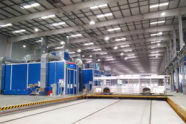
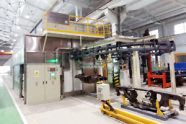
The non-stick performance of a rice cooker liner directly impacts the user experience and the overall quality tier of the product. The consistent realization of this performance relies heavily on the process sophistication and control capabilities of the rice cooker liner coating line. From material selection to spraying, curing, and inspection, every stage influences the final non-stick effect.

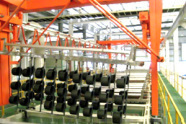
During the production process, surface pretreatment serves as the foundational stage for enhancing adhesion and non-stick performance. Through degreasing, sandblasting, or chemical treatment processes within the coating line, surface contaminants—such as oil stains and oxide layers—can be effectively removed from the substrate. This increases surface roughness, facilitating uniform coating adhesion and, at the source, mitigating future issues related to peeling or localized coating failure.
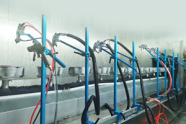
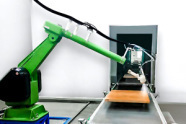
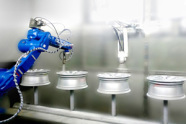
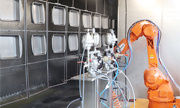
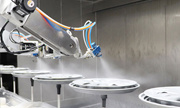
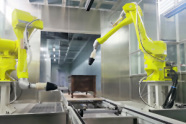
The spraying process is the pivotal step influencing non-stick performance. Advanced automated spraying systems enable precise control over coating thickness and distribution uniformity, thereby preventing instances of localized excessive thickness or thinness. A multi-layer coating structure (comprising a primer, mid-coat, and topcoat) significantly enhances the coating's density and abrasion resistance, thereby bolstering its non-stick performance over the long term. Furthermore, optimizing spraying parameters—such as spray gun pressure, atomization quality, and conveyor speed—can further improve coating consistency.
The curing stage is equally critical. Precise control of the temperature profile ensures that the coating undergoes complete cross-linking, forming a stable, dense structure that enhances both high-temperature resistance and surface smoothness. When equipped with an intelligent temperature control system, the coating line can effectively minimize fluctuations in non-stick performance caused by uneven curing.
In-line inspection and quality control systems also play a vital role in continuously improving product stability. Through thickness measurements, visual inspections, and adhesion tests, non-conforming products can be promptly identified and rejected, ensuring that every liner leaving the facility delivers consistent non-stick performance.
By optimizing key stages within the rice cooker liner coating line—including pretreatment, spraying, curing, and inspection—manufacturers can significantly enhance the non-stick performance of the liners, thereby achieving the manufacturing goals of producing higher-quality, longer-lasting rice cooker products.


Contact Us
No.2 Yingbin Avenue, High-tech District, Zhaoqing City, Guangdong Province, China.
Online Message