















23
2026
-
09
Cake Pan Coating Line for Consistent Surface Quality and High Output
Author:
Chuangzhi Coating
Cake pans require more than a basic painting process. Their shape, surface condition, coating adhesion, production speed, and resistance to deformation all affect the final quality of baking molds. For manufacturers producing aluminum alloy cake pans and other cookware components, a dedicated cake pan coating line can provide a more controlled production process than manual or loosely connected coating equipment.
A modern coating line integrates several production stages into one continuous system. Depending on the product and coating requirements, the process may include pretreatment, cleaning, surface treatment, conveying, spraying, drying, curing, and other auxiliary operations. By coordinating these stages, manufacturers can reduce variations between batches and maintain a more consistent coating result across large production volumes.
Attractivechina provides customized automated coating solutions for cookware and related metal products. Its cookware coating systems are designed around the geometry, material, production capacity, and surface treatment requirements of individual products. The company's published equipment range includes customized cake pan coating lines, non-stick cookware coating systems, anodizing equipment, and automated spraying equipment.
Why Cake Pans Need a Dedicated Coating Process
Cake pans are not simply flat metal components. Their curved surfaces, edges, inner walls, and different structural sections can make coating more difficult. If the spraying distance, coating volume, conveying speed, or curing conditions are not properly controlled, the finished surface may show differences in thickness or appearance.
Manual spraying can also create variations between operators. Even when the same coating material is used, differences in spray angle, gun movement, coating quantity, and drying time may influence the final result. For manufacturers producing hundreds or thousands of pieces, these small variations can become a significant production issue.
An automated cake pan coating line addresses this challenge by connecting the main processing stages and establishing more repeatable operating conditions. Conveying speed, spraying parameters, curing temperature, and other process conditions can be configured according to the product and coating system.
The objective is not simply to increase automation. More importantly, automation creates a more stable production environment in which the same process can be repeated across different batches.

Stable Handling Helps Protect Cake Pan Geometry
One important consideration in cake pan production is workpiece handling. Cake pans have relatively thin metal sections, and improper handling or unsuitable conveying arrangements may affect their shape during processing.
The published cake pan coating solution emphasizes a no-curling design for maintaining product geometry during coating and curing. The corresponding equipment configuration is designed for cake pans made from aluminum alloy and composite materials and can accommodate products up to approximately Φ300×160 mm(H). A standard product size of around Φ220×160 mm(H) is also specified.
This type of design is particularly relevant when manufacturers need to maintain dimensional consistency throughout an automated process. Instead of treating coating as an isolated spraying operation, the complete production system considers conveying, hanging, spraying, and curing as connected stages.
Stable workpiece positioning can also help spraying equipment maintain a consistent distance and angle relative to the surface. This is useful for cake pans with curved or recessed areas where manual spraying can be more difficult to standardize.
Automated Spraying for More Consistent Coating
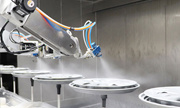
Spraying is one of the most important stages of a cake pan coating line. The coating must reach the required surface areas while maintaining an appropriate and repeatable application condition.
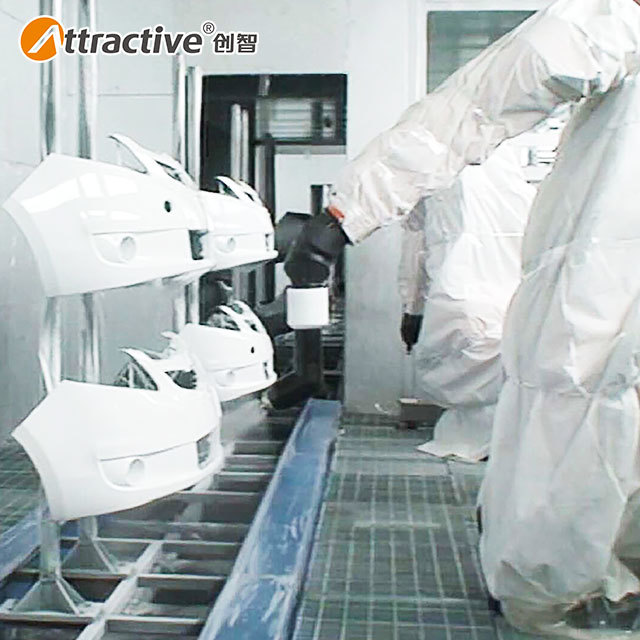
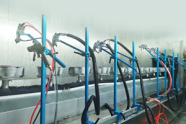
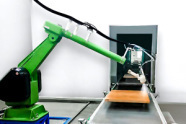
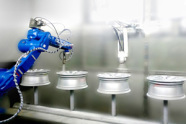
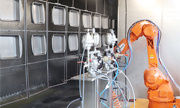
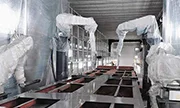
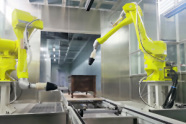
An automated spraying system can coordinate the movement of the workpiece with the spraying equipment. This allows manufacturers to establish repeatable spray paths instead of relying entirely on manual movement.
For production managers, this can provide several practical benefits. First, it can reduce differences between operators. Second, it makes production parameters easier to monitor and adjust. Third, it can support continuous production when large quantities of cake pans need to be processed.
The purpose is not to apply as much coating as possible. A suitable coating process aims to achieve the required surface coverage and quality while controlling material consumption and avoiding unnecessary overspray.
The spraying system can therefore be selected according to cake pan dimensions, coating material, production capacity, and required surface performance. For manufacturers with different product specifications, the coating line can also be configured around different hanging arrangements and process speeds.
Integrated Pretreatment and Surface Preparation
Coating performance starts before the coating material reaches the workpiece. Surface cleanliness and preparation directly affect coating adhesion and the stability of the finished surface.
Attractivechina's documented cake pan spraying project uses an automated immersion and spray pretreatment process. The workpieces automatically pass through the treatment stages, allowing the inner and outer surfaces to be cleaned before subsequent coating operations. The system is designed to provide stable treatment while reducing the need for manual intervention.
The pretreatment equipment can include spray pipes, pressure-regulating components, temperature and pressure monitoring instruments, and customized nozzle arrangements. Such configuration allows the pretreatment process to be adjusted according to the workpiece and production requirements.
A properly designed pretreatment stage can also help reduce contamination entering later coating processes. This is particularly important for cookware and baking mold manufacturers that need stable surface quality over long production runs.
Efficient Conveying for Continuous Production
A coating line is only as efficient as its overall production flow. If workpieces need to be repeatedly loaded, unloaded, and manually transferred between separate machines, the benefits of automated spraying can be reduced.
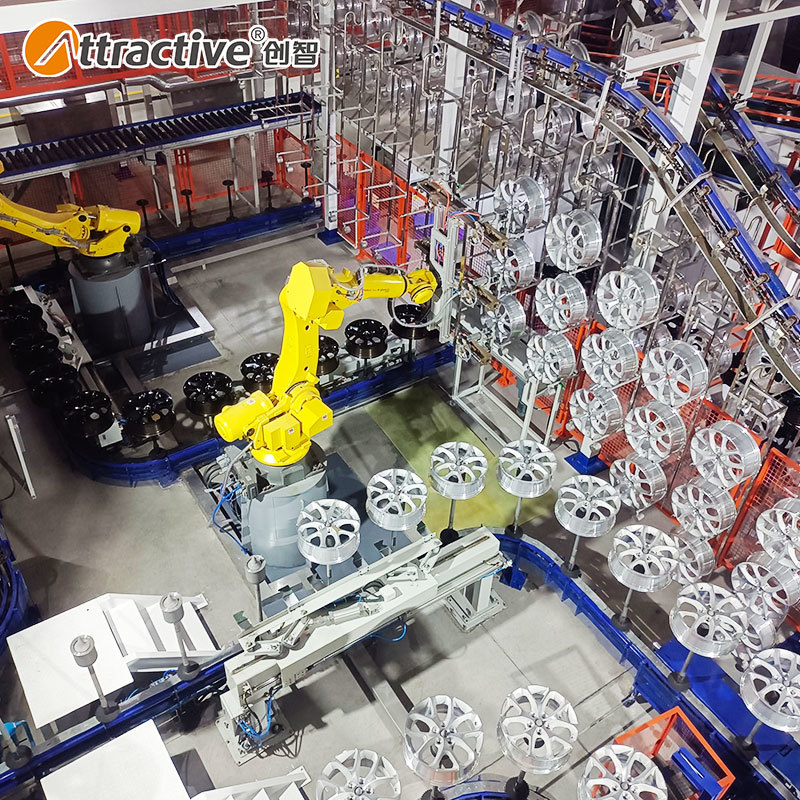
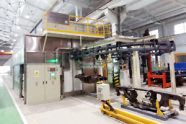
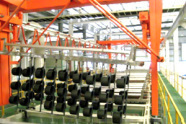
For this reason, conveying is an important part of a cake pan coating system. Attractivechina's documented project uses a heavy-duty suspended conveyor system. The conveyor can be arranged according to the production layout and can transport workpieces through different processing areas. Its configuration is intended to support continuous transportation while allowing processes such as cleaning and spraying to be completed during conveying.
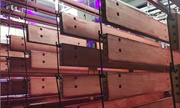
For high-volume cake pan manufacturers, continuous conveying can help connect pretreatment, spraying, drying, and curing into a coordinated production route. It also allows the production line to be designed according to available factory space rather than treating every machine as an independent unit.
Production Capacity for Large-Scale Cake Pan Manufacturing
Production capacity is another major factor when selecting a cake pan coating line. According to the published specifications for this equipment configuration, the production output can reach approximately 800–1,000 pieces per hour. The workpiece pitch can be configured within a range of approximately 450–900 mm, while the hanging method can accommodate four inner pots per hanging position and up to 20 lids per hanging position.
These figures provide a useful reference for manufacturers evaluating production requirements. Actual output, however, depends on product dimensions, coating specifications, conveying speed, curing conditions, hanging configuration, and other process variables.
The equipment is therefore not simply selected according to a nominal hourly output. A complete production line should be matched to the customer's actual product mix and expected production schedule.
For factories producing several cake pan sizes, the line can be configured with appropriate hanging positions and adjustable operating parameters. This provides greater flexibility than a system designed around only one fixed workpiece.

Curing Is Essential to the Final Coating Result
After spraying, the coating needs suitable drying and curing conditions to achieve the required surface properties. The curing stage must be coordinated with coating type, workpiece material, production speed, and temperature requirements.
The published equipment specifications indicate that the curing oven can operate at around 1,000 mm/min, with an adjustable speed range of approximately 0.5–1.5 m/min. The overall system can use natural gas and electricity as energy sources.
Adjustable curing speed gives manufacturers more flexibility when processing different products. Rather than forcing every cake pan through the same fixed production condition, the curing process can be configured according to the actual manufacturing requirements.
Stable temperature control is also important because inconsistent curing conditions may affect coating appearance and performance. Integrating the curing stage into the complete coating line makes it easier to coordinate production speed with the required thermal process.
Materials and Equipment Construction
A production line for cookware must also consider the working environment around pretreatment, spraying, and curing.
The published configuration uses a carbon steel main frame, while the spray booth and related pipeline are made from stainless steel.
The equipment structure can therefore be configured according to the process area and operating requirements. In the documented cake pan spraying project, the spray booth uses a water-curtain design to help capture paint particles generated during spraying. The structure also includes inspection and cleaning access for maintenance.
For long-term industrial operation, these details matter because coating equipment needs to remain accessible for inspection, cleaning, adjustment, and routine maintenance.
A Cake Pan Coating Line Should Be Designed Around the Factory
There is no single coating line configuration that fits every cake pan manufacturer. Product dimensions, materials, coating type, annual production, available factory space, energy supply, and automation requirements can all influence the final design.
A manufacturer producing standard-size aluminum cake pans may require a different hanging and conveying arrangement from a factory producing several sizes of baking molds. Likewise, a plant focused on high-volume production may prioritize line speed and continuous conveying, while another manufacturer may require greater flexibility for multiple product specifications.
This is why turnkey coating line engineering normally begins with the workpiece rather than the equipment catalogue. Product drawings, dimensions, material, coating requirements, expected output, and factory layout can all be considered before the line configuration is finalized.
Attractivechina describes its business as covering plant planning, R&D, design, manufacturing, installation, commissioning, and after-sales service for customized coating production lines. Its coating solutions cover cookware, furniture, auto parts, metal products, and industrial equipment.
Choosing the Right Cake Pan Coating Line
When evaluating a cake pan coating line, buyers should look beyond the basic equipment list. Several questions are worth confirming before purchasing.
Can the line accommodate the actual cake pan dimensions? Is the hanging method suitable for the product geometry? Can the spraying system provide the required coating coverage? Is the pretreatment process compatible with the workpiece material? Can the curing oven maintain the required production conditions? Does the conveyor match the required output? Are the spray booth, pipelines, and other components suitable for continuous industrial operation?
Production capacity should also be evaluated together with product quality. A faster line does not automatically provide better manufacturing results if pretreatment, spraying, conveying, or curing cannot remain stable at the required speed.
For this reason, a customized coating solution can be more practical when a manufacturer has specific product dimensions or production targets.
Building a More Consistent Cake Pan Production Process
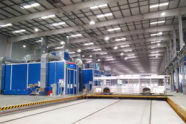
For modern baking mold manufacturers, surface coating is part of the overall production system rather than an isolated finishing operation. A well-designed cake pan coating line connects surface preparation, conveying, spraying, drying, curing, and environmental control into one coordinated workflow.
The documented equipment configuration supports cake pan sizes up to approximately Φ300×160 mm(H), with a reference production capacity of 800–1,000 pieces per hour. It also provides adjustable conveying and curing parameters and can be configured for different hanging requirements.
For manufacturers looking to improve coating consistency, increase production efficiency, and reduce dependence on manual spraying, an automated cake pan coating system provides a structured approach to modernization. More importantly, the right solution should be designed around the actual cake pan, coating process, production volume, and factory conditions.
By matching equipment configuration with real production requirements, manufacturers can build a coating process that is more repeatable, easier to manage, and better suited to continuous cake pan manufacturing.


Contact Us
No.2 Yingbin Avenue, High-tech District, Zhaoqing City, Guangdong Province, China.
Online Message