













Related News

11
2026
-
10
High-Efficiency Cookware Coating Line for Uniform Non-Stick Coatings on Cookware
Author:
Chuangzhi Coating
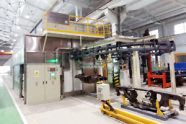
Modern cookware manufacturing requires more than simply applying a layer of paint to the surface of a pan or pot. The coating must be uniform, firmly bonded, resistant to repeated heating, and suitable for the intended application. At the same time, manufacturers need stable production efficiency, controlled material consumption, and repeatable quality from one batch to the next. A well-designed cookware coating line integrates surface pretreatment, spraying, drying, curing, cooling, conveying, and process control into one continuous production system, helping cookware manufacturers achieve more consistent surface performance while reducing dependence on manual operations.
The cookware coating solution provided by Attractivechina is a fully automatic system designed for cookware and related products. The equipment can be configured for non-stick pans, kettles, rice cooker inner pots, enamel pots, bakeware, and other cookware or home appliance components. According to the product specifications, the system can handle workpieces made from aluminum alloy and composite materials including stainless steel, aluminum alloy, and copper. The applicable workpiece diameter is approximately 130–300 mm with a maximum height of 160 mm, while the reference production output reaches 800 pieces per hour.

Why a Dedicated Cookware Coating Line Matters
Cookware surfaces are exposed to demanding working conditions. During daily use, a pan may experience repeated heating and cooling cycles, contact with food ingredients, cleaning, abrasion, and mechanical handling. If the coating thickness is inconsistent or the substrate has not been properly prepared, problems such as poor adhesion, uneven appearance, premature wear, or coating defects may occur.
This is why cookware coating should be treated as a complete process rather than an individual spraying operation. A dedicated production line allows manufacturers to control each important stage and coordinate the process parameters between pretreatment, coating, drying, curing, and cooling.
For example, the surface preparation process can remove contaminants and prepare the substrate for better coating adhesion. The spraying system can then apply primer and topcoat according to the product design. Finally, controlled drying and high-temperature curing help establish the required coating performance.
The result is a more repeatable manufacturing process and a better foundation for large-scale cookware production.
Integrated Pretreatment for Better Surface Preparation
Surface preparation is one of the most important stages in cookware coating. Even a high-quality coating material cannot perform properly if oil, dust, oxidation residues, or other contaminants remain on the substrate.
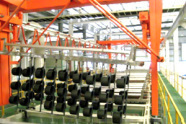
The cookware coating system can be configured with an integrated pretreatment process. The documented process includes loading, hot rinsing, pre-degreasing, degreasing, rinsing, pure-water spraying, water blowing, drying, cooling, sandblasting, desanding, alkaline corrosion, neutralization, rinsing, DI-water rinsing, drying, cooling, and transfer.
Such a multi-stage process provides manufacturers with greater control over surface cleanliness before coating. For aluminum cookware and other metal substrates, appropriate pretreatment can also help create a more suitable surface condition for subsequent coating operations.
Depending on the cookware material and production requirements, the line can also incorporate anodizing-related processing. The documented anodizing route includes degreasing, alkaline corrosion, neutralization, oxidation, rinsing, sealing, DI-water rinsing, drying, and cooling.
The exact configuration does not have to be identical for every factory. Since cookware sizes, materials, coating systems, and production targets vary, the line can be customized according to the customer's actual requirements.
Automatic Spraying for Consistent Coating
One of the major advantages of an automated cookware coating line is its ability to reduce variation caused by manual spraying. Manual coating may depend heavily on operator experience, spray distance, gun movement, coating speed, and working conditions. These variables can make it difficult to maintain consistent coating quality when production volume increases.
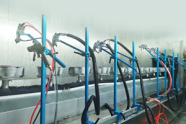
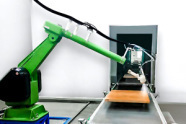
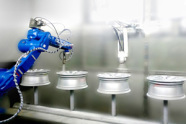
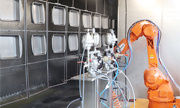
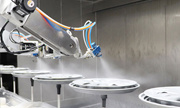
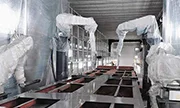
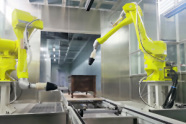
The cookware coating line supports fixed-gun and robotic spraying methods. Automated spraying allows the movement and application process to be controlled more precisely, which is especially useful for high-volume production.
For inner pot applications, the documented process includes automatic dedusting, preheating, primer spraying, primer drying, cooling, inner-pot processing, water-level mark pad printing, preheating, powder spraying, high-temperature curing, cooling, and unloading.
For outer pot applications, the process includes automatic dedusting, preheating, primer spraying, primer drying, cooling, topcoat spraying, topcoat drying, high-temperature curing, cooling, and unloading.
This process-based design makes the line suitable for cookware manufacturers that need repeatable multi-stage coating rather than a simple standalone paint booth.

High-Temperature Curing for Stable Coating Performance
Drying and curing are critical because the coating needs to develop the required physical properties after spraying. Insufficient curing can affect adhesion and durability, while uncontrolled heating may influence the appearance or performance of the coating.
The cookware coating line combines drying, high-temperature curing, and cooling stages to create a controlled thermal process. Electricity and natural gas can be used as heating energy sources, depending on the line configuration. The reference system uses a 380V, three-phase, 50Hz power supply, while natural gas is specified at a standard medium pressure of 80 kPa.
A controlled curing system is particularly important for cookware applications because the coating must withstand the thermal conditions associated with cooking and repeated household use.
The curing parameters should always be matched to the actual coating material, cookware substrate, product geometry, and production requirements. For this reason, equipment specifications should be finalized after the coating process and workpiece characteristics have been evaluated.
Production Efficiency for High-Volume Manufacturing
For cookware factories, production capacity is closely connected with equipment utilization, labor requirements, material consumption, and production consistency.
The reference cookware coating line has a stated production output of up to 800 pieces per hour, with a work system of 300 days per year, 20 hours per day, and an equipment utilization rate of 85%.
Automation can reduce repetitive manual operations while allowing different processing stages to work as an integrated system. This is particularly valuable for manufacturers producing large quantities of similar cookware products.
The line also lists several performance advantages, including a claimed 30% increase in production efficiency compared with traditional lines, a 25% energy saving through an advanced heat recovery system, coating thickness deviation below ±2 μm, and a low-maintenance design intended to reduce annual service costs. These figures are equipment supplier specifications and should be evaluated against the customer's actual product, coating material, and production conditions before project implementation.
Environmental and Process Control Considerations
Modern coating production requires manufacturers to consider not only output but also energy consumption, material efficiency, working conditions, and process stability.
The spray booth of this cookware coating system is designed around controlled environmental conditions. The listed reference parameters include a spray booth temperature of 18–26°C and spray room humidity of 45–75% RH. The compressed-air system is specified with pressure and cleanliness requirements to support stable spraying.
Maintaining suitable environmental conditions can help reduce fluctuations during coating application. For automated production, stable air quality, temperature, humidity, spray pressure, and coating parameters are important for maintaining repeatability.
The system can also incorporate automatic dedusting and other process-control functions. These features are especially useful when manufacturers are producing cookware with demanding appearance requirements.
Flexible Applications Across Cookware Products
A cookware coating line should not be limited to a single type of pan. Different manufacturers may produce frying pans, saucepans, kettles, rice cooker inner pots, cake molds, bakeware, enamel cookware, or other home appliance components.
The equipment described on the product page is designed around this broader application range. Its listed workpieces include non-stick pans, kettles, rice cooker inner pots, home appliances, enamel pots, and bakeware.
For example, a frying pan production process may require primer and non-stick topcoat application, while an outer cookware surface may require a different coating structure and appearance. Cake molds may also require a dedicated coating process based on their geometry and production volume.
A flexible automated line can therefore provide a more practical solution for manufacturers producing multiple product models.
Customization Is Important When Selecting a Cookware Coating Line
There is no universal cookware coating line that can perfectly match every factory. Workpiece dimensions, material, coating formulation, output target, factory layout, heating source, conveyor arrangement, and automation level can all affect the final equipment configuration.
The product specifications state that the line dimensions are customized and that production capacity depends on customer requirements. The supplier also provides overseas engineering service, while the actual technical data is calculated according to customer requirements.
Before purchasing a system, manufacturers should therefore provide detailed information about their products and production plans. Useful information includes cookware type, substrate material, product dimensions, daily or hourly output, coating type, number of coating layers, curing requirements, available utilities, factory space, and expected automation level.
This information allows the coating line supplier to design a more suitable pretreatment system, spray booth, conveyor, curing oven, and control system.
Why Choose an Automated Cookware Coating Solution
For cookware manufacturers planning to increase production capacity, automation can provide benefits beyond labor reduction. A complete coating system can connect previously separate production stages and create a more controlled manufacturing workflow.
Instead of manually transferring cookware between pretreatment, spraying, drying, and curing stations, an integrated line can coordinate these operations through automated conveying and process control. This can improve production continuity and make it easier to maintain standardized operating conditions.
The equipment described by Attractivechina is positioned as a turnkey coating solution with customized design capabilities. The supplier states that it has more than 30 years of experience and provides engineering support, spare-parts supply, maintenance, technical assistance, and process upgrade services.
For an international cookware manufacturer, after-sales support is an important consideration because coating equipment is a long-term production asset. Fast technical response, spare-parts availability, and process support can help reduce unexpected downtime after installation.
How to Evaluate a Cookware Coating Line Before Purchase
When comparing different cookware coating equipment suppliers, buyers should look beyond the headline production capacity. A suitable evaluation should cover the complete process.
First, check whether the line is designed for the actual cookware material and product dimensions. Second, evaluate the pretreatment process because surface preparation directly affects coating adhesion. Third, confirm whether the spraying system can achieve the required coating structure and repeatability. Fourth, review the drying and curing system and make sure its heating capacity matches the coating process.
It is also important to examine environmental control, compressed-air requirements, energy consumption, conveyor design, automation level, maintenance access, spare-parts support, and overseas installation service.
Finally, manufacturers should ask the supplier to confirm the final technical parameters based on actual samples. A coating line is a complete production system, so the most reliable design is one developed around the real cookware rather than based only on a standard equipment model.
Conclusion
A modern cookware coating line brings together pretreatment, automatic spraying, drying, high-temperature curing, cooling, conveying, and process control to create a more stable cookware manufacturing workflow. For non-stick pans, rice cooker inner pots, kettles, cake molds, bakeware, and other cookware products, automation can help manufacturers improve production consistency while reducing dependence on manual operations.
The Attractivechina system supports workpieces in the approximate range of 130–300 mm in diameter and up to 160 mm in height, with a reference output of 800 pieces per hour. It supports fixed-gun or robotic spraying, customized line design, multiple pretreatment options, and integrated curing processes.
For manufacturers planning a new cookware production facility or upgrading an existing painting system, the right approach is to select the coating line according to actual product dimensions, coating requirements, production capacity, factory layout, and utility conditions. A properly configured automated line can become an important part of a reliable and scalable cookware manufacturing process.


Contact Us
No.2 Yingbin Avenue, High-tech District, Zhaoqing City, Guangdong Province, China.
Online Message