

























19
2016
-
10
Factors affecting various aspects of sandblasting machine
Author:
Chuangzhi Coating
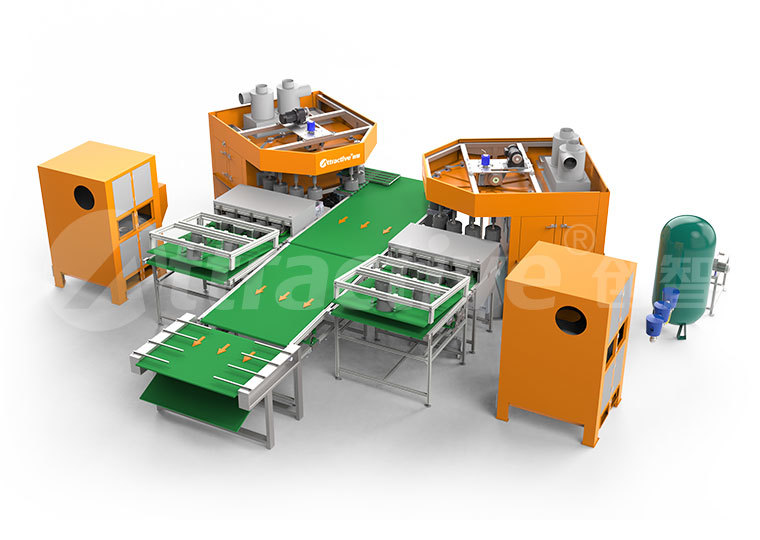
Sandblasting machine uses compressed air to flow at high speed in the spray gun to generate negative pressure to produce the spray effect. The abrasive in the cyclone separator storage box is sucked into the spray gun through the sand pipe, and then sprayed from the nozzle to the workpiece surface along with the compressed air flow. Achieve the purpose of sandblasting. Under working conditions, compressed air and sand are mixed while spraying, making full use of the compressed air. The air flow and sand flow can be easily adjusted to obtain an ideal mixing ratio, low energy and sand consumption, and high cleaning efficiency.
Factors affecting various aspects of sandblasting machine:
1. The influence of abrasive type on surface results
Abrasives are divided into spherical and rhombus shapes according to their particle state. Diamonds (white corundum, brown corundum) commonly used in sandblasting are diamond-shaped abrasives. Glass beads are spherical abrasives. After the P, H, and θ values are set, the surface obtained by sandblasting with spherical abrasives is relatively smooth, while the surface obtained by diamond-shaped abrasives is relatively rough, and the same abrasives are divided into coarseness and fineness. The number of abrasive grains divided by the number of domestic sieves. Thickness is generally called quantity. The higher the number, the smaller the particle size. After setting the values of P, H and θ, for the same sandblasting times, the higher the number, the smoother the surface result will be.
2. The impact of pressure adjustment on surface results. After the three quantities S, H, and θ are set, the larger the P value, the higher the jet velocity, the higher the blasting efficiency, and the better the blasting effect. Make the workpiece surface rougher. Instead, the surface is smoother.
3. The impact of changes in distance and angle of the spray gun on the surface effect. After setting the P and S values, this item is the key to manual sandblasting technology. The distance between the spray gun and the workpiece is generally 50 to 150 mm. The farther the spray gun is from the workpiece, the lower the efficiency of the jet stream and the smoother the surface of the workpiece. The smaller the angle between the spray gun and the workpiece, the lower the efficiency of the jet flow and the smoother the surface of the workpiece.
Next Page


Contact Us
No.2 Yingbin Avenue, High-tech District, Zhaoqing City, Guangdong Province, China.
Online Message