
















All categories
Related News

08
2025
-
08
Enamel Coating Solutions for Die-Cast Aluminum and Cast Iron
Author:
Chuangzhi Coating
In the manufacturing fields of cookware, auto parts, etc., die-cast aluminum and cast iron are widely used due to their unique properties. The enamel coating, as a key process to improve their corrosion resistance, wear resistance and aesthetics, has high requirements for coating technology. As a professional manufacturer of coating line equipment, we have developed targeted enamel coating solutions based on the characteristics of the two substrates to ensure the perfect combination of coating and substrate, meeting diverse industrial needs.
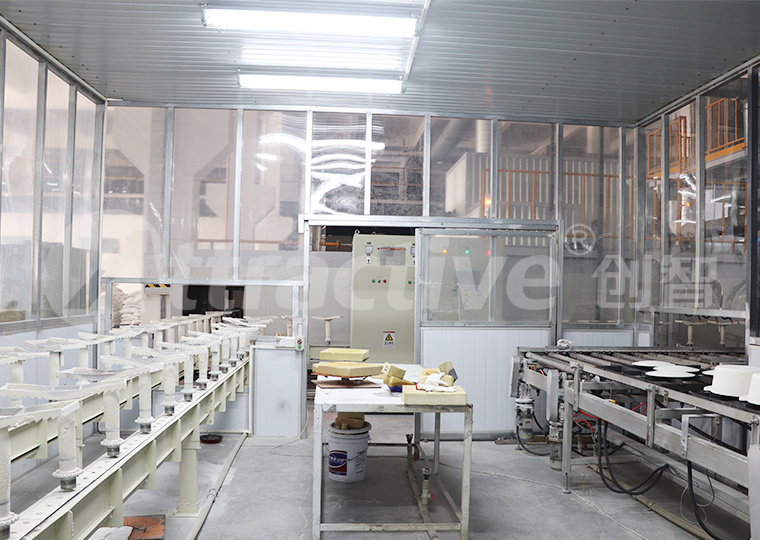
Enamel Coating Solution for Die-Cast Aluminum
Die-cast aluminum has the characteristics of light weight and good formability, but its surface is easy to form an oxide film, and the material has high compactness, which brings challenges to the adhesion of the enamel coating.
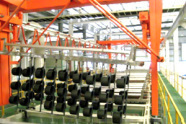
Pretreatment is a key link in the enamel coating of die-cast aluminum. First, degreasing treatment is required. Alkaline cleaning agents are used to remove oil and release agents on the surface. The temperature is controlled at 50-60℃, and the treatment time is 8-10 minutes to ensure that the surface cleanliness reaches more than 95%. Then, acid pickling activation is carried out. A mixed solution of nitric acid and hydrofluoric acid is used to remove the oxide film and form a micro-rough surface at the same time, enhancing the coating adhesion. After treatment, it is necessary to thoroughly rinse with deionized water to avoid residual acid solution corroding the substrate.
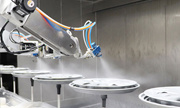
In terms of coating material selection, special aluminum enamel glazes with low expansion coefficients should be used. Their thermal expansion coefficient needs to be close to that of die-cast aluminum (about 20-25×10⁻⁷/℃) to prevent coating cracking due to expansion differences during high-temperature firing. The coating process can adopt electrostatic spraying or dipping. During electrostatic spraying, the voltage should be controlled at 60-80kV, and the film thickness should be kept at 80-120μm to ensure uniform coating. In the firing stage, the temperature curve is crucial, which needs to go through three stages: preheating (200-300℃), heating (500-550℃), and heat preservation (10-15 minutes). A dense coating is formed after slow cooling.
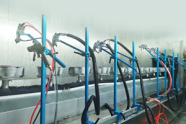
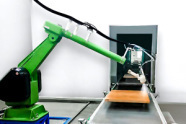
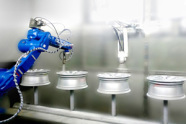
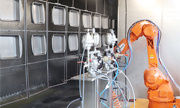
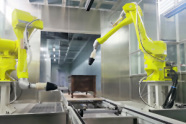
For the complex structure of die-cast aluminum, our automatic coating line is equipped with a 3D visual positioning system, which can accurately control the spraying angle and flow, ensuring the coating integrity of grooves, corners and other parts. After a cookware enterprise adopted this solution, the adhesion of the enamel coating of die-cast aluminum pans increased by 40%, and the salt spray resistance reached more than 500 hours.
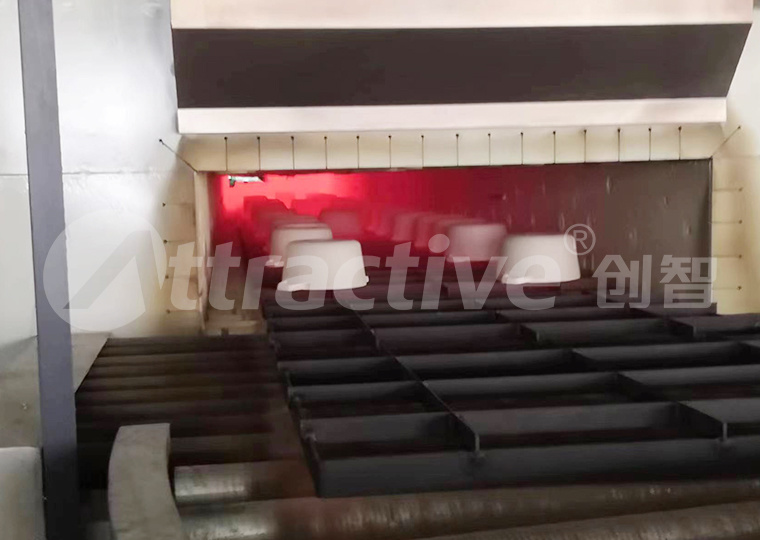
Enamel Coating Solution for Cast Iron
Cast iron has high strength and good thermal conductivity, but it is easy to rust and has uneven surface roughness. The enamel coating needs to take both corrosion protection and flatness into account.
The pretreatment process is different from that of die-cast aluminum. Cast iron first needs to go through sandblasting. 80-120 mesh emery is selected, and the surface is sprayed at a pressure of 0.4-0.6MPa to remove rust and scale, and at the same time form a uniform rough surface (roughness Ra2.5-3.2μm) to provide mechanical anchoring for coating adhesion. After sandblasting, phosphating treatment should be carried out immediately to form a phosphating film on the surface to prevent secondary rusting, and the treatment time is controlled at 5-8 minutes.
Cast iron enamel glazes should be of high viscosity and high hiding power varieties, which can cover the defects on the substrate surface. For cast iron parts used in cookware, it is recommended to use porcelain glaze with temperature resistance above 400℃ to meet the needs of high-temperature cooking. During coating, wet enameling (firing directly after enameling) or dry enameling (drying first and then firing after enameling) can be adopted. Wet enameling is suitable for large-area flat parts, while dry enameling is suitable for products with complex shapes. The firing temperature is usually 800-850℃, and the heat preservation is 20-30 minutes to make the glaze fully melt and level, forming a smooth and flat coating.
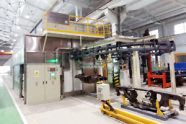
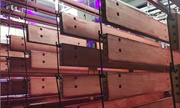
The special drying room we designed for the cast iron enamel production line adopts a hot air circulation system to ensure uniform coating drying and avoid cracking. After a cast iron cookware manufacturer introduced this production line, the flatness of the product's enamel coating increased by 30%, and the defective rate was reduced to less than 1%.
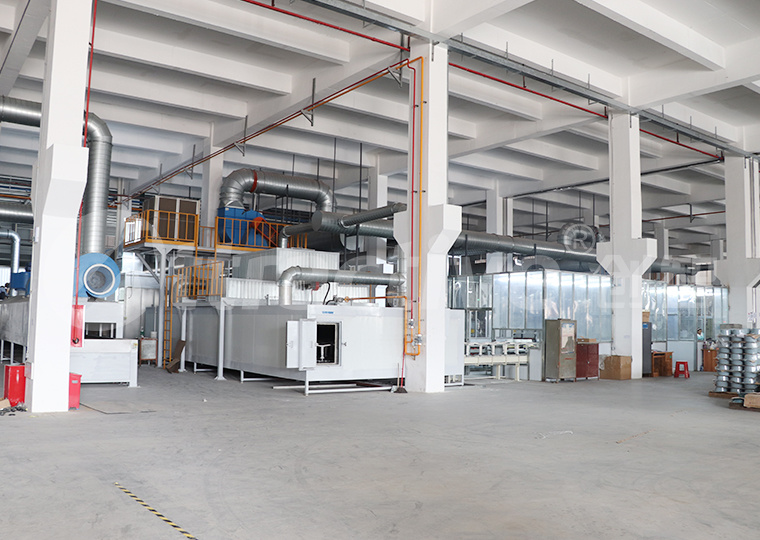
Commonalities and Differences Between the Two Substrate Solutions
Whether it is the enamel coating of die-cast aluminum or cast iron, it is necessary to strictly control the pretreatment quality and firing curve, which is the core of ensuring coating performance. The differences are mainly reflected in the following aspects: in the pretreatment process, die-cast aluminum is mainly chemical treatment, while cast iron is mainly physical sandblasting combined with chemical treatment; in glaze selection, die-cast aluminum focuses on matching the expansion coefficient, and cast iron focuses on hiding power and temperature resistance; in firing temperature, cast iron enamel is much higher than die-cast aluminum enamel.
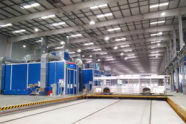
Our coating line equipment has a modular design, which can quickly switch process parameters according to the substrate type, meeting the needs of multi-variety production. At the same time, it is equipped with an online detection system to monitor the coating thickness and adhesion in real time, ensuring stable product quality.
Conclusion
The enamel coating solutions for die-cast aluminum and cast iron need to be designed according to the characteristics of the substrates. Our solution not only provides process guidance but also seamlessly connects the pretreatment, coating, firing and other links through customized coating line equipment to achieve efficient and stable production. Choosing a professional solution can enable die-cast aluminum and cast iron products to have excellent performance and a longer service life, adding advantages for enterprises in the market competition.


Contact Us
No.2 Yingbin Avenue, High-tech District, Zhaoqing City, Guangdong Province, China.
Online Message