










Related News

11
2025
-
12
Innovative Coating Line Designs for Enhanced Productivity
Author:
Chuangzhi Coating
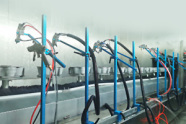
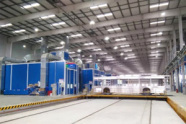
In the era of intelligent and sustainable manufacturing, coating lines are undergoing transformative innovations. As a leading manufacturer of coating line equipment, we focus on delivering high-efficiency, eco-friendly solutions through technological advancements and process optimization. This article explores how smart coating lines, automated spraying equipment, and high-efficiency coating processes are redefining productivity and competitiveness.
1. Intelligent Control Systems: Data-Driven Closed-Loop Optimization
The cornerstone of modern coating lines lies in the development of smart coating lines. By integrating sensors and industrial IoT technologies, systems can monitor critical parameters such as paint viscosity, spraying pressure, and curing temperature in real time. For instance, when environmental conditions change, the system automatically adjusts paint dilution ratios and drying times to maintain consistent coating quality. This closed-loop control reduces manual intervention and minimizes rework caused by parameter drift.
Predictive maintenance further enhances efficiency by continuously monitoring equipment status (e.g., pumps, fans, motors) to identify potential failures before they occur. Compared to traditional scheduled or reactive maintenance, this approach reduces maintenance costs by over 30% and improves equipment uptime.
2. Automated Spraying Equipment: Precision and Resource Efficiency
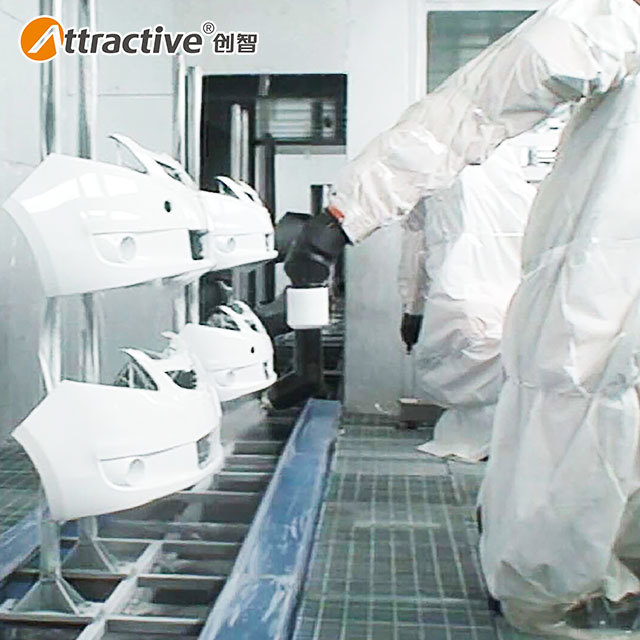
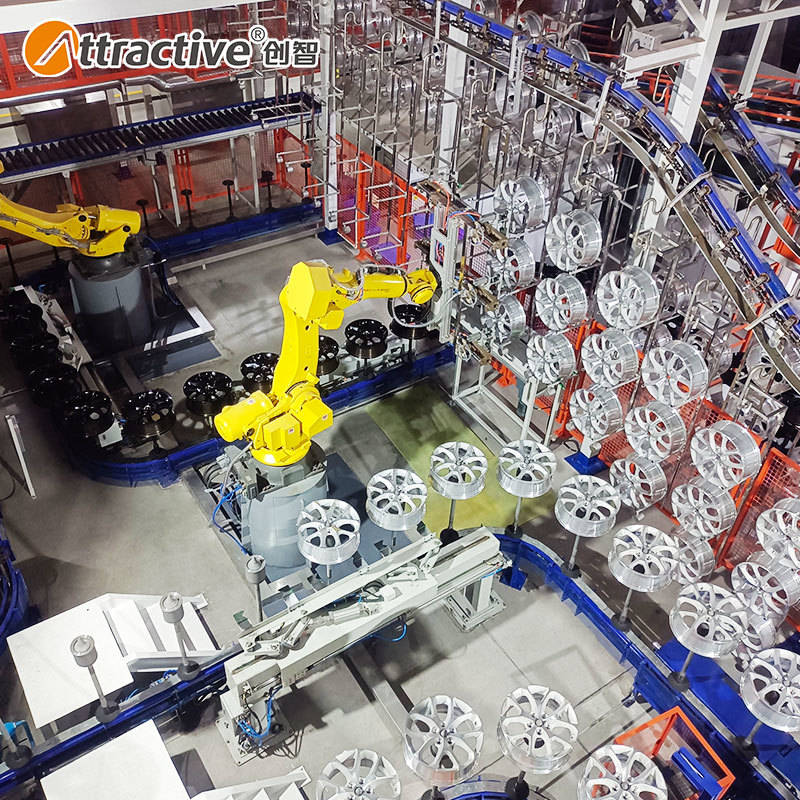
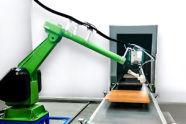
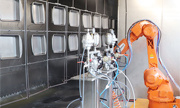
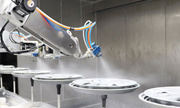
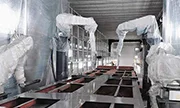
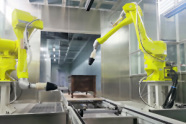
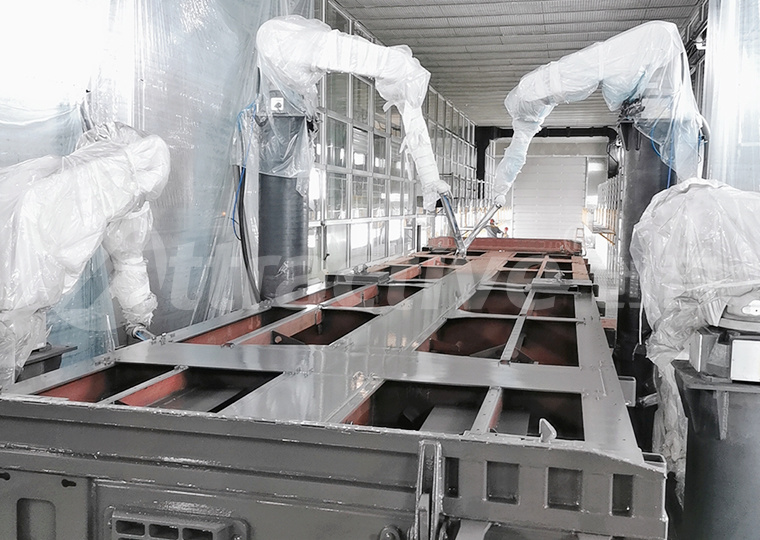
Automated coating equipment is pivotal for boosting productivity. A six-axis robotic system with 3D vision positioning, for example, ensures ±0.5mm accuracy in coating complex geometries like welded joints and curved tank surfaces. A case study from a heavy machinery enterprise demonstrated a 90% improvement in coating uniformity and a rework rate drop to under 5%.
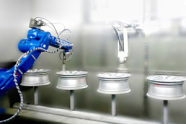
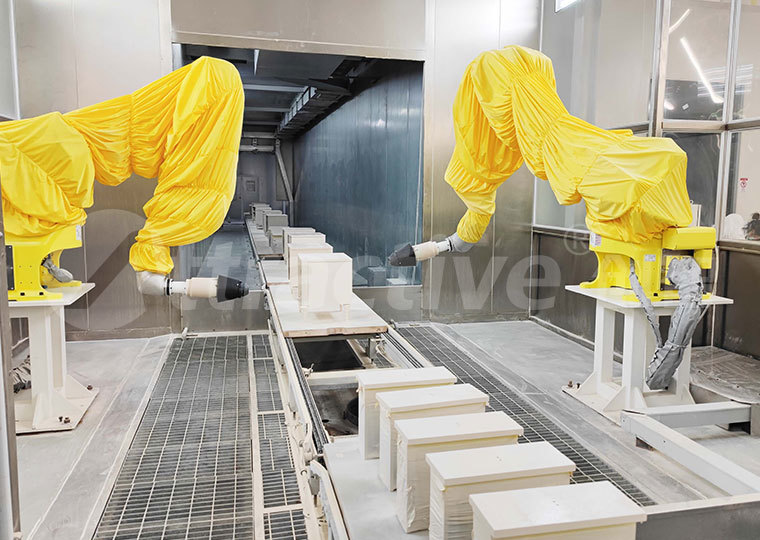
Electrostatic spraying technology achieves a paint utilization rate of 85% (compared to 40% for conventional air spraying), while overspray recovery systems save over ¥500,000 annually (for 100,000㎡/year production). Flexible conveying systems and rapid tooling switches reduce changeover time by 30%, enhancing production flexibility.
3. High-Efficiency Coating Processes: Sustainability and Energy Savings
High-efficiency coating processes combine productivity with environmental responsibility. The adoption of water-based and powder coatings reduces VOC emissions to below 50g/㎡ (vs. the national standard of 120g/㎡), enabling faster environmental compliance approvals. Emerging technologies like UV and electron beam curing complete coating curing in seconds, cutting drying time by 60% and energy consumption by 40% compared to traditional thermal curing.
Energy-saving designs such as heat recovery systems capture 50% of waste heat from spray booths and ovens, using it to preheat fresh air. Vertical laminar flow and Venturi-style airflow optimization further reduce fan energy consumption while improving paint mist capture efficiency.
4. Case Study: 5G + Industrial Internet for Full-Scenario Empowerment
A high-end custom furniture coating line showcases the power of 5G standalone (SA) networking and TSN time-sensitive networks in synchronizing robotic sprayers, AGV conveyors, and industrial internet platforms. Edge computing nodes and full-data acquisition reduce cycle time by 18%, supporting small-batch, multi-model production.
Dynamic temperature curve adjustments via an energy efficiency cockpit achieve 12–15% energy savings. Rapid color-switching systems complete pipeline cleaning in 15 minutes (vs. 30 minutes for traditional systems), significantly improving line responsiveness.
5. Future Outlook: Technological Convergence and Continuous Innovation
With AI, digital twins, and bio-based coatings maturing, coating line designs will advance toward higher intelligence. For example, adaptive spraying path planning based on real-time visual feedback will enhance coating consistency on complex parts. Lifecycle cost assessment models will help enterprises optimize investments in equipment, energy, and environmental compliance for long-term sustainability.
Previous
Next Page


Contact Us
No.2 Yingbin Avenue, High-tech District, Zhaoqing City, Guangdong Province, China.
Online Message