























Related News
30
2026
-
07
How to Build a Truly Environmentally Compliant Coating Line?
Author:
Chuangzhi Coating
Against the backdrop of accelerating green transformation in global manufacturing, environmental compliance for coating lines is no longer a simple issue of "end-of-pipe treatment." It has become a systematic engineering task that runs through the entire process of process selection, equipment design, and daily operations. From VOCs emission limits and wastewater treatment standards to solid waste management and carbon accounting, every regulatory red line can become a critical factor affecting the legal operation of the production line, export access, and even the company's brand reputation.
This guide aims to provide manufacturing enterprises with a systematic framework for environmental compliance and sustainable development of coating production lines. Leveraging over 30 years of industry experience and the delivery of over 2,000 automated coating lines, Attractivechina integrate environmental concepts into every stage from design to delivery. This article analyzes the core elements of coating line environmental compliance from four dimensions: emission standards interpretation, source reduction technologies, end-of-pipe treatment solutions, and compliance management.

1. Environmental Challenges of Coating Production Lines: Which Areas Require Special Attention?
The coating process is one of the most pollutant-intensive procedures in manufacturing. Understanding the environmental risks at each stage is the first step in formulating a compliance strategy.
| Pollution Type | Main Sources | Major Pollutants | Environmental Impact |
|---|---|---|---|
| Waste Gas Emissions | Spraying and drying processes | VOCs (Volatile Organic Compounds), paint mist particles, dust | Air pollution, photochemical smog, worker health hazards |
| Wastewater Discharge | Pre-treatment (degreasing, phosphating/silanation), spray booth circulating water | Heavy metal ions, COD, SS, acid/alkaline waste liquids | Water pollution, soil contamination |
| Solid Waste | Waste paint slag, waste filter materials, waste solvents, waste packaging | Hazardous waste (Category HW12) | Soil contamination, high disposal costs |
| Noise Pollution | Fans, air compressors, conveyor systems | Industrial noise | Occupational health impacts, exceeding site boundary noise limits |
| Carbon Emissions | Oven combustion, electricity consumption | CO₂, NOx | Climate change, carbon tariff risks |
Key Insight: The focus of environmental compliance management for coating lines is shifting from "end-of-pipe treatment" to the full-chain management of "source reduction + process control + end-of-pipe treatment." Relying solely on end-of-pipe treatment equipment is not only costly but also insufficient to meet increasingly stringent emission standards.
2. Overview of Key Environmental Regulations and Emission Standards
Different countries and regions have varying environmental requirements for the coating industry. Understanding these standards is the foundation for developing a compliance strategy.
| Market/Region | Core Regulations/Standards | Key Control Indicators | Critical Requirements for Coating Lines |
|---|---|---|---|
| China | GB 16297-1996 "Comprehensive Emission Standard of Air Pollutants"; GB 37822-2019 "Standard for Fugitive Emission Control of VOCs" | VOCs emission concentration and rate; fugitive emissions at plant boundary | VOCs emission concentration limits for coating processes; fugitive emission monitoring in workshops and at plant boundaries |
| European Union | Solvent Emissions Directive (1999/13/EC); Industrial Emissions Directive (2010/75/EU) | Total VOCs emissions, wastewater discharge | VOCs emission limits for specific industries; Best Available Techniques (BAT) requirements |
| United States | EPA 40 CFR Part 63 (NESHAP); Clean Air Act (CAA) | HAPs (Hazardous Air Pollutants), VOCs | Specific emission standards for coating sources; compliance monitoring and reporting requirements |
| International General | ISO 14001 Environmental Management System | Systematic environmental management capability | Demonstrates the organization's ability to continuously improve environmental performance |
Compliance Points: When selecting a coating line supplier, buyers should confirm whether the supplier's equipment design can meet current and foreseeable emission standards of the target market. Suppliers holding ISO 14001 certification (such as Attractivechina) typically have more comprehensive experience in establishing environmental management systems.
3. Source Reduction: Starting with Process and Material Selection
Source reduction is the most cost-effective strategy for coating line environmental compliance. Making the right decisions during the process and material selection phase can significantly reduce the burden of subsequent end-of-pipe treatment.
3.1 Low-VOCs Coating Substitution
| Coating Type | VOCs Content (Typical) | Application Scenarios | Environmental Advantages |
|---|---|---|---|
| Solvent-Based Coatings | 300-600 g/L | High-performance anti-corrosion, high appearance requirements | — |
| Waterborne Coatings | 50-150 g/L | Automotive, furniture, general industry | VOCs emissions reduced by 60%-80% |
| Powder Coatings | Near zero (<5 g/L) | Metal furniture, home appliances, general industry | Almost zero VOCs emissions; overspray powder can be recovered |
| High-Solid Coatings | 150-250 g/L | Heavy-duty anti-corrosion, industrial equipment | VOCs emissions reduced by 30%-50% |
Selection Suggestion: Under the premise of meeting product performance requirements, give priority to powder coatings or waterborne coatings. For scenarios where solvent-based coatings are still necessary, choose high-solid formulations to reduce VOCs generation.
3.2 High-Transfer-Efficiency Spraying Technologies
Improving the transfer efficiency of the spraying process is an effective means of reducing paint consumption and VOCs emissions at the source.
- Electrostatic Spraying: Achieves transfer efficiency of 70%-85%, compared to 40%-60% for conventional air spraying, significantly reducing overspray and VOCs generation.
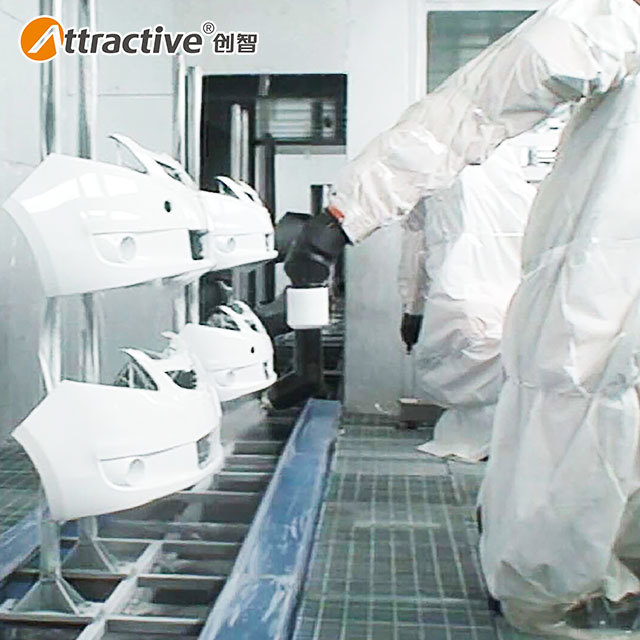
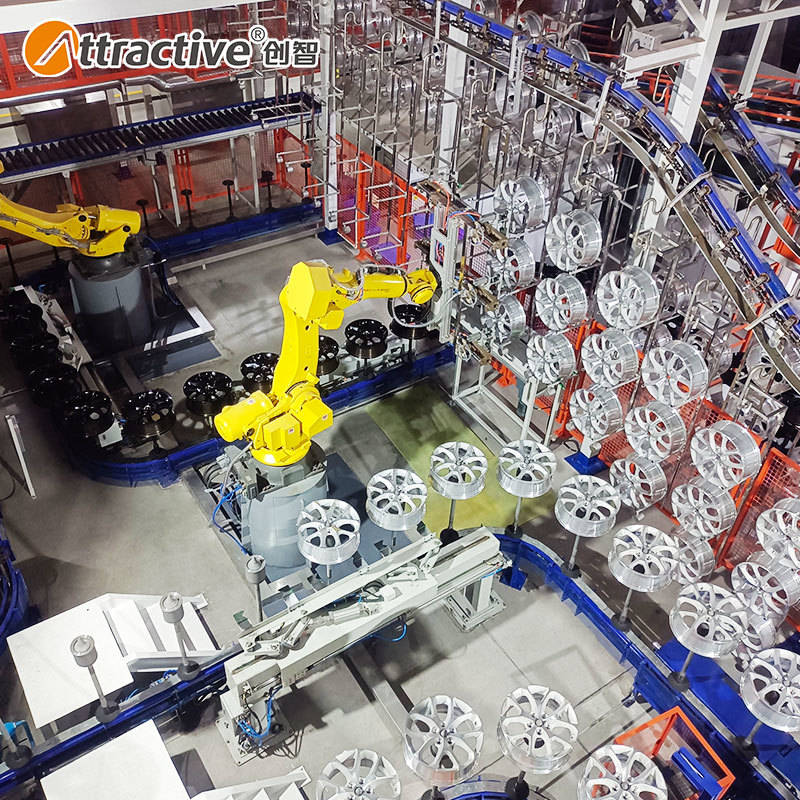
- Robotic Automated Spraying: Precise trajectory control and parameter optimization eliminate paint waste associated with manual operations.
- Over-Spray-Free Application Technology: Cutting-edge technology that achieves 100% transfer efficiency, completely eliminating overspray, reducing energy consumption by approximately 25% and CO₂ emissions by approximately 300 tons annually.
4. End-of-Pipe Treatment: Efficient Exhaust Gas Treatment System Design
For VOCs and paint mist that cannot be completely eliminated through source reduction, efficient end-of-pipe treatment facilities are essential. Current mainstream technology routes include:
| Treatment Technology | Applicable Scenarios | Treatment Efficiency | Advantages & Disadvantages |
|---|---|---|---|
| Activated Carbon Adsorption | Small air volume, low concentration | 60%-90% | Low investment; requires periodic replacement, generating hazardous waste |
| Zeolite Rotor Concentration + Combustion | Large air volume, low concentration | Over 95% | Suitable for large-scale coating (automotive, appliances); relatively low overall operating cost |
| Regenerative Thermal Oxidizer (RTO) | High-concentration VOCs | 95%-99% | High treatment efficiency; heat recovery rate up to over 95% ; relatively high investment |
| Catalytic Oxidation (CO) | Medium concentration | 90%-98% | Lower operating temperature; catalyst has limited lifespan |
| Water Curtain/Water Swirl Spray Booth | Paint mist particle capture | 90%-98% | Effectively removes paint mist; requires supporting wastewater treatment |
System Design Points:
- Airflow Matching: Over-designed air volume significantly increases equipment investment and operating energy consumption. Accurately calculate the required airflow based on spray booth dimensions, operating openings, coating types, and other factors.
- Heat Recovery Integration: Recovering waste heat from RTO or ovens for preheating fresh air or heating water can achieve full-process heat recovery, reducing overall energy consumption by 30%.
- Online Monitoring: Install online VOCs monitoring systems to track emission concentrations in real time, ensuring compliant operation and providing early warnings.
5. Wastewater and Solid Waste Compliance Management
5.1 Wastewater Treatment
Coating pre-treatment (degreasing, phosphating/silanation) and spray booth circulating water are the primary sources of wastewater.
- Pre-treatment Wastewater: Contains heavy metal ions, acids/bases, COD, and other pollutants. Requires neutralization, flocculation, sedimentation, and filtration physico-chemical treatment processes before discharge or reuse.
- Spray Booth Circulating Water: Paint mist coagulants are added to agglomerate paint slag for flotation or settlement. Paint slag is regularly removed, and fresh water is replenished to reduce wastewater discharge.
- Water Reuse: Encourages the reuse of treated wastewater for non-process purposes such as cleaning, achieving water conservation and emission reduction.
5.2 Solid Waste Management
Waste paint slag, waste filter materials, and waste solvents generated during coating processes are classified as hazardous waste (Category HW12) and must be strictly managed in accordance with regulatory requirements for separate collection, temporary storage, transfer, and disposal.
- Reduction: Reduce waste paint slag generation at the source by improving transfer efficiency and optimizing spraying parameters.
- Recycling: Some waste solvents can be recovered and reused through distillation.
- Compliant Disposal: Entrust qualified hazardous waste disposal companies for safe treatment and maintain complete transfer manifest records.
6. Key Points for Evaluating Supplier Environmental Capabilities
When selecting a coating line supplier, buyers should incorporate environmental compliance design capability as a core evaluation dimension:
- Systematic Environmental Design Capability: Can the supplier provide a detailed environmental compliance analysis report during the proposal phase, covering predicted generation volumes of waste gas, wastewater, and solid waste along with corresponding treatment plans?
- Core Environmental Technologies: Does the supplier hold patented technologies related to exhaust gas treatment, wastewater treatment, and heat recovery? Patent counts (especially invention patents) are hard indicators of technological strength.
- Verified Environmental Compliance Cases: Request actual environmental test data from delivered projects to prove the equipment can achieve stable compliance.
- Environmental Management System Certification: Does the supplier hold ISO 14001 certification? This demonstrates their systematic environmental management capability.
- Lifecycle Environmental Services: Does the supplier offer not only equipment but also ongoing environmental compliance monitoring and optimization services?
7. Common Environmental Misconceptions and Avoidance Suggestions
- Misconception 1: "Buying environmental equipment means environmental compliance."
- Fact: Environmental equipment is only a tool; compliant operation is the goal. Improper equipment selection, incorrect operating parameters, and inadequate maintenance can all lead to emission exceedances. A comprehensive environmental management system—including operating procedures, monitoring records, and emergency response plans—must be established.
- Misconception 2: "Waterborne coatings are always more environmentally friendly than solvent-based coatings."
- Fact: While waterborne coatings significantly reduce VOCs emissions, their production process may have higher energy and water consumption. True environmental friendliness should be based on Life Cycle Assessment (LCA) , comprehensively considering energy consumption, water usage, emissions, and waste generation.
- Misconception 3: "Environmental compliance is a cost, not an output."
- Fact: Environmental compliance investment can translate into market competitiveness. With the gradual implementation of global "carbon tariff" mechanisms (such as the EU CBAM), low-carbon, green production is becoming a market access threshold for products entering international markets. Companies that plan ahead will gain significant first-mover advantages.
Conclusion
Environmental compliance for coating production lines is not an isolated "add-on task" but a systematic engineering project that runs through process design, equipment selection, and daily operations. From adopting low-VOCs coatings and high-transfer-efficiency spraying technologies at the source, to installing efficient exhaust gas and wastewater treatment facilities, to establishing comprehensive monitoring and management systems—every stage is critical to the legal operation of the production line and the sustainable development of the enterprise.
Choosing a supplier with systematic environmental design capability, extensive industry experience, and robust certification systems is the foundation for ensuring coating line environmental compliance.
Guangdong Chuangzhi Intelligent Equipment Co., Ltd. (Attractivechina) , as a national-level "Little Giant" Enterprise holding ISO 14001 Environmental Management System Certification, deeply integrates environmental concepts into the design and manufacturing of coating lines. Our solutions consider key environmental factors—VOCs source reduction, efficient exhaust gas treatment, wastewater minimization, and heat recovery—at the design stage, committed to providing global customers with compliant, efficient, and sustainable coating solutions.
We invite you to share your specific product and production plans—our environmental and engineering teams will provide you with a comprehensive report including emissions assessment, compliance solution design, and return-on-investment analysis.
SEO:
Previous


Contact Us
No.2 Yingbin Avenue, High-tech District, Zhaoqing City, Guangdong Province, China.
Online Message