














Related News
28
2026
-
08
Why Can't a Coating Line Be "Universal" Across Different Industries?
Author:
Chuangzhi Coating
Having served clients across a wide range of industries—including automotive parts, rail transit, furniture, musical instruments, cookware, home appliances, hardware, and aerospace—one common misconception stands out: some buyers tend to look for a "universal" coating line, hoping to use the same system for products of different materials, shapes, and quality requirements. While this idea is understandable, the costs are extremely high.
Workpieces from different industries vary enormously in substrate, geometry, production volume, quality standards, and cost structure. Purchasing a coating line as if it were "standardized equipment" is a primary reason for post-commissioning modifications, frequent coating defects, and prolonged payback periods. Guangdong Chuangzhi Intelligent Equipment Co., Ltd., a national "Little Giant" enterprise integrating pre-sales factory planning, independent R&D, design, manufacturing, installation, commissioning, and after-sales service, has over thirty years of experience in the coating equipment industry, having delivered over 2,000 coating lines. Based on extensive cross-industry delivery data, this article breaks down the differentiated requirements for coating lines across five major industries, helping you understand why "dedicated" solutions are more economical than "universal" ones.

1. Coating Requirements for Five Typical Workpieces: Where Are the Core Differences?
To illustrate the differences intuitively, let us first look at a simplified comparison. These five industries represent the most common application areas for coating lines.
| Dimension of Comparison | Automotive Parts (e.g., Wheels, Bumpers) | Cookware (e.g., Frying Pans, Inner Pots) | Metal Furniture (e.g., Office Chairs, Filing Cabinets) | Wood Products (e.g., Furniture Panels, Decorative Moldings) | General Industrial Equipment (e.g., Agricultural Machinery, Electrical Cabinets) |
|---|---|---|---|---|---|
| Substrate | Metal (steel, aluminum, alloys) | Metal (cold-rolled steel, aluminum, cast iron) | Metal (tubes, sheets) | Wood, engineered wood | Heavy metal parts, irregular shapes |
| Core Process Requirements | Extremely high corrosion protection, high appearance quality, high consistency, high volume | Temperature resistance, non-stick properties, food contact safety, decorative finish | Balance of decoration and protection, diverse colors, cost-sensitive | Substrate filling, grain reproduction, environmental friendliness (low VOC), tactile feel | Heavy-duty anti-corrosion, thick coatings, single-piece or small batch |
| Key Performance Indicators | Salt spray ≥1000h; High DOI; Film thickness deviation ±5μm | Coating hardness, scratch resistance; High-temperature stability; Color accuracy | Strong adhesion, good weatherability; Flexible color change; High material utilization | Transparency, fullness; Scratch resistance; UV curing efficiency | Coating thickness ≥80μm; Impact resistance; Good edge coverage |
| Best-Matched Coating Technology | Electrostatic rotary bell spraying / Robotic automation | Powder electrostatic spraying / Liquid electrostatic air-spraying | Powder electrostatic spraying (with rapid color-change system) | UV-curable paint / Waterborne paint spraying | Air-assisted airless spraying / Powder spraying |
| Common "Universal Line" Pitfall | Using standard spray guns leads to severe orange peel | A standard powder line cannot meet the precise sintering temperature control for non-stick coatings | Lines have lengthy color-change times, unable to handle high-mix orders | High-temperature ovens cause wood deformation or cracking |
2. A Deeper Dive: Why These Differences Are Critical?
Every industry has its unique "process code." Ignoring these codes will significantly compromise equipment performance.
2.1 Automotive Parts: Precision and Traceability Are the Lifelines
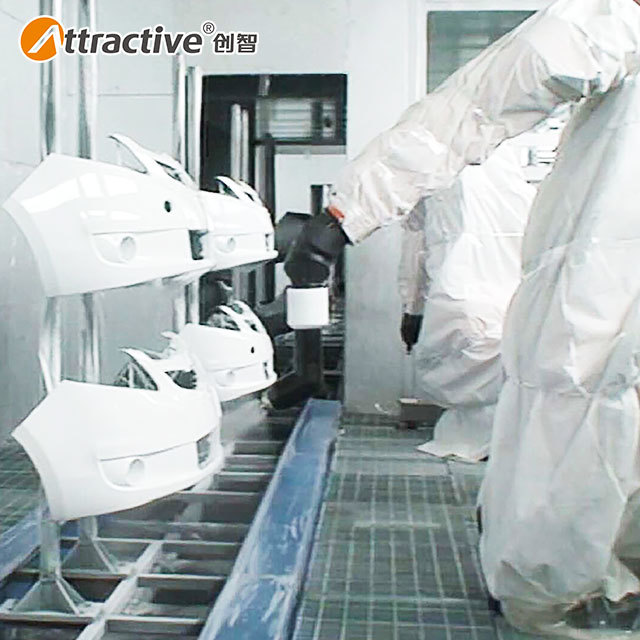
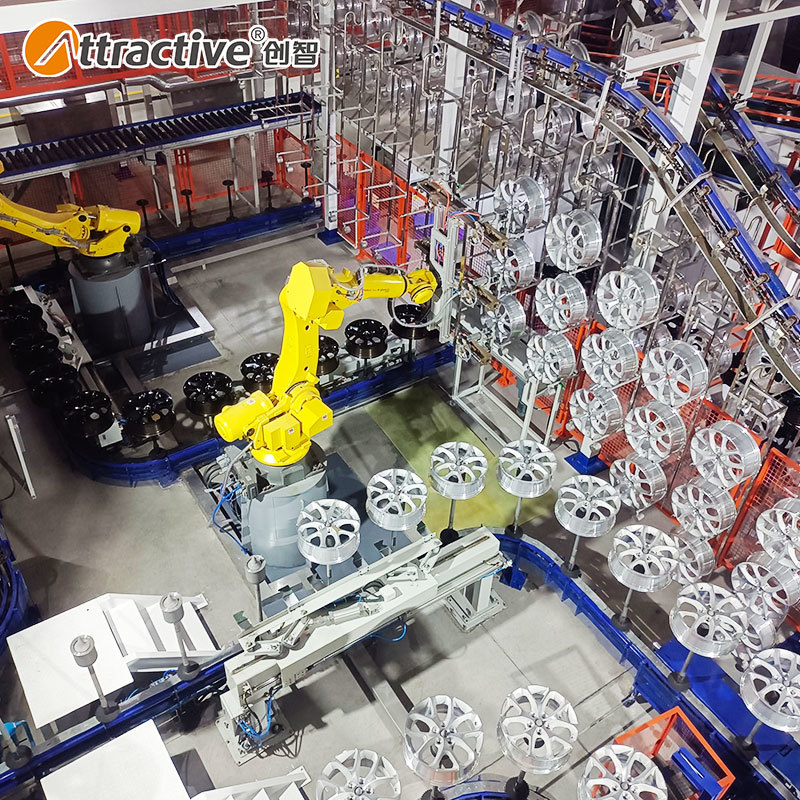
The automotive industry demands the highest standards for coating appearance (such as high Distinctness of Image, DOI) and corrosion resistance (salt spray tests typically requiring ≥1000 hours). This necessitates coating equipment with extremely high control precision (e.g., closed-loop film thickness control, robotic trajectory accuracy of ±0.5mm) and complete data traceability (integration with MES systems). Furthermore, the rapid iteration of new energy vehicle models requires production lines capable of quickly switching between different workpieces (e.g., battery housings, motor housings).
2.2 Cookware and Home Appliances: Process Compatibility and Food Safety Are Key
The non-stick coatings (e.g., PTFE, ceramic) for cookware and the high-decorative coatings for appliance panels impose special requirements for spraying uniformity, precise control of the sintering temperature profile, and food contact safety compliance. A general-purpose coating line designed for metal structural parts is often unable to meet the stringent requirements for temperature zoning and ramp rates in cookware sintering ovens, leading to coating detachment or short service life.
2.3 Metal Furniture: Flexibility and Cost Control Are at the Core
The metal furniture industry generally faces the challenge of high-mix, low-volume production and frequent color changes. Therefore, the rapid color (powder) change capability (target <3 minutes) and high transfer efficiency (paint utilization >80%) of the coating line are crucial. Blindly adopting an automotive-grade high-precision robotic system can, conversely, lead to poor return on investment.
2.4 Wood Products: Substrate Characteristics Dictate the Process Path
Wood is a poor conductor of heat and contains moisture, making it susceptible to deformation or cracking under high-temperature baking. Therefore, wood coating must employ low-temperature curing technologies (such as waterborne paints or UV curing), requiring precise control of temperature and humidity during drying. Using a high-temperature oven designed for metal workpieces to cure wood coatings is a recipe for disaster.
2.5 General Industrial Equipment: Adaptability Is the Primary Consideration
Workpieces such as large agricultural machinery and electrical cabinets are typically bulky, irregularly shaped, and heavy, with high coating thickness requirements (≥80μm). The coating line must feature high-capacity conveying systems, high-load-bearing fixtures, and equipment with high protection ratings to withstand harsh environments. Overly sophisticated automation systems can prove fragile and costly to maintain in such scenarios.
3. A Critical Decision: Professional Customization Is More Economical Than a "Universal" Solution
Many enterprises worry that customization will significantly increase costs. However, based on our project experience, moderate customization on a mature technology platform typically incurs an initial investment only 10%-20% higher than a standard "universal" line. This incremental investment, however, can yield a 15%-25% improvement in paint transfer efficiency, increase yield rates to over 95%, and reduce changeover time by 60%-70%. The payback period is generally stable at 2-3 years.
Conversely, choosing a "universal" line that is not fully matched often leads to a spiral of frequent modifications within 1-2 years of commissioning. The cumulative costs (production losses + modification expenses + quality costs) typically exceed 50% of the initial equipment purchase price.
Frequently Asked Questions (FAQ)
Q: If my factory produces multiple types of products, should I choose a universal line or a customized one?
A: The key is product family planning. Group products with similar materials, dimensions, and coating requirements. Customize the line based on the core needs of this "dominant product," while reserving flexible interfaces for other products (e.g., changeable spray applicators, adjustable conveyor speeds). This is the most common path to success.
Q: How can I determine if a supplier has cross-industry customization capabilities?
A: Evaluate three aspects. First, patented technologies—do they hold patents for specific industries (e.g., cookware sintering furnace patents, low-temperature curing technology for wood)? Second, industry case studies—do they have more than 3 successful cases in your specific industry? Third, process databases—has the supplier accumulated mature process parameter packages for different industries? This requires substantial cross-industry experience.
Q: Will a customized coating line affect future equipment resale value?
A: Highly customized equipment may indeed have a narrower resale market. However, a coating line is a production asset with a 15-20 year service life, whose value lies in generating stable profits for you over the long term, not in resale. Investment decisions should be based on internal rate of return calculations, not second-hand residual value.
Conclusion: From "Selecting Equipment" to "Selecting a Solution"
Choosing a coating line is essentially choosing a production solution that can match the specific process code of your products. Understanding the core differences in requirements across automotive parts, cookware, metal furniture, wood products, and general industrial equipment—and avoiding the trap of applying a "universal" mindset to "dedicated" needs—is a crucial prerequisite for ensuring a sound return on investment.
Guangdong Chuangzhi Intelligent Equipment Co., Ltd. (Attractivechina) , as a national "Little Giant" enterprise with cross-industry service capabilities, distinguishes itself by not having a ready-made machine in search of a customer. Instead, we first conduct an in-depth study of your product's process requirements, then match or design the most suitable equipment. To date, the company has accumulated over 200 patents and has established the Guangdong Provincial Engineering Technology Research Center for Automatic Coating Complete Equipment, serving members of over 20 industry associations.
If you are still deliberating over which equipment to choose, we suggest taking a step back and rethinking the question from the perspective of "what process does my product require?" We welcome the opportunity to discuss your needs and provide process-matching recommendations based on your products.


Contact Us
No.2 Yingbin Avenue, High-tech District, Zhaoqing City, Guangdong Province, China.
Online Message