















13
2026-08
Attractivechina Customizes a Guitar Omega Painting Line for a Musical Instrument Manufacturer in Zhaoqing
Author:
Chuangzhi Coating
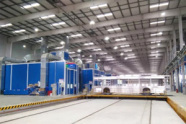
In September 2025, the wood guitar painting line project for a well-known musical instrument manufacturer in Zhaoqing, Guangdong, was successfully delivered and put into mass production. The line was custom‑designed by Guangdong Chuangzhi Intelligent Equipment Co., Ltd. (brand name: Attractivechina) specifically for automated wood guitar coating. The successful implementation of this project provides a replicable model for the transformation of musical instrument coating from traditional manual operations to intelligent manufacturing.

The "Temper" of Wood and the Challenge of Coating
Coating a wood guitar has never been a simple task.
Unlike metal parts, wood is a material that "breathes". Changes in ambient temperature and humidity directly affect the moisture content of the wood, and fluctuations in moisture content in turn affect coating adhesion and the final appearance. A guitar body is assembled from multiple pieces of wood – the soundboard, back, and sides – each with different grain patterns, densities, and absorbency. The soundboard is typically made of lightweight woods such as spruce, while the back and sides often use hardwoods like rosewood. These material differences mean that the same coating can behave quite differently on different parts of the instrument.
Even more challenging is the guitar's shape. The body has complex curves, the soundhole is deeply recessed, and there is a pronounced step where the neck meets the body. These structural features place extremely high demands on spray uniformity and coverage completeness. Traditional manual painting relies on the operator's personal experience – gun speed, spray distance, and paint output are all judged by feel, making quality fluctuations unavoidable. Moreover, wood guitar finishing typically requires multiple processes: sealer, colour toning, PE primer, UV topcoat, and more. A deviation in any single process can ruin the entire instrument.
The client had long relied on manual painting, struggling with unstable yield rates, high rework rates, and production bottlenecks. With order volumes steadily increasing, an upgrade to automation became imperative.
From "Relying on Feel" to "Controlling Parameters"
After taking on the project, Attractivechina did not simply apply a generic wood coating line solution. Instead, it carried out a targeted design based on the material properties and structural characteristics of wood guitars.
Pre‑treatment of moisture content. Before wood enters the painting line, uniform moisture content is the first critical factor determining coating adhesion. The line incorporates a dedicated temperature‑humidity conditioning zone at the loading station, which precisely controls the ambient conditions to stabilise the moisture content of guitar components within the required process range. This upfront treatment, while seemingly straightforward, is the prerequisite for stable performance in all subsequent coating processes.
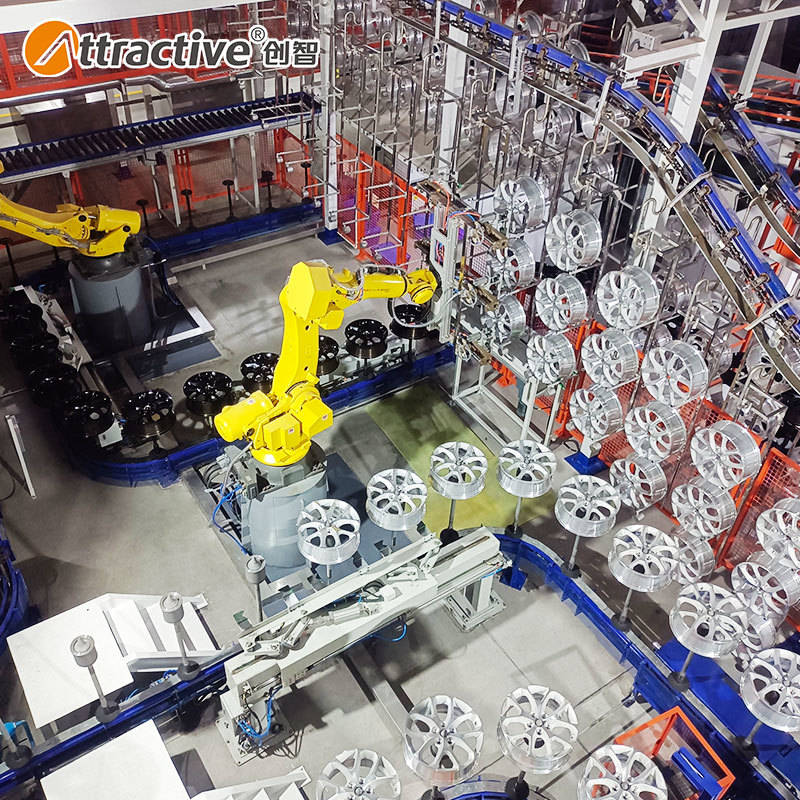
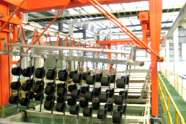
Conveying and positioning system. The line uses an overhead circulating conveyor chain, with guitar components suspended on specially designed hangers. The hangers ensure stability during transport and facilitate complete spray coverage from multiple angles. The chain speed is infinitely adjustable, allowing flexible adaptation to production rhythm.
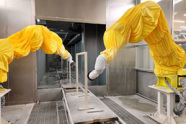
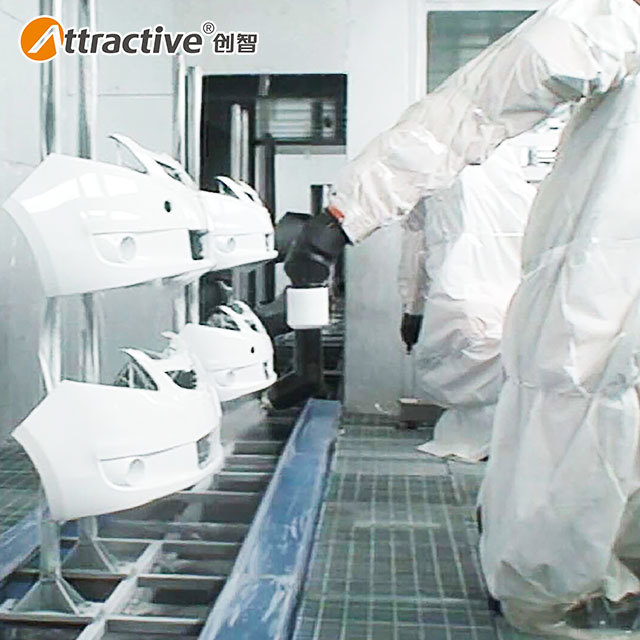
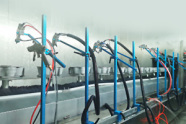
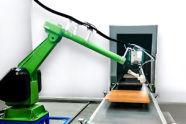
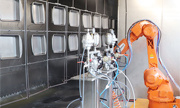
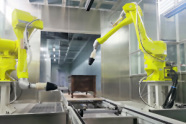
Omega coating system. The painting section adopts Omega painting technology, widely recognised as a highly effective solution for coating irregularly shaped wood parts. The defining feature of the Omega spray booth is its circular gun arrangement – multiple automatic spray guns are positioned in a ring around the workpiece. As the guitar component rotates through the booth at a controlled speed, the guns spray simultaneously from multiple directions, achieving complete coverage of complex curved surfaces in a single pass. For the guitar body, areas that are traditionally difficult to reach – such as the inner wall of the soundhole, the base of the bridge, and the curved sides – all receive uniform coating in the Omega booth. Multiple spray guns work in coordination, with independent preset parameters for different sections (soundboard, back, sides, neck, etc.) based on the curvature and absorbency of each area. This differentiated control effectively eliminates shadow zones and ensures consistent coating thickness on every guitar.
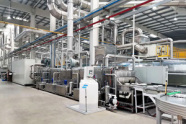
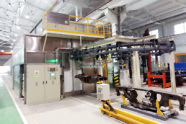
Levelling and UV curing. After painting, the workpieces enter a levelling zone where the coating flows out naturally under gravity, eliminating spray marks. They then pass through a far‑infrared pre‑drying oven, and finally through a UV curing oven for rapid cross‑linking and setting of the film. UV curing is the key to dramatically improving guitar coating efficiency – whereas traditional hot‑air baking takes hours, UV curing is completed in just tens of seconds. The complete process flow is: loading → moisture conditioning → dust removal → Omega painting (multiple coats) → levelling → pre‑drying → UV curing → unloading.
Results and Value
The line was delivered on schedule and passed customer acceptance in September 2025. After commissioning, the first‑pass yield of guitar coating increased from less than 80% with manual painting to over 95%, with coating thickness deviation controlled within ±0.05 mm. The adoption of UV curing reduced the coating cycle per guitar from several days to minutes. Paint utilisation was significantly improved, VOCs emissions were greatly reduced, and the working environment was fundamentally improved. The client gave high praise to the line's operational stability, quality consistency, and environmental performance.
For Attractivechina, this line validates the company's system integration capability in wood instrument coating – not merely providing painting equipment, but systematically designing the entire line – from humidity‑temperature control, conveying method, painting process, to curing path – based on the intrinsic characteristics of wood. This perhaps best illustrates the essential difference between an equipment manufacturer and a mere equipment trader.


Contact Us
No.2 Yingbin Avenue, High-tech District, Zhaoqing City, Guangdong Province, China.
Online Message