












21
2026-08
The Process Threshold of Ceramic Coating – Attractivechina Customizes an Air Fryer Plate and Rice Cooker Inner Pot Coating Line for a Thai Kitchen Appliance Manufacturer
Author:
Chuangzhi Coating
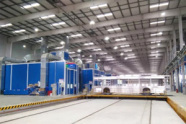
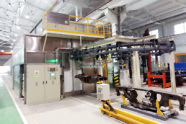
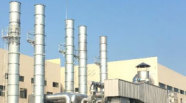
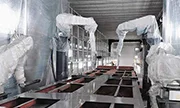
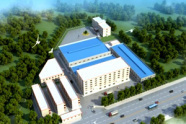
In June 2025, the ceramic coating line project for air fryer plates and rice cooker inner pots for a well-known kitchen appliance manufacturer in Thailand was successfully delivered and put into mass production. The line was integrally planned and integrated by Guangdong Chuangzhi Intelligent Equipment Co., Ltd. (brand name: Attractivechina), specifically designed for automated ceramic non-stick coating of these two core cooking components. The successful implementation of this project provides a replicable technical pathway for the large-scale production of ceramic coatings in small appliances.

Ceramic Coatings: Excellent Performance, Demanding Process
Ceramic coatings have been increasingly used in kitchen appliances such as air fryers and rice cookers in recent years, owing to their superior non-stick properties, high temperature resistance, and wear resistance. However, the application of ceramic coatings is far more challenging than traditional Teflon-type non-stick coatings.
The primary challenge lies in the trade-off between hardness and brittleness. While ceramic coatings become hard and wear-resistant after curing, they are extremely sensitive to the cleanliness of the pretreatment and film thickness uniformity during the coating stage. Even a slight deviation in film thickness can result in micro-cracks or poor adhesion after curing. Secondly, the curing window is narrow. Ceramic coatings require relatively high curing temperatures and a precise heating curve—too low a temperature results in incomplete cross-linking, while too high a temperature can cause discoloration or brittleness. Third, the two workpieces differ significantly in shape. The air fryer plate is a flat, perforated sheet with a large area but thin thickness; the rice cooker inner pot is a deep-drawn rotational body with a wide mouth and narrow bottom, requiring coating on the inner wall. Coating both types on the same line imposes high demands on the conveying method and spraying process for compatibility.
The client previously had a semi-automatic coating line at its Thai factory, but it suffered from insufficient capacity and unstable yield, failing to meet the order demands of brand customers.
How the Line Handles Both Plates and Inner Pots Simultaneously
Rather than building separate lines for the two workpieces, Attractivechina designed a single line that accommodates both through hanger changes and program switching—a decision that directly reduced the client's equipment investment and floor space usage.
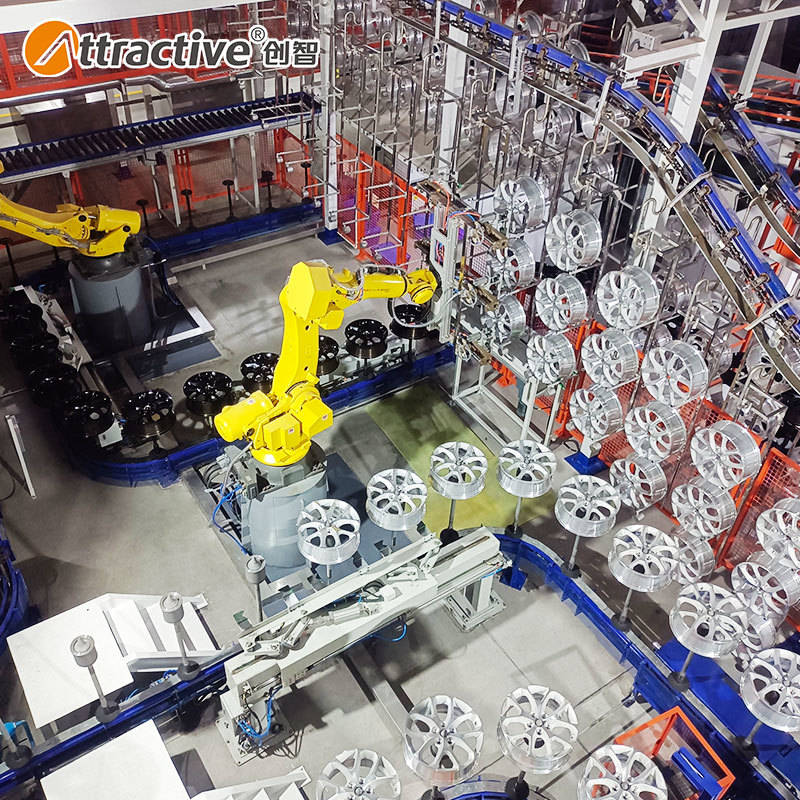
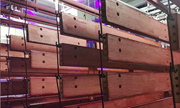
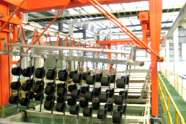
Hanger design and conveying solution. The plates and inner pots share the same overhead conveyor chain, but the hangers are plug-in interchangeable. When producing plates, flat-type hangers are mounted to hold the workpieces horizontally in multiple layers; when switching to inner pots, pot-specific hangers are installed to suspend the pots at an angle with the opening facing outward. The pitch between hangers on the chain is consistent for both types, ensuring the same spacing and dwell time when passing through the spray booth, eliminating the need to adjust the chain speed.
Dust removal and preheating. Before entering the spray booth, both workpieces pass through ionized air dust removal to eliminate particles adhering to the surface via static electricity. They then move into a preheating zone, where they are heated to the temperature required for ceramic coating application. The purpose of preheating is that when the coating is sprayed onto the warm substrate, solvent evaporation accelerates, contributing to the establishment of initial adhesion.
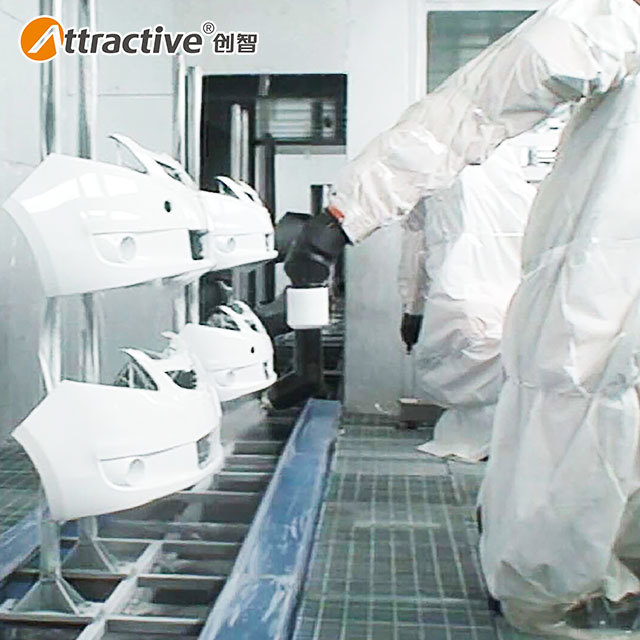
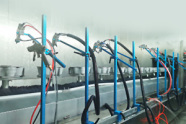
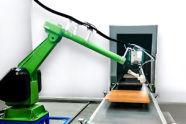
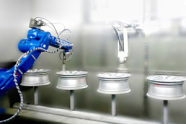
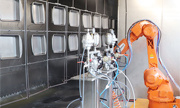
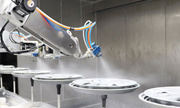
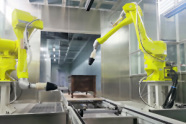
Differentiation and unification of spraying processes. The line is equipped with multiple automatic spray guns, with different spraying programs called up depending on the workpiece type. For plates, the guns follow a transverse reciprocating path, covering the entire flat surface row by row. Since the plate surface has dense perforations, the system uses zoned control to avoid the hole areas, preventing paint from blocking the ventilation holes. For inner pots, the guns are angled to reach inside the pot body, and with the workpiece rotating, the guns cover the inner wall spirally from bottom to top. Both sets of programs are stored independently, and switching between them is done simply by selecting the corresponding workpiece type on the touchscreen.
Leveling and curing. After spraying, the workpieces enter a leveling section. Leveling time, temperature, and humidity are set according to the specific characteristics of the ceramic coating. The curing oven features a multi-zone design with independent temperature control for the heating, holding, and cooling sections. Because the plate has a large area and low thermal mass, its heating rate must be relatively gentle to avoid thermal stress that could cause warping; the inner pot, with its thicker walls and greater thermal mass, allows a slightly faster heating rate. Both curing profiles are saved separately and switch automatically in conjunction with the spraying program selection.
Operational Results and Client Feedback
After commissioning, the first-pass yield for the ceramic coating on plates reached over 93%, and over 95% for inner pots. The line's cycle time meets the client's capacity requirements, and the changeover time between products is within 30 minutes—from switching from plates to inner pots, only three steps are needed: changing the hangers, loading the corresponding program, and waiting for the spray booth temperature to stabilize.
In the acceptance report, the client noted that the stable operation of the ceramic coating line has for the first time enabled the Thai factory to supply brand customers in volume, reducing delivery lead times from "weeks" to "days." Attractivechina's value in this project extends beyond providing a set of coating equipment—it lies in finding a technical path that allows two dramatically different workpieces, plates and inner pots, to be produced on the same line.


Contact Us
No.2 Yingbin Avenue, High-tech District, Zhaoqing City, Guangdong Province, China.
Online Message