












Related News

21
2025
-
05
Key surface pretreatment steps before painting of bumper plastic parts
Author:
Chuangzhi Coating
In the automotive manufacturing industry, bumpers, as an important part of the vehicle, not only have the function of protecting the vehicle structure, but also bear the role of beautifying the appearance of the vehicle body. With the development of materials science, plastics have gradually become the mainstream material for bumper manufacturing due to their light weight, corrosion resistance, and easy processing.
However, the surface painting of plastic bumpers faces many challenges, especially in terms of adhesion and durability. Therefore, it is particularly important to carry out a series of fine surface pretreatments before painting. This article will introduce in detail the surface pretreatment steps that must be carried out before painting of bumper plastic parts.
1. Cleaning and degreasing
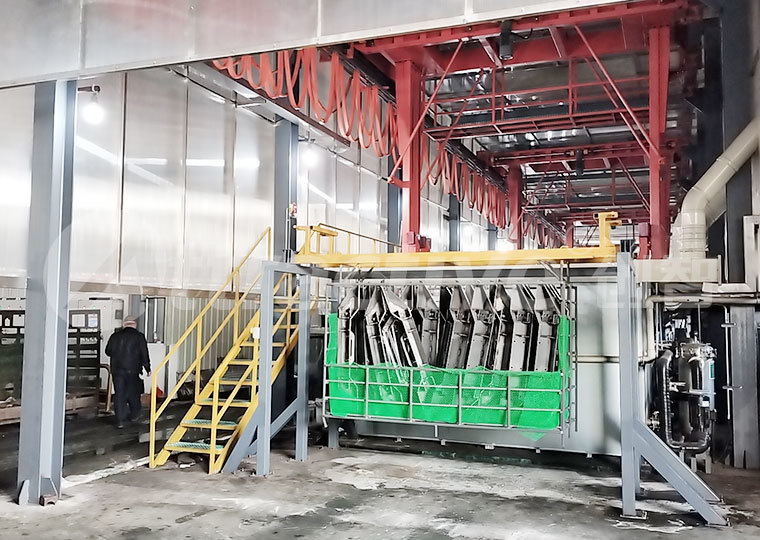
During the manufacturing and transportation process of plastic bumpers, impurities such as oil, dust, and mold release agents are often attached to the surface. These impurities will seriously affect the adhesion of the coating, causing problems such as paint peeling and bubbling. Therefore, the first step before painting is to thoroughly clean and degrease.
The cleaning process usually includes two methods: solvent cleaning and mechanical cleaning. Solvent cleaning is to wipe the surface of the bumper with a specific solvent to dissolve and remove oil stains. It should be noted that the selected solvent should not corrode the plastic and should evaporate quickly. Mechanical cleaning is to remove stubborn stains and impurities on the surface by sandpaper polishing or high-pressure water gun washing.
2. Stress relief
During the molding process of plastic products, internal stress will be generated due to uneven cooling and uneven arrangement of molecular chains. These stresses may cause cracking or fine lines in the coating during the painting process, affecting the quality of the coating. Therefore, stress relief must be performed before painting.
There are two main methods of stress relief: annealing and solvent stress reduction. Annealing is to heat the bumper to a certain temperature and keep it warm for a period of time to rearrange the plastic molecular chains, thereby eliminating internal stress. Solvent stress reduction is to release local stress on the plastic surface by spraying appropriate solvents to achieve the purpose of uniform stress.
3. Surface modification
Due to the low polarity and high crystallinity of plastics, the bonding force with the coating is often weak. In order to improve the adhesion of the coating, the plastic surface needs to be modified.
There are many methods for surface modification, including mechanical treatment, solvent erosion, chemical oxidation treatment, flame treatment, low-temperature plasma treatment, ultraviolet irradiation, corona treatment, etc. Among them, flame treatment and corona treatment are more commonly used methods. Flame treatment uses high-temperature gas flame to oxidize the plastic surface, increase the surface roughness and polarity, and thus improve adhesion. Corona treatment uses a high-frequency and high-voltage electric field to produce micro-discharge on the plastic surface to form an oxide layer, which can also improve adhesion.
4. Anti-static treatment
Plastic products are prone to accumulate static electricity during processing and transportation, causing dust and impurities to be adsorbed on the surface. These impurities adsorbed by static electricity will form defects during the coating process and affect the quality of the coating. Therefore, anti-static treatment must be performed before coating.
The main methods for removing static electricity include compressed air ionization, applying anti-static liquid, and adding anti-static agents to plastics. Compressed air ionization is to ionize the air through a spark discharge device and then blow it to the plastic surface, thereby neutralizing static electricity and taking away dust. Anti-static liquid coating is to apply a layer of anti-static liquid on the plastic surface to form a conductive layer to prevent static electricity accumulation. Adding antistatic agent to plastic means adding specific additives during the plastic manufacturing process to make the finished product have antistatic properties.
5. Inspection and repair
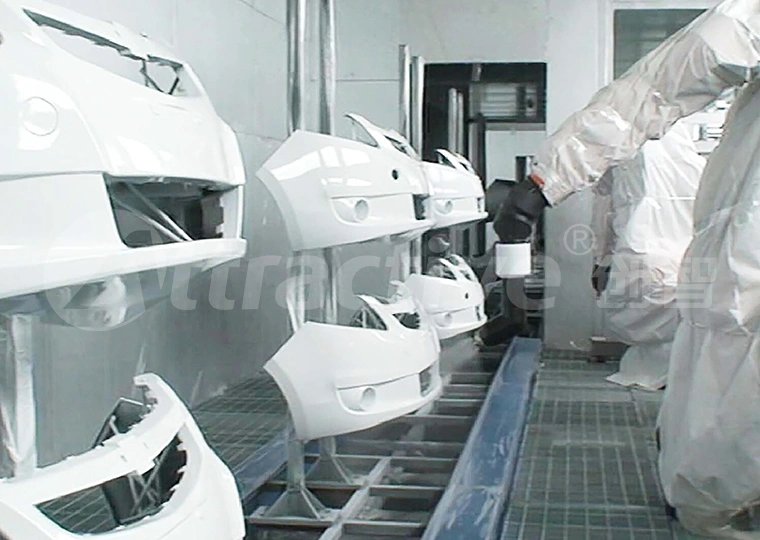
After completing the above pretreatment steps, the bumper needs to be fully inspected to ensure that there are no defects such as oil, dust, cracks, etc. on the surface. For existing defects, such as cracks and dents, repair treatment is required. Repair methods include plastic welding, bonding, filling putty, etc. After the repair is completed, the repaired part needs to be polished and trimmed to ensure that the surface is flat and smooth.
In summary, the surface pretreatment of bumper plastic parts before painting is a complex and delicate process involving cleaning and degreasing, stress relief, surface modification, destaticization, inspection and repair. Only after strict pretreatment can good adhesion and durability between the coating and the plastic bumper be ensured, thereby improving the overall quality and aesthetics of the car.


Contact Us
No.2 Yingbin Avenue, High-tech District, Zhaoqing City, Guangdong Province, China.
Online Message