














Related News

29
2025
-
05
Intelligent Coating Systems: Leading a New Revolution in the Spraying Industry
Author:
Chuangzhi Coating
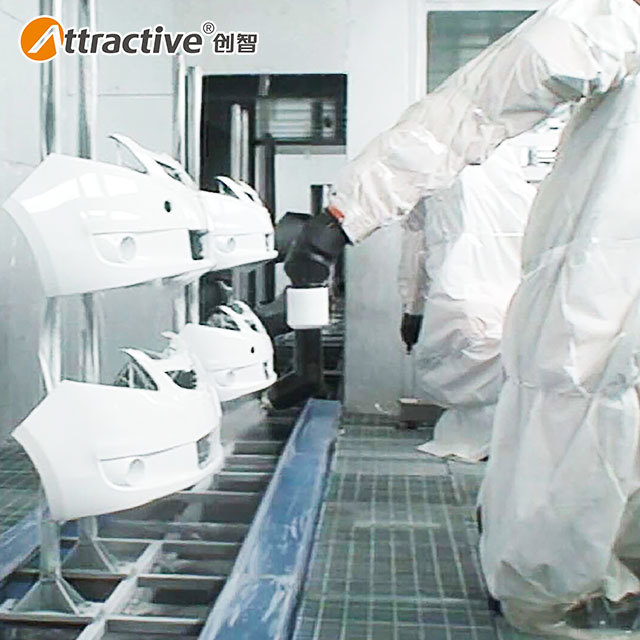
In manufacturing sectors such as automotive parts, cookware, home appliances, hardware, wood furniture & musical instruments, and industrial equipment, spraying serves as a core surface treatment process directly impacting product appearance and performance. Traditional manual spraying faces pain points like low efficiency (daily output under 500 pieces), unstable quality (yield rate only 80%), and high environmental pressure (VOC emissions exceeding standards by 30%). Intelligent coating Systems, integrating AI, machine vision, and automation technologies, are reshaping the industry's production paradigm.
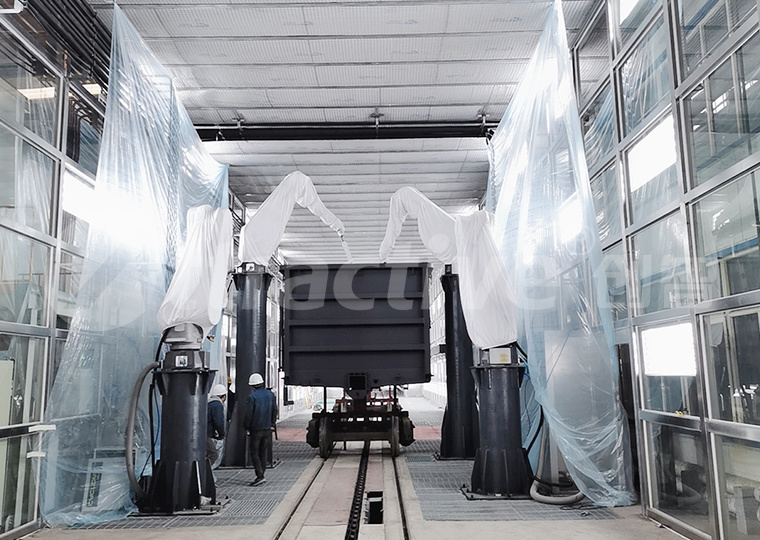
Technical Architecture: Building an Intelligent Spraying Ecosystem
The system uses a sensor matrix (pressure, flow, distance sensors) to collect over 30 spraying parameters in real time. Data is transmitted via 5G IoT to an edge computing platform, where AI algorithms complete path planning and parameter optimization within 0.1 seconds. Key modules include:
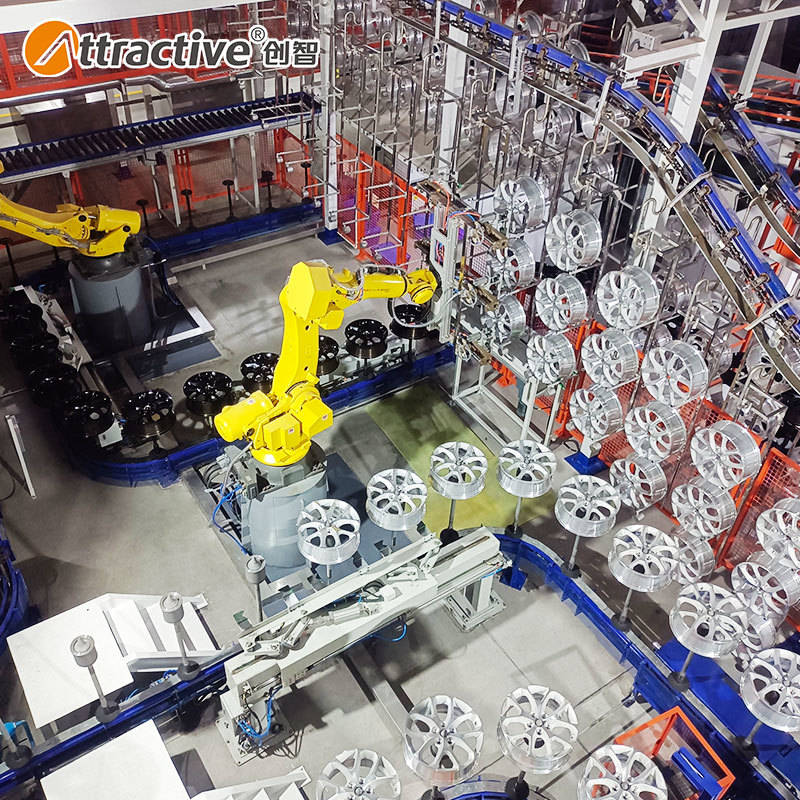
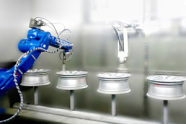
- Machine Vision System: A 12K resolution linear array camera identifies 0.1mm-level workpiece defects, generating Blind Spot-free spraying trajectories for automotive wheel hub curves;
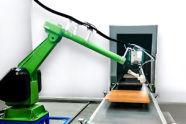
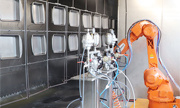
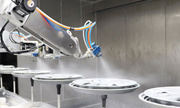
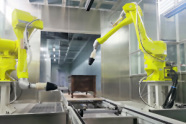
- Six-Axis Robot: With ±0.2mm positioning accuracy and adaptive spray guns, it achieves dynamic adjustment of 5-50μm atomized particles, ensuring coating uniformity error <1%.
Four Core Advantages Reconstructing Industrial Value
1. Efficiency Breakthrough: 24/7 Flexible Production
Spraying robots operate at 600mm/s—3 times faster than manual labor—supporting 24/7 continuous production. Hardware spraying efficiency increases by 70%, and color switching for home appliance casings is shortened to 10 seconds, boosting monthly output for small and medium enterprises from 20,000 to 50,000 pieces.
2. Quality Leap: Micron-Level Precision Control
AI algorithms optimize spraying angles (±0.5°) and paint output (±1%) in real time, achieving ±5μm coating thickness control precision. Piano lacquer yield rate rises from 85% to 99.2%, and automotive chassis parts pass 1,500-hour salt spray tests without rusting, far exceeding industry standards.
3. Cost Optimization: Comprehensive Resource Savings
- Labor Costs: Reduce 80% of operational posts, saving mid-sized home appliance lines $2 million annually;
- Material Costs: Paint utilization increases from 60% to 92%, saving $350,000 yearly for industrial equipment spraying;
- Energy Costs: Smart energy-saving mode reduces equipment power consumption by 30%, with waste paint mist recycling cutting overall energy use by 40%.
4. Green Transformation: New Benchmark for Environmental Technology
Electrostatic cup spraying (95% paint utilization) combined with water-based coatings reduces VOC emissions by 85% compared to traditional processes, complying with EU REACH and China GB 38508 standards. A smart filtration system recycles 98% of waste paint residue, aiding ISO 14001 certification.

Precise Empowerment Across Six Manufacturing Sectors
1. Automotive Parts
- Engine blocks undergo automated wear-resistant coating with ±2% thickness error, resisting 150℃ high temperatures;
- Chassis suspension parts receive Blind Spot-free spraying in recessed areas, passing 1,500-hour salt spray tests.
2. Cookware Manufacturing
- Non-stick pans get nano-ceramic coatings with <0.3% uniformity error and Class 0 adhesion (GB/T 9286);
- Stainless steel tableware protection coatings triple corrosion resistance while increasing production efficiency by 60%.
3. Home Appliances
- Refrigerator casings achieve 0.1mm ultra-thin metallic paint spraying, switching multi-color gradients in 30 seconds with gloss deviation <1.5GU;
- Washing machine inner drums receive antibacterial coatings covering corner areas, achieving 99.9% bacterial inhibition rate.
4. Hardware Products
- Bathroom fittings get chrome-plated coatings (8-12μm thickness, surface roughness Ra≤0.2μm) for mirror finishes;
- Door lock components complete six-sided anti-oxidation treatment in one setup, increasing production efficiency 5x.
5. Wood Furniture & Musical Instruments
- Solid wood carvings receive 0.5mm line-precise spraying, improving paint utilization by 40%;
- Guitar panels undergo contour-adaptive spraying with <5μm surface flatness error, reducing sound quality loss by 20%.
6. Industrial Equipment
- Construction machinery casings form 300μm wear-resistant coatings in one pass, increasing efficiency 3x;
- Pipeline inner walls are sprayed by crawling robots, reducing missing spots from 15% to 0.5%.
Future Outlook: From Automation to Intelligence
With deep integration of 5G+AI, the system will achieve:
- Self-Learning Optimization: Industrial big data drives hourly AI model iterations, boosting first-pass yield for complex workpieces to 95%;
- End-to-End Digitalization: Integration with MES systems enables full-process control from order to quality inspection, achieving 85% OEE;
- Low-Carbon Innovation: Technologies like supercritical CO₂ spraying (98% paint utilization) and powder electrostatic spraying (zero VOC emissions) will cut industry energy consumption by 50%.
Conclusion
Intelligent coating Systems break through traditional spraying bottlenecks in efficiency, quality, and environmental protection, rapidly penetrating from high-end manufacturing to SMEs. In the Industry 4.0 era, their "data-driven" production model is reshaping the spraying industry landscape, providing core equipment support for the global manufacturing sector's green and intelligent transformation.


Contact Us
No.2 Yingbin Avenue, High-tech District, Zhaoqing City, Guangdong Province, China.
Online Message