













Related News

04
2026
-
02
Industrial Spray Painting Line: The Core Engine for High-Quality Surface Treatment in Modern Manufacturing
Author:
Chuangzhi Coating
In the modern industrial manufacturing system, the quality of surface coating is a key metric for measuring a product's comprehensive performance and brand value. Whether it's a speeding automobile, colossal construction machinery, or precision rail transit equipment, their durability, aesthetics, and market competitiveness are inseparable from a robust and fine coating. The Industrial Spray Painting Line, as the core industrialized and scaled equipment to achieve this goal, has evolved from a traditional application tool into a complex systems engineering project integrating precision machinery, materials science, automatic control, and environmental technology. It not only determines coating efficiency and cost but is also directly linked to the final quality and lifespan of the product.

Industrial Spray Painting: A Complex Systems Engineering Beyond "Spraying Paint"
Spray painting in the industrial sector is far more than a simple "spraying" operation. It is a complete technological chain encompassing pre-treatment, coating application, curing/drying, exhaust treatment, and logistics control, designed to provide long-term protection and decoration for substrates like metals and composites. The core mission of an advanced Industrial Spray Painting Line is to form a high-quality coating that is uniform in thickness, stable in performance, and consistent in appearance on complex and varied industrial components, in a highly repeatable and controllable manner. This is to meet the challenges of extreme working conditions such as outdoor exposure, chemical corrosion, and mechanical wear.
Core Component Modules of an Industrial Spray Painting Line
A typical, high-performance Industrial Spray Painting Line is usually composed of the following closely coordinated modules:
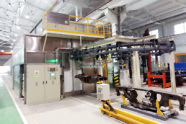
Intelligent Pre-treatment System: This is the foundation for all quality coatings. The system transports workpieces sequentially through multiple stages via an automated conveyor chain (e.g., overhead conveyor, roller bed), including pre-degreasing, main degreasing, rinsing, surface conversion (e.g., phosphating, silanization), deionized water rinsing, and drying. Its goal is to thoroughly remove oils, rust, and mill scale from the workpiece surface and form a uniform chemical conversion film with micro-porosity. This significantly enhances coating adhesion and corrosion resistance, serving as the "invisible defense line" ensuring coating longevity. This process is particularly crucial for large workpieces like heavy equipment.
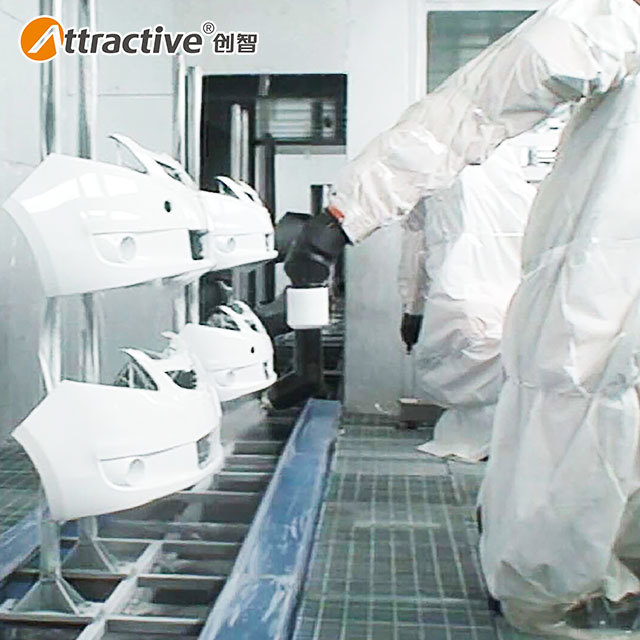
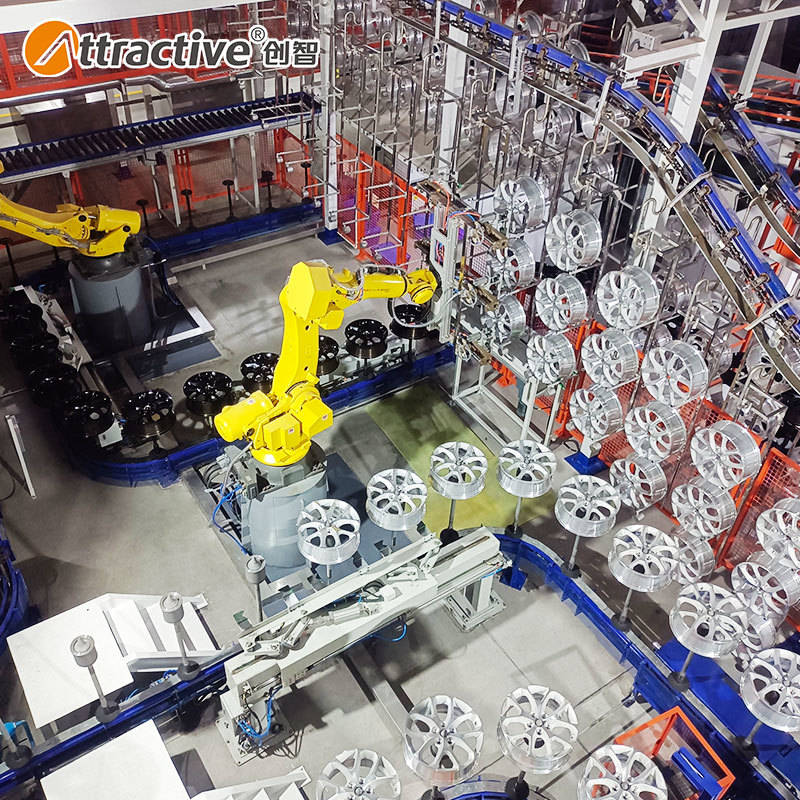
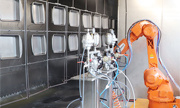
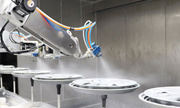
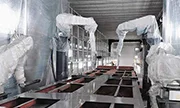
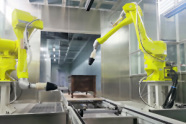
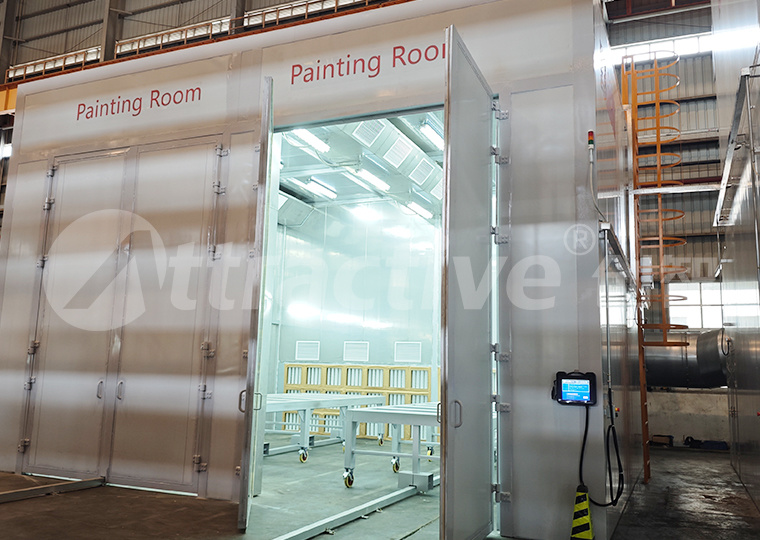
High-Efficiency Automated Spraying System: This is the "heart" of the production line. Modern industrial lines commonly employ automated coating solutions, with robot spraying stations or high-precision reciprocating automatic spray guns at their core. They operate precisely within enclosed spray booths according to pre-set programs. Electrostatic spray technology is mainstream, where charged paint particles are efficiently attracted to the grounded workpiece, significantly improving material utilization (can exceed 80%) and ensuring uniform coverage on complex curves and edges. The system integrates temperature- and humidity-controlled air supply, overspray treatment (Venturi or dry filtration), and paint circulation supply units to ensure a stable and clean process environment.
Precision Curing and Drying System: Here, the coating acquires its final physico-chemical properties. The production line is equipped with multi-zone temperature-controlled drying tunnels or ovens, utilizing heat sources like gas, electricity, or steam to evaporate solvents and cross-link resins in the coating via hot air circulation or radiation. Precise heating curves, uniform temperature fields (often controlled within ±5°C), and sufficient dwell time are critical to ensure the coating achieves its designed hardness, gloss, and durability requirements. Integrating waste heat recovery systems has become standard for high-efficiency spray systems, greatly reducing energy consumption.
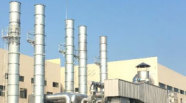
Environmental Treatment and Central Control System: This ensures the line's green and intelligent operation. The Environmental Treatment System (e.g., RTO regenerative thermal oxidizer, exhaust scrubbers, wastewater treatment stations) handles VOCs, overspray, and wastewater generated during spraying and curing, ensuring emissions comply with the strictest environmental regulations. The Central Control System (based on PLC and SCADA) acts as the brain, coordinating and monitoring all line equipment, collecting real-time process parameters (temperature, pressure, flow rate, etc.) and production data. It enables fault warning, quality traceability, and energy efficiency management, serving as the command center for stable and efficient line operation.
Core Strategic Value of Deploying an Industrial Spray Painting Line
Investing in an advanced Industrial Spray Painting Line can provide manufacturing enterprises with multi-dimensional competitive advantages:
Exceptional and Stable Coating Quality: Automation eliminates the variability of manual operation, ensuring consistent film thickness, color difference, and gloss from the first to the ten-thousandth workpiece, meeting the most stringent industry standards (e.g., automotive OEM standards).
Leap in Production Efficiency and Capacity: Continuous flow line operation enables stable 7x24 production with precise cycle times, greatly shortening product manufacturing lead times and enhancing market responsiveness and delivery capability.
Significant Cost Reduction, Efficiency Gains, and Sustainability: High material utilization directly reduces paint costs; automation reduces reliance on highly skilled painters; integrated environmental systems ensure compliance, avoiding penalty risks; energy-efficient designs lower carbon emissions.
Empowers Flexible Manufacturing and Process Upgrades: The production line can adapt to multi-variety, small-batch production needs through program changes. Simultaneously, it provides a reliable hardware platform for introducing environmentally friendly new materials like water-based or high-solid paints, or implementing more complex coating process optimization.
Path to Success: Key Considerations for Implementing an Industrial Spray Painting Line
Introducing an Industrial Spray Painting Line is a major investment. Successful implementation requires careful planning:
In-depth Process Requirement Analysis: Clearly define the substrate, dimensions, capacity targets, coating specifications (e.g., corrosion resistance level, appearance requirements) for the main products, and future product plans.
Choosing a Comprehensive Solution Provider: The ideal partner should possess turnkey engineering capabilities encompassing process design, non-standard equipment manufacturing, system integration, installation/commissioning, and training services, rather than being just a single-equipment supplier.
Emphasize Scalability and Intelligence: Consider the possibility of future capacity expansion and technological upgrades during the initial planning phase. Choose an open, modular system architecture. Treat data collection and analysis capabilities as a core requirement to lay the foundation for future smart manufacturing.
Total Cost of Ownership Assessment: Comprehensively evaluate equipment investment, operational energy consumption, maintenance costs, material consumption, and environmental treatment expenses, rather than focusing solely on the initial purchase price.
Conclusion
The Industrial Spray Painting Line is an indispensable core process equipment in modern industry, especially for equipment manufacturing. It elevates coating, a traditional craft, to the level of precision manufacturing through systematic engineering integration and intelligent process control. In the era of manufacturing transformation toward high quality, green development, and intelligence, a technologically advanced and efficiently operating Industrial Spray Painting Line is not only a "quality guardian" ensuring a product's intrinsic quality and external aesthetics but also a strategic asset for enterprises to enhance operational efficiency, fulfill social responsibility, and build lasting market competitiveness. Investing in advanced spray painting technology is an investment in longer product lifecycles, stronger environmental adaptability, and higher brand added value, thereby laying a solid foundation in the fierce competition of the global manufacturing industry.
Previous


Contact Us
No.2 Yingbin Avenue, High-tech District, Zhaoqing City, Guangdong Province, China.
Online Message