












Related News

30
2026
-
01
How Do Intelligent Robot Coating Lines Tackle the Challenges of Oversized Workpiece Coating?
Author:
Chuangzhi Coating
In the realm of heavy industrial manufacturing, from towering wind turbine towers and sprawling construction machinery to massive mining equipment and cross-sea bridge steel structures, these "national pillars" share common characteristics: enormous size, complex structure, and extreme service environments. Their surface coating is far from simple "painting"; it is a critical corrosion protection engineering task that determines decades of equipment service life, safe operation, and value preservation. Traditional manual spraying or simple automation can no longer meet the stringent demands for coating uniformity, adhesion, and ultimate anti-corrosion performance. At this juncture, the Intelligent Robot Coating Line is becoming the inevitable choice for upgrading the coating process of heavy industrial equipment, leading the field toward intelligence and standardization with its powerful adaptability, precision, and reliability.

Unique Challenges and Core Requirements of Heavy Equipment Coating
Coating heavy equipment presents numerous challenges distinct from consumer goods or automotive manufacturing:
- Oversized and Irregular Workpieces: Components often measure tens of meters, weigh dozens of tons, and feature complex curved surfaces, internal cavities, stiffeners, and dense weld seams, creating numerous spraying blind spots.
- Complex Coating Systems with Extreme Requirements: Typically require multiple coating layers (e.g., zinc-rich primer, epoxy intermediate coat, polyurethane topcoat), with a total dry film thickness potentially exceeding 300 microns. The uniformity and integrity of each layer directly impact the final corrosion protection.
- Environmental and Cost Pressures: In vast spray booths, achieving efficient paint utilization and reducing waste, VOC emissions, and costs from overspray is a significant challenge.
- Difficulty Ensuring Quality Consistency: Manual spraying is labor-intensive, and quality heavily depends on worker skill and condition, easily leading to defects like uneven film thickness, sagging, or missed spots on large workpieces.
The Systematic Solution of Intelligent Robot Coating Lines
To address these challenges, a Heavy-Duty Intelligent Coating Line designed specifically for heavy industry offers a systematic solution:
1. Flexible and High-Reach Robot Systems:
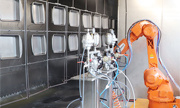
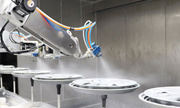
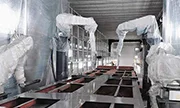
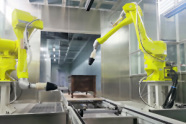
Utilizes industrial robots with high payload capacity and long reach, sometimes mounted on large mobile gantries or rails to cover extensive work envelopes. The robot end-effector is equipped with explosion-proof high-speed electrostatic bells or air spray guns. Controlled by sophisticated algorithms, they can reach deep inside equipment and navigate complex structures, ensuring no-blind-spot spraying. This Industrial Robot Spraying System completely solves the problem of difficult and unstable access for manual labor.
2. 3D Vision Perception and Adaptive Path Planning:
This is the core of intelligence. Through laser scanning or 3D vision systems, the production line can automatically identify the 3D contour, weld seam locations, and surface condition of each piece of equipment entering the station. The system automatically generates or optimizes the spraying path, dynamically adjusting the gun's trajectory, angle, speed, and material flow for different features like flat panels, curves, and weld seams. For example, over weld seams, the robot will automatically execute "cross" or "zigzag" patterns to ensure complete coverage and achieve extra thickness requirements.
3. Integrated Process Control and Data Management:
The complete line integrates intelligent paint supply systems, temperature- and humidity-controlled air handling, and efficient exhaust recovery (e.g., RTO). A central control system precisely manages paint temperature, viscosity, and mix ratio, syncing with the robots to keep process parameters optimal. All spraying parameters and quality inspection data (e.g., online film thickness monitoring) are recorded and analyzed, creating a "coating digital passport" for each equipment piece. This enables full lifecycle quality traceability and provides data for continuous process optimization.

Revolutionary Value Enhancement
Deploying an Intelligent Robot Coating Line brings comprehensive and profound benefits to the heavy industry:
- Quality Leap and Ultimate Uniformity: Robot spraying offers repeatable precision up to ±0.1 mm and film thickness control within ±5 microns, providing heavy equipment with a high-quality coating as uniform and dense as an automotive finish, significantly enhancing salt spray and weather resistance.
- Significant Production Efficiency Gains: Enables 24/7 continuous operation, with spraying efficiency 3-5 times higher than skilled workers, drastically reducing the coating cycle for large equipment and accelerating project delivery.
- Notable Cost Reduction and Green Manufacturing: Electrostatic application combined with closed-loop paint recovery systems increases material utilization from 30-50% (manual) to over 80%, directly saving substantial industrial paint costs. Simultaneously, centralized VOC treatment meets the strictest environmental regulations.
- Empowers Flexible Production and Standardization: A single line can quickly switch programs to handle coating for different products like excavators, cranes, and wind turbine towers, enabling flexible, small-batch, high-mix production. It also transforms valuable expert experience into replicable digital process packages, achieving standardized coating quality independent of individual operators.
Key to Successful Implementation: Deeply Customized Solutions
For heavy industry, there is no "one-size-fits-all" solution. Success hinges on obtaining a deeply Customized Coating Solution. This requires the equipment supplier to be not only proficient in robotics and automation but also possess a profound understanding of the process characteristics, coating systems, and industry standards of heavy industrial coating. Everything from workshop layout planning and workpiece handling methods (heavy-duty pallets, transfer cars) to integration with existing production rhythms requires one-on-one professional design. A reliable partner should offer full-service support from process testing and simulation to turnkey project delivery and long-term maintenance.
Conclusion
On the path toward more efficient, reliable, and longer-lasting heavy industrial equipment, surface protection is a vital link. The application of the Intelligent Robot Coating Line marks the iconic leap of transforming this link from a traditional "craftsmanship" to a modern "precision science." It is not merely a tool for improving product appearance and protection level but a strategic investment for heavy equipment manufacturers to reduce lifecycle costs, practice green manufacturing, and build the core competitiveness of a high-end brand. Facing the dual pressures of global market competition and sustainable development, equipping heavy equipment with the "digital armor" applied by intelligent robots has become the consensus and action of leading manufacturers, safeguarding these national pillars on their steady and long journey.
SEO:


Contact Us
No.2 Yingbin Avenue, High-tech District, Zhaoqing City, Guangdong Province, China.
Online Message