











Related News
18
2026
-
06
How long does a coating line last?
Author:
Chuangzhi Coating
"How long does a coating line last?" This is a question every purchasing decision-maker asks. The answer is not a single number—coating line life is determined by three dimensions: physical life, economic life, and technological life. Physical life refers to how many years the equipment can operate under normal maintenance (typically 10-20 years). Economic life refers to the period during which operating costs remain lower than building a new line (typically 8-15 years). Technological lifespan refers to the number of years that equipment will not be rendered obsolete by new technologies (usually 5-10 years). This article systematically analyzes these three dimensions and provides practical strategies for extending coating line service life.

I. Physical Life: How Many Years Can the Equipment Run?
A coating line consists of various equipment types, and different modules have significantly different physical lives:
| Equipment Module | Typical Physical Life | Key Influencing Factors |
|---|---|---|
| Oven/steel structure | 15-25 years | Insulation aging, corrosion |
| Pre-treatment tanks (stainless steel) | 15-20 years | Chemical corrosion, weld cracking |
| Overhead chain/conveyor system | 10-15 years | Chain wear, rail deformation |
| Spray booth (stainless steel/PP) | 12-18 years | Chemical corrosion, powder buildup |
| Burner/heating system | 8-12 years | Thermal fatigue, combustion efficiency decline |
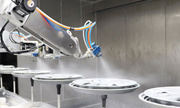
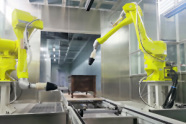
| Spray robot | 8-12 years | Gearbox wear, cable aging |
| Control system (PLC/industrial PC) | 6-10 years | Electronic component aging, spare parts obsolescence |
| Pumps/valves/filters | 3-8 years | Wear, seal aging (require periodic replacement) |
Core conclusion: The overall physical life of a coating line is typically 10-15 years, but this assumes:
- Regular maintenance (lubrication, cleaning, calibration)
- Timely replacement of wear parts (filters, seals, nozzles)
- Environmental control (avoiding high temperature/humidity and corrosive gases)
Many lines over 15 years old are still operating, but maintenance costs have risen significantly and failure frequency has increased. At this point, while physical life has not ended, economic life may have already expired.
II. Economic Life: When Does Replacing Beat Repairing?
Economic life is the point at which the total cost of continuing to operate equipment (maintenance + energy + quality losses + downtime losses) exceeds the average annual cost of building a new coating line.
Signs of economic life expiration:
- Annual maintenance costs exceed 8-10% of initial investment
- Per-unit energy consumption is more than 30% higher than new lines
- Rework/scrap losses from equipment aging continue to rise
- Spare parts are increasingly difficult to source, with longer downtime
Example: An automated coating line in its 12th year had annual maintenance costs of $62,500 (initial investment approx. $486,000, ratio 12.8%), energy consumption 35% higher than industry benchmarks, and annual quality losses of $83,000. Total annual losses were approximately $208,000. In comparison, the average annual depreciation + operating cost of a new line with similar capacity was about $139,000. At this point, economic life had expired, and replacement was more cost-effective than repair.
III. Technological Life: Has New Technology Made You Outdated?
Technological life refers to how long equipment remains viable before being phased out in terms of process, control, and environmental compliance. In 2026, technological life is shortening rapidly.
Signs of technological life expiration:
- Control system cannot connect to MES/SCADA
- Cannot support waterborne coatings or low-temperature curing processes
- VOC emissions cannot meet new environmental standards
- Lacks data collection and remote diagnostic capabilities
- Incompatible with existing smart factory architecture
A physically sound old line may be forced into retirement because it cannot meet new environmental regulations or customer requirements for carbon footprint traceability. This is a classic scenario of technological life expiration.
IV. Common Factors Affecting Coating Line Service Life
4.1 Maintenance Quality
- Excellent maintenance: Regular lubrication, cleaning, calibration, replacement of wear parts → life extended by 30-50%
- Neglected maintenance: Small issues accumulate into major failures → life shortened by over 50%
4.2 Operating Intensity
- 24/7 three-shift continuous operation vs. single-shift operation: mechanical wear is 3 times higher
- Frequent color change/changeover accelerates wear on color change valves, piping, and spray guns
4.3 Environmental Conditions
- High temperature and humidity accelerate electronic component aging
- Corrosive gases (such as phosphating acid mist) accelerate steel structure corrosion
- Dusty workshops accelerate wear on moving parts
4.4 Operational Standardization
- Standardized operation: Equipment operates within design parameters, maximizing life
- Overload operation: Forced speed increase, over-temperature operation → significantly shorter life
V. Practical Strategies to Extend Coating Line Service Life
5.1 Establish a Preventive Maintenance System
- Develop annual, monthly, and daily maintenance plans
- Record operating hours of critical components and replace based on life cycle
- Use vibration analysis, thermal imaging, and other tools for condition monitoring
5.2 Proactive Replacement of Critical Components
Don't wait until failure to repair. Proactively replace according to supplier-recommended schedules:
- Burners (8-10 years)
- Robot gearbox lubricant (based on operating hours)
- Filter cartridges (based on pressure differential or time)
- Seals (based on time intervals)
5.3 Technology Upgrades Instead of Full Line Replacement
For lines with expired technological life but acceptable physical life, local upgrades can extend service life:
- Control system upgrade (PLC + SCADA)
- Add online inspection equipment (film thickness gauges, vision systems)
- Environmental equipment retrofit (RTO, dry spray booths)
- Replace manual stations with robots
This "phased upgrade" strategy typically costs only 20-40% of full line replacement, making it an effective way to extend the economic life of coating line equipment.
5.4 Data-Driven Life Management
Using vibration, temperature, current, and other data collected by intelligent coating systems, build equipment health models to predict remaining life, transforming from "scheduled maintenance" to "predictive maintenance."
VI. Typical Life Reference Table
| Project Type | Physical Life | Economic Life | Technological Life | Practical Recommendation |
|---|---|---|---|---|
| Manual/Semi-auto line | 10-12 years | 6-8 years | 5-7 years | Consider upgrade after 8 years |
| Fully automatic standard line | 12-15 years | 8-10 years | 7-10 years | Consider retrofit assessment after 10 years |
| Smart fully automatic line | 15-20 years | 10-12 years | 10-12 years | Modular upgrades can extend to 15 years |
Conclusion
There is no standard answer to how long a coating line lasts. Physical life depends on maintenance; economic life depends on costs; technological life depends on trends. A well-maintained, timely-upgraded coating line can operate for over 15 years. A line with neglected maintenance and refused upgrades may become a liability within 8 years. The key is not "how long can it last" but "how to keep it delivering optimal value at every stage."
If you want to build a new long-life, upgradeable coating line, Attractivechina is worth your serious consideration. As a professional turnkey integrator of coating lines, Attractivechina not only provides high-quality, long-life coating line equipment but also offers preventive maintenance solutions, condition monitoring systems, helping you maximize the value of every dollar invested.
Previous
Next Page


Contact Us
No.2 Yingbin Avenue, High-tech District, Zhaoqing City, Guangdong Province, China.
Online Message