














Related News

21
2026
-
09
Common Defects In Automotive Wheel Coating & How Automated Coating Lines Solve Them
Author:
Chuangzhi Coating
For automotive component manufacturers, high‑quality coating finish directly determines the corrosion resistance, visual appearance and market competitiveness of automotive Wheel products. Manual or semi‑automatic production frequently brings recurring coating defects, high rework cost and unstable output quality. Many factories are shifting toward fully‑automated automotive wheel coating lines to fix these pain points once and for all.
Attractivechina (Guangdong Chuangzhi Intelligent Equipment Co., Ltd.) is a national high‑tech enterprise with more than 30 years of experience in coating turn‑key system integration. We have delivered over 2000 successful coating projects globally, including multiple mass‑production automotive wheel coating lines for new‑energy auto‑part clients in Thailand and domestic markets, helping customers reach over 95% one‑time product pass‑rate on finished auto‑parts.

Typical Defects for Automotive Wheel Coating & Root Causes
1. Peeling & Poor Coating Adhesion
Peeling and flaking are common failures for aluminum‑cast wheel coating. Main triggers include incomplete degreasing, residual oil and contaminants on substrate surface, improper conversion coating parameters, or insufficient rinsing after pretreatment. Under manual operation, inconsistent chemical processing time easily leaves invisible residues, leading to coating delamination after short‑term road usage.
2. Pinholes, Crater & Outgassing Bubbles
Cast aluminum wheel contains tiny porous structures. Moisture and gas trapped inside will expand during curing and punch through coating layers, creating pinholes and micro‑craters. This defect often occurs without controlled pre‑heating outgassing procedures in conventional workshops.
3. Uneven Film Thickness & Faraday‑Cage Effect
Automotive wheel has complex geometry with spokes, deep grooves and inner cavities. In manual spraying, Faraday‑cage effect causes insufficient powder/paint deposition inside recessed zones, while over‑thick coating builds up on outer edges. Orange‑peel texture and gloss difference appear across a single wheel surface, raising rejection rate sharply.
4. Dust Particles & Surface Impurities
Without constant‑temperature dust‑free workshop control, floating dust contaminates wet paint or powder layers, generating particle defects. Manual transfer between stations also introduces fingerprint and foreign‑object pollution.
How Attractivechina Automated Coating Line Solves Wheel Coating Defects
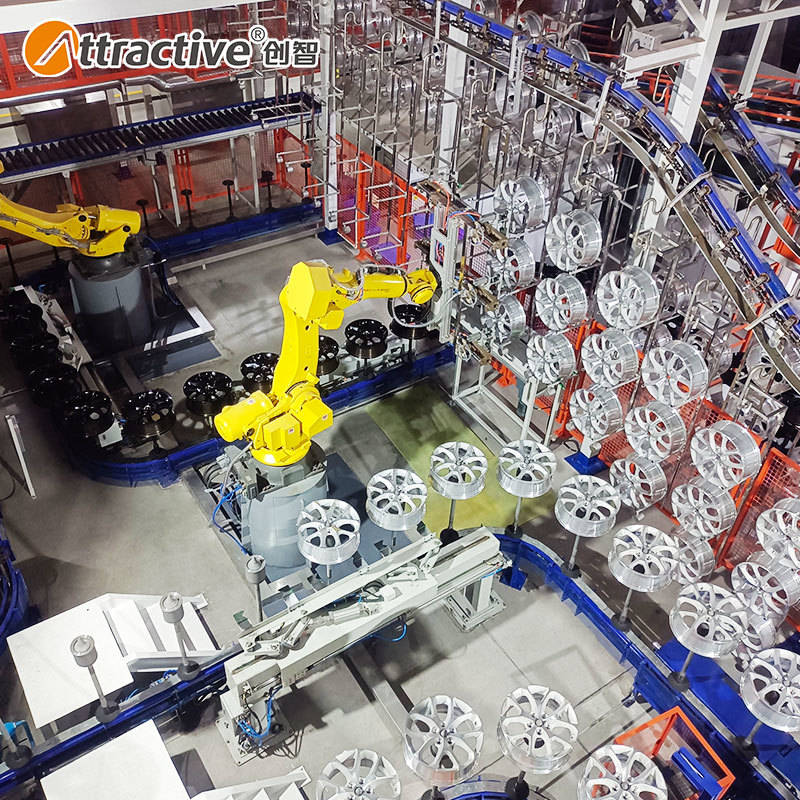
Our automated coating line for auto‑parts covers full workflow: pretreatment, robotic spraying, curing oven, MES visual production management and online quality monitoring, targeting above‑mentioned defects point‑by‑point.

1. Closed‑loop automatic pretreatment system to eliminate adhesion‑related defects
Programmable digital‑controlled pretreatment line strictly executes degreasing, conversion coating and multi‑stage rinsing with fixed time, temperature and chemical concentration. No manual intervention removes unstable human factors. Zirconium‑based conversion treatment fits aluminum wheel substrate perfectly, creating uniform conversion film for stable coating adhesion.
2. Standardized outgassing & curing oven to avoid pinhole and bubble flaws
Zone‑divided intelligent curing ovens precisely control outgassing pre‑bake and formal curing temperature & holding time. Trapped gas inside cast‑aluminum wheel can be fully released before coating application, greatly reducing crater and bubble failures. Waste‑heat recovery design also cuts overall workshop energy consumption.
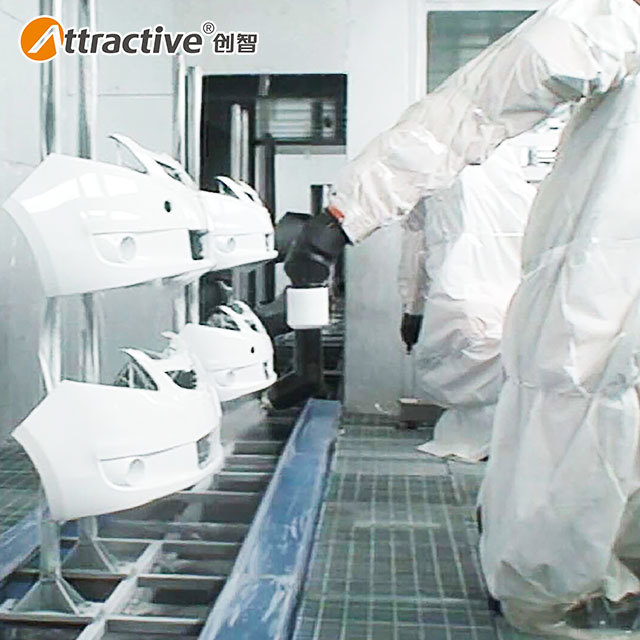
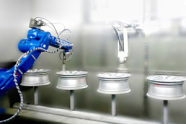
3. 6‑axis robotic spraying for consistent film thickness on complex Wheel geometry
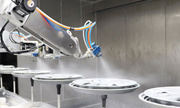
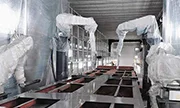
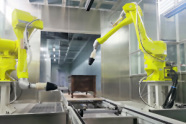
Robot spraying booth supports pre‑programmed spraying trajectories adapted for various wheel spoke structures. Robots automatically adjust spraying distance, flow rate and electrostatic parameters for inner cavities and edges, overcoming Faraday‑cage effect. The whole line is built matching class 10000 dust‑free coating workshop standards, minimizing particle contamination. Combined with MES system, real‑time production data can be tracked for every batch of automotive wheel products.
4. Stable conveying & intelligent production monitoring reduce human‑made pollution
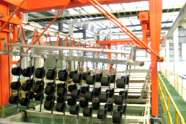
Power‑and‑free conveyor realizes touchless full‑line material handling from loading to unloading, avoiding manual contact pollution. Production data is recorded by MES for traceability, helping technical team quickly locate abnormal parameters when quality fluctuation appears.
Real‑world Production Benefit
With our automated automotive wheel coating line, many auto‑part customers have lifted one‑time pass‑rate above 95%, cut rework material loss and reduced labor input for spraying posts. Our turn‑key solutions have been exported to Thailand, Mexico, Russia, India and other global manufacturing bases, serving new‑energy automotive component factories of different scales.
Final Takeaway
Most recurring automotive wheel coating defects stem from unstable manual operation and non‑standard process control. Investing in a customized automated coating line is not only quality improvement, but also long‑term OPEX saving for auto‑parts manufacturers.
If you are planning new workshop construction for automotive wheel production, feel free to contact Attractivechina for professional project assessment and quotation.
SEO:
Previous


Contact Us
No.2 Yingbin Avenue, High-tech District, Zhaoqing City, Guangdong Province, China.
Online Message