














Related News

21
2026
-
10
Aluminum Pot Coating Line: Automated Coating Solutions for Cookware Manufacturing
Author:
Introduction to the Aluminum Pot Coating Line
An aluminum pot coating line is designed to provide efficient and consistent surface treatment for aluminum cookware, including frying pans, saucepans, stockpots, and other kitchenware products. As cookware manufacturers face increasing demands for coating quality, production efficiency, and product appearance, automated coating equipment has become an important part of modern manufacturing.
Aluminum cookware requires appropriate surface preparation and carefully controlled coating processes to achieve a smooth finish and reliable coating adhesion. An integrated coating line can combine pretreatment, automatic dust removal, preheating, primer spraying, topcoat application, drying, and high-temperature curing into a coordinated production system.
The cookware coating solutions provided by Attractivechina are designed for non-stick cookware and related products, with equipment configurations that can be customized according to workpiece dimensions, coating requirements, factory layout, and production targets.

Why Choose an Automated Aluminum Pot Coating Line?
1. Consistent Coating Quality
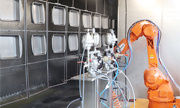
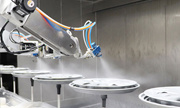
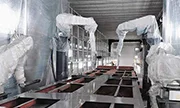
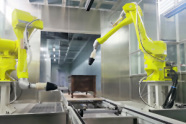
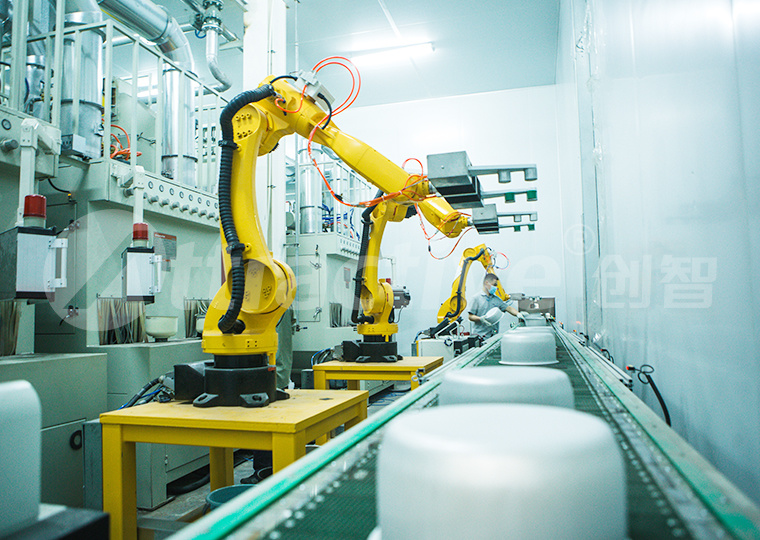
Uniform coating is essential for aluminum pots because surface defects, uneven thickness, or insufficient adhesion can affect both appearance and product performance. Automated spraying systems help control the application process and improve consistency between workpieces. Fixed spray guns or robotic spraying equipment can be selected according to the cookware design, production volume, and process requirements.
2. Improved Production Efficiency
Manual spraying can create variations in coating thickness and increase dependence on operator experience. An automated aluminum pot coating line coordinates workpiece transportation, spraying, drying, and curing to support continuous production. By reducing unnecessary handling and stabilizing process times, manufacturers can improve output while maintaining consistent quality standards.
3. Better Surface Preparation
Coating performance depends not only on the paint or coating material but also on the condition of the substrate. Pretreatment may include degreasing, rinsing, surface cleaning, drying, cooling, and other operations selected for the aluminum material and the intended coating system. Proper preparation helps remove contaminants and creates more suitable conditions for subsequent coating application.
4. Flexible Production Configuration
Different aluminum pots may require different coating treatments on their inner and outer surfaces. The inner surface may need a non-stick coating system, while the exterior may require a decorative or protective finish. A customized line can arrange separate spraying and curing stages to accommodate these requirements and support multiple cookware specifications.
Main Process of an Aluminum Pot Coating Line
The production process should be designed around the cookware material, coating system, and required finish. A typical automated coating workflow includes the following stages.
1. Loading and Pretreatment
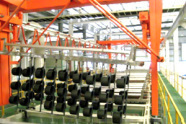
Aluminum pots are loaded onto the conveyor system and transferred through the required pretreatment stages. Depending on the production process, these may include pre-degreasing, degreasing, rinsing, surface treatment, and drying. Effective pretreatment helps improve surface cleanliness before coating.
2. Automatic Dust Removal and Preheating
Before spraying, automatic dust removal helps reduce loose particles on the workpiece. Preheating prepares the pot for the next coating stage and supports a more stable application process. Temperature settings should be adjusted according to the coating material and production specifications.
3. Primer Spraying and Drying
A primer may be applied to improve adhesion between the substrate and subsequent coating layers. The workpiece then passes through a controlled drying stage before cooling. Spray parameters, coating quantity, and drying conditions should be selected according to the technical requirements of the coating system.
4. Topcoat Application
The topcoat determines important surface characteristics, including color, gloss, texture, and functional performance. For non-stick cookware, the coating process must follow the coating supplier's specifications and the cookware manufacturer's quality requirements. Automated spraying helps maintain a more repeatable application across production batches.
5. High-Temperature Curing and Cooling
After coating, the cookware enters a curing oven where the coating is treated under specified time and temperature conditions. Correct curing is essential to achieving the intended coating properties. The workpieces are then cooled before unloading and inspection.
For cookware with different inner and outer surface requirements, the production line can be configured with corresponding spraying and curing stages. The final process sequence should be confirmed through product trials and coating validation.
Key Equipment and Customization Options
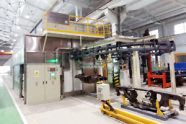
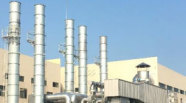
An aluminum pot coating line may integrate conveyor equipment, pretreatment systems, automatic spraying machines, spray booths, drying ovens, curing ovens, cooling sections, and environmental protection equipment. The specific combination depends on the production requirements and available factory space.
Attractivechina lists non-stick pans, kettles, rice cooker inner pots, enamel pots, and bakeware among its applicable workpieces. The reference configuration includes aluminum alloy and composite materials, fixed-gun or robotic spraying, a spray booth temperature of 18–26°C, and a stated production output of up to 800 pieces per hour. These figures are reference parameters rather than guaranteed results for every aluminum pot production line. Actual capacity depends on the workpiece dimensions, coating process, loading arrangement, and curing cycle.
Customization can cover conveyor speed, fixture design, spraying method, oven dimensions, heating energy, and line layout. Manufacturers should also consider compressed-air quality, workshop ventilation, coating-material compatibility, and maintenance access when planning the system.
How to Select the Right Aluminum Pot Coating Line
Before purchasing equipment, cookware manufacturers should clarify several practical requirements:
Product specifications: Confirm pot diameter, height, shape, material, and the number of product models.
Coating requirements: Identify whether the inner surface, outer surface, or both require treatment, and define the required finish.
Production capacity: Calculate the target output based on actual demand, working hours, and the curing cycle.
Factory conditions: Evaluate available floor space, utilities, ventilation, and environmental requirements.
Quality control: Establish inspection standards for coating appearance, thickness, adhesion, and curing performance.
Long-term operating costs: Consider energy consumption, coating utilization, labor, maintenance, and spare-part availability.
A coating line should be evaluated as a complete production system rather than simply by the price of individual machines. A well-matched configuration can help reduce rework, stabilize production, and improve the consistency of finished cookware.
Conclusion
An automated aluminum pot coating line provides cookware manufacturers with a practical way to improve spraying consistency, coordinate production stages, and adapt to different product specifications. By combining appropriate pretreatment, controlled spraying, reliable drying, and accurate curing, manufacturers can establish a coating process that supports both production efficiency and finished-product quality.
Attractivechina offers customized cookware coating line solutions based on workpiece parameters, coating requirements, and production targets. Defining these requirements before equipment selection helps ensure that the proposed system fits the actual manufacturing process.
Next Page


Contact Us
No.2 Yingbin Avenue, High-tech District, Zhaoqing City, Guangdong Province, China.
Online Message