














Related News

27
2025
-
01
Revolutionizing Non-Stick Pan Coating Production Lines for Enhanced Efficiency
Author:
Chuangzhi Coating
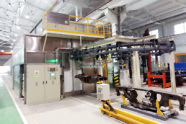
In the competitive world of cookware manufacturing, non-stick pan coating production lines play a pivotal role in ensuring that products meet quality and performance standards. These production lines are specifically designed to apply non-stick coatings, such as PTFE (polytetrafluoroethylene) and ceramic, to metal substrates, primarily aluminum or stainless steel, to create durable and functional cookware.
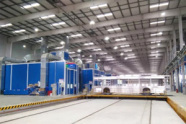
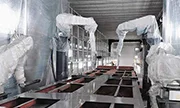
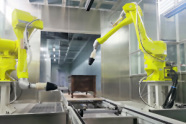
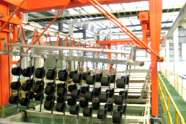
The production line typically consists of several stages, including surface preparation, coating application, curing, and quality inspection. Each stage is crucial to achieving the desired properties of the non-stick coating, such as adhesion, thermal stability, and resistance to scratching.

1. Surface Preparation: The first step in a non-stick pan coating production line involves cleaning and preparing the surface of the pan. This process may include degreasing, sanding, or shot blasting to ensure optimal adhesion of the coating. Proper surface preparation is essential for preventing defects like peeling or flaking during the service life of the cookware.
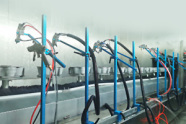
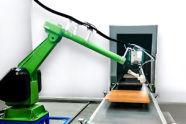
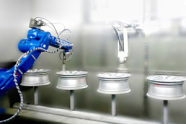
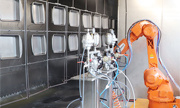
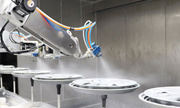
2. Coating Application: The next stage involves applying the non-stick coating. Various methods can be employed, including spray coating, dip coating, and electrostatic coating. Each method has its advantages and can be selected based on production volume, coating thickness, and desired finish. Spray coating is often preferred for its uniform coverage and ability to reach intricate designs, while dip coating is efficient for high-volume production.
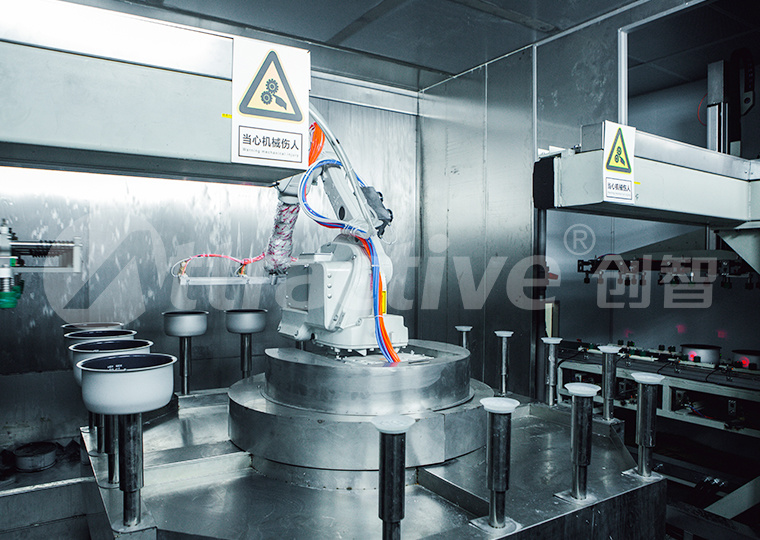
3. Curing Process: After application, the coated pans must undergo a curing process, which typically involves heating the pans in an oven to allow the coating to bond effectively to the substrate. This step is critical, as it enhances the durability and performance characteristics of the non-stick surface. Proper temperature control and timing are vital to achieving the best results.
4. Quality Inspection: Finally, a robust quality inspection process ensures that the finished non-stick pans meet the required specifications. This may involve checking for coating thickness, adhesion strength, and overall finish quality. Advanced testing methods, such as adhesion tests and thermal cycling, can be implemented to ensure the pans will perform well under various conditions.
By optimizing each segment of the non-stick pan coating production line, manufacturers can improve efficiency, reduce waste, and enhance product quality. Implementing automation and advanced monitoring systems also contributes to a more streamlined operation, allowing for better tracking of production metrics and faster response to potential issues.
In conclusion, understanding the key components and processes involved in non-stick pan coating production lines is essential for manufacturers aiming to produce high-quality cookware. By focusing on each stage of the production line, companies can not only meet but exceed customer expectations, ultimately leading to a more successful and sustainable business operation.


Contact Us
No.2 Yingbin Avenue, High-tech District, Zhaoqing City, Guangdong Province, China.
Online Message