


















Related News

05
2025
-
03
The impact of artificial intelligence and machine learning on coating quality control
Author:
Chuangzhi Coating
With the rapid development of science and technology, artificial intelligence (AI) and machine learning technologies are gradually penetrating into various industries, and the coating industry is no exception. The introduction of these advanced technologies has not only greatly improved the accuracy and efficiency of coating operations, but also brought revolutionary changes to coating quality control. This article will explore the application of AI in real-time monitoring, defect detection and process optimization, and reveal its profound impact on coating quality control.

1. Real-time monitoring: 24-hour quality protection without blind spots
In the coating process, real-time monitoring is a key link to ensure quality. Traditional manual monitoring methods are not only time-consuming and labor-intensive, but also easily affected by subjective factors, making it difficult to ensure the accuracy and timeliness of monitoring. The introduction of AI technology has completely changed this situation.
The AI precision supervision system can monitor the coating process 24 hours a day, and key parameters such as coating speed, coating thickness and environmental conditions can be recorded and analyzed in real time. This all-round monitoring method not only greatly improves the efficiency and accuracy of monitoring, but also enables potential quality problems to be discovered and handled at the first time, thereby effectively avoiding the occurrence of quality accidents.
2. Defect detection: accurate and efficient, improving yield rate
Coating defects are one of the important factors affecting product quality. Traditional defect detection methods often rely on manual visual inspection, which is not only inefficient, but also difficult to ensure the accuracy and consistency of detection. The product defect recognition technology based on machine learning provides a new solution for coating defect detection.
By training a large amount of defect sample data, the machine learning model can automatically identify and classify various coating defects, such as bubbles, cracks, peeling, etc. This automated detection method not only greatly improves the detection efficiency, but also significantly improves the accuracy of defect detection. In addition, the machine learning model can also predict the occurrence trend of potential defects based on historical data, providing strong data support for the prevention and control of defects.
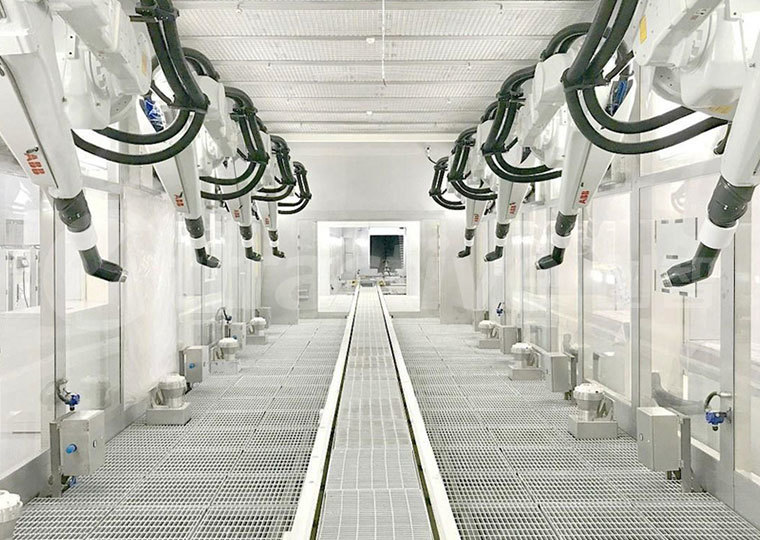
3. Process optimization: data-driven, achieving continuous improvement
In the coating process, the optimization of process parameters is crucial to improving product quality and efficiency. However, traditional process optimization methods often rely on empirical judgment and trial and error, which is not only inefficient, but also difficult to ensure the accuracy and stability of optimization. The introduction of AI technology provides new ideas and methods for process optimization.
By collecting and analyzing a large amount of data during the coating process, AI algorithms can discover the complex relationship between process parameters and product quality, and make optimization suggestions accordingly. These suggestions are not only data-driven, but also rigorously verified and tested, so they are highly reliable and practical. In addition, AI algorithms can also adjust process parameters in real time according to changes in the production environment to ensure the continued stability of coating quality.
In summary, the introduction of artificial intelligence and machine learning technology has brought revolutionary changes to coating quality control. Through the application of real-time monitoring, defect detection, and process optimization, AI technology has not only greatly improved the accuracy and efficiency of coating operations, but also provided strong data support and intelligent means for the continuous improvement of coating quality.
With the continuous advancement of technology and the continuous expansion of application scenarios, I believe that AI will play a more important role in the coating industry and contribute more wisdom and strength to the improvement of coating quality.


Contact Us
No.2 Yingbin Avenue, High-tech District, Zhaoqing City, Guangdong Province, China.
Online Message