











Related News

26
2026
-
02
Looking for a Coating Line That Can Handle Both Powder and Liquid Paint?
Author:
Chuangzhi Coating
Driven by today's diversified and customized market demands, many manufacturing enterprises face a common challenge: their product lines are becoming increasingly diverse, with different products requiring different surface coating characteristics—some need the durability and environmental friendliness of powder coatings, while others require the rich colors and high gloss effects of liquid paints. The traditional approach involves investing in two separate coating lines, which entails high equipment costs, larger factory footprints, and complex operation and maintenance. So, does there exist a flexible coating production line that can flexibly switch within a single system to meet the needs of both powder and liquid processes? The answer is yes. This article will comprehensively analyze the technical solutions, core advantages, and implementation points of such a combination coating line.
I. Why Need a Hybrid Coating Line That Handles Both Powder and Liquid?
Changes in market demand are reshaping the production methods of coating workshops:
- Product Diversification Needs: The same factory may produce equipment for outdoor use (requiring the high weather resistance of powder coatings) and delicate components for indoor use (requiring the high decorative properties of liquid coatings).
- Order Fluctuation and Flexible Manufacturing: Facing the trend of small batches and high product mix, the utilization rate of single-process lines may be insufficient, whereas a hybrid line can flexibly allocate capacity.
- Technology Transition Needs: Some companies are transitioning from traditional solvent-based paints to more environmentally friendly powder or waterborne paints; a hybrid line provides a platform for a smooth switch.
- Maximizing Return on Investment: For small-to-medium enterprises or startups, a one-time investment in a line compatible with both processes is far more economical than investing in two separate lines in stages.
II. Core Architecture and Technical Challenges of a Hybrid Coating Line
A hybrid spray system capable of handling both powder and liquid is far more than simply placing a powder booth and a liquid booth side-by-side. Its technical core lies in resolving the fundamental conflicts during process switching: cross-contamination between powder and solvent/dust, and differences in curing temperature and time.
A well-designed combination coating line typically includes the following key modules:
1.Switchable Spray Booth System:
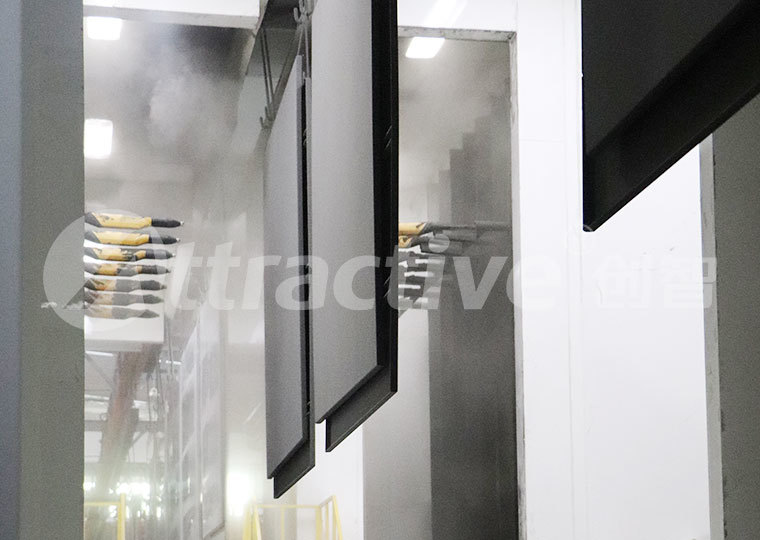
- Physical Isolation Design: Achieve complete physical isolation between the powder and liquid spraying areas during process switching using mobile booths, rotating spray platforms, or retractable partition walls. For example, during powder coating, the liquid booth is moved out or sealed off to prevent solvent mist and paint fog from contaminating the powder recovery system, and vice versa.
- Shared or Independent Air Supply/Exhaust Systems: Powder and liquid have different requirements for airflow organization (powder requires explosion protection, liquid requires preventing VOC accumulation). Advanced intelligent coating solutions design switchable or adjustable airflow balancing systems to ensure airflow within the booth meets safety and process specifications in both modes.
2. Dual-Use Spraying Equipment for Powder and Liquid:
- Quick Color Change and Cleaning System: For the liquid part, equip automatic quick color change valve groups and pipeline cleaning systems to switch colors within minutes. For the powder part, efficient powder recovery and sieving systems are needed to avoid color mixing during color changes.
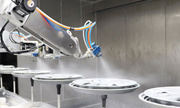
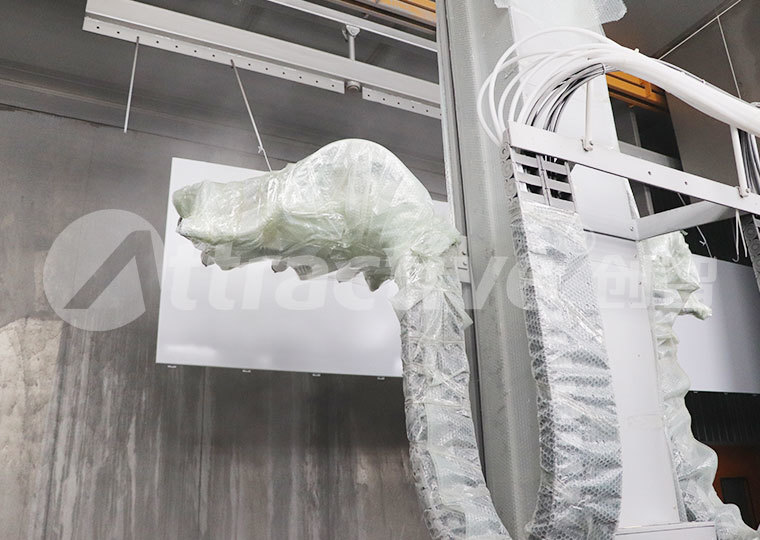
- Interchangeable Robot End Effectors: For lines using robots, quick-change couplings can be designed, allowing the robot to rapidly switch to a powder gun or a liquid bell/gun depending on the current mode.
3. Conveying and Curing Systems Compatible with Both Processes:
- Curing Oven Flexibility: Powder coatings typically require higher temperatures (180-220°C) and longer soak times, while liquid coatings (especially waterborne) cure at lower temperatures (80-150°C). One solution is to use a multi-zone, adjustable-temperature oven design, or equip two separate curing ovens (one high-temperature, one low-temperature), guiding workpieces to the corresponding oven via the conveyor system.
- Universal Rack Design: Racks must simultaneously meet the grounding requirements of both processes (powder electrostatic spraying requires good grounding) and load-bearing stability.
III. Core Advantages of a Hybrid Coating Line
Investing in a combination coating line brings multi-dimensional strategic value to an enterprise:
- Ultimate Production Flexibility: One line possesses two process capabilities, ready to switch at any time based on order demands, easily adapting to changing customer requirements. This is a true flexible coating production line.
- Significantly Reduced Initial Investment: Compared to building two independent coating lines, the equipment investment for a hybrid line can save 30%-50%, while also drastically reducing factory floor space and related auxiliary facility costs.
- Improved Overall Equipment Effectiveness: Single-process lines may face idle capacity when orders are insufficient. A hybrid line can consolidate orders for both processes onto one line, maximizing equipment utilization.
- Hedging against risks from market and technological changes: Whether it's the updating of coating technology (such as the popularization of water-based paints) or changes in market preferences, hybrid production lines can help companies cope with the situation and avoid being eliminated by the market due to a single technology route.
- Simplified Operation and Centralized Management: One control system, one conveying system, and one maintenance team can manage both processes, significantly improving management efficiency.
IV. Key Considerations for Implementing a Hybrid Coating Line
Successfully deploying a combination coating line requires professional planning and design:
- Clear Process Definition: Define the respective proportions of the two processes, the switching frequency, and the typical workpiece sizes and materials. This is the foundation of the design.
- Supplier's Professional Capability: Choosing a supplier with successful cases of hybrid spray systems is crucial. They must possess deep knowledge of both powder and liquid processes and be able to solve the key technical challenges of integrating them.
- Standardization of Switching Procedures: Develop standardized operation procedures for process switching, including booth isolation, equipment cleaning, parameter switching, and first-article quality confirmation, ensuring the switching process is safe, rapid, and error-free.
- Environmental and Safety Compliance: A hybrid line must simultaneously meet the dual safety and environmental requirements of powder explosion protection and liquid VOC treatment. The exhaust treatment system (e.g., RTO) must be capable of handling the exhaust generated in both modes.
V. Conclusion
For manufacturing enterprises seeking to maximize production flexibility and optimize return on investment, a combination coating line capable of handling both powder and liquid spraying is undoubtedly a highly attractive strategic choice. It breaks the traditional "either-or" limitation of coating processes and, through systematic engineering design, integrates the advantages of both technologies into one.
However, this is also a highly specialized systems engineering project. Enterprises need to collaborate deeply with suppliers possessing profound process knowledge and integration experience to jointly plan, design, and implement an intelligent coating solution that truly meets their own needs. When this line becomes operational, what the enterprise gains is not just a set of equipment, but a core manufacturing capability that can flexibly respond to market dynamics and continuously create value. In a business environment where uncertainty is the norm, this kind of "versatile" flexibility is precisely an enterprise's most valuable competitive asset.
Previous


Contact Us
No.2 Yingbin Avenue, High-tech District, Zhaoqing City, Guangdong Province, China.
Online Message