















Related News

06
2026
-
03
How to Ensure Uniform Coating Thickness on Complex-Shaped Parts in a Production Line?
Author:
Chuangzhi Coating
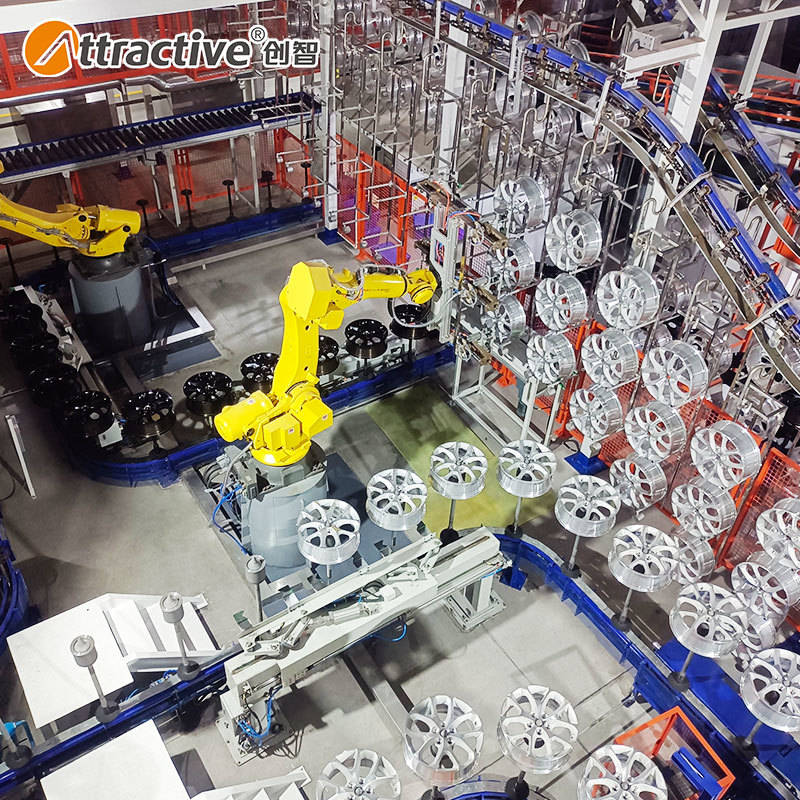
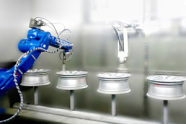
In fields such as aerospace, automotive manufacturing, and high-end equipment, coating complex-shaped parts has always been a technical challenge in production. Whether it's the film cooling holes on aircraft engine blades, the complex curved surfaces of aluminum alloy wheels, or the deep-cavity structures of car bodies, the uniformity of coating thickness in these areas directly determines the product's corrosion resistance, fatigue life, and aesthetic quality. However, due to geometric complexity, traditional spraying processes are prone to defects in these areas, such as insufficient thickness (exposing the substrate) or excessive buildup (sagging). So, in a modern automated coating line, how can we ensure uniform coating on these complex-shaped parts? This article systematically analyzes the four core technologies for achieving this goal.
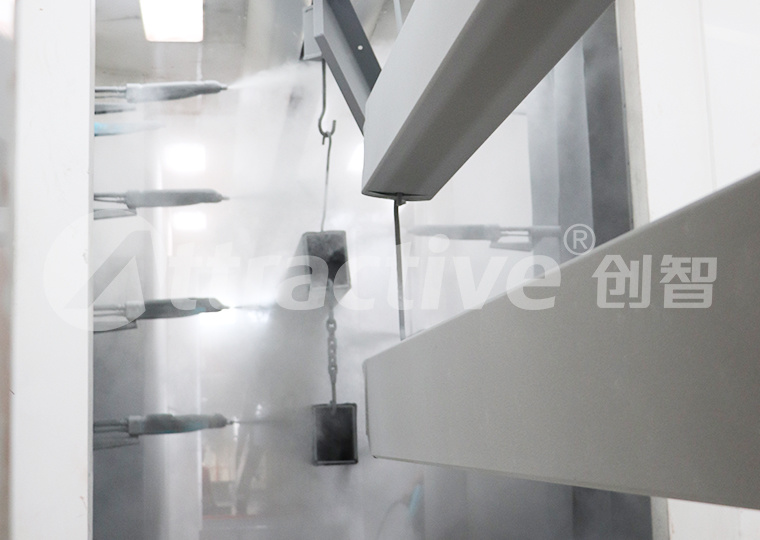
I. Precision Path Planning: The "Optimal Trajectory" for Robotic Spraying
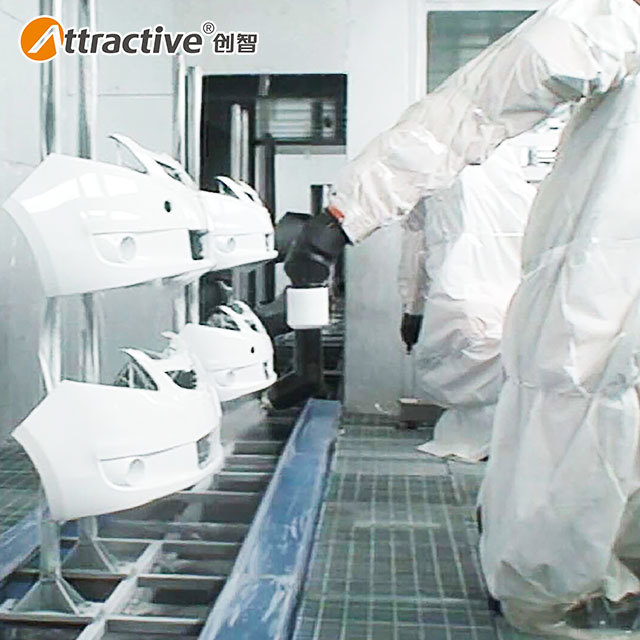
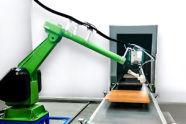
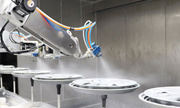
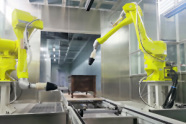
For parts with complex curved surfaces, manual spraying struggles to maintain consistent gun distance, angle, and speed, making uniformity unattainable. The core of a modern intelligent coating system lies in planning the "optimal trajectory" for spraying robots through offline programming and simulation.
- Path Generation Based on 3D Models: Engineers import the CAD 3D model of the workpiece into specialized offline programming software. Based on curvature changes and concave/convex features, the software automatically calculates the gun's trajectory, spacing, orientation, and speed to ensure consistent paint deposition in every minute area as much as possible.
- Accessibility and Collision Verification: Simulate robot motion in a virtual environment to check if the spray gun can reach all complex surfaces (e.g., deep holes, backside of grooves) without blind spots, and automatically avoid collision risks with the workpiece or fixtures.
- Segmented Strategy for Complex Curvature: For areas with abrupt curvature changes (e.g., the junction between the spoke and rim of a wheel), the system automatically adopts a "variable speed" or "variable angle spraying" strategy—reducing speed or adjusting the angle in steep areas to compensate for deposition differences per unit time.
II. Intelligent Process Perception: Enabling Machines to "See" and "Adapt"
Even with a perfect offline program, factors like incoming material tolerances, fixture deformation, and thermal expansion can cause deviations between the actual workpiece and the theoretical model. Therefore, equipping the production line with "perception" capabilities is crucial.
- 3D Vision Scanning and Workpiece Positioning: Before the workpiece enters the spray station, a high-resolution 3D vision system scans it to accurately identify its actual position, orientation, and contour. The system automatically calibrates the offline-planned path to match the actual workpiece, compensating for positional deviations.
- Adaptive Trajectory and Parameter Adjustment: Based on visual feedback, the intelligent coating system fine-tunes the robot's spray trajectory and process parameters in real time. For example, if a weld seam is detected higher than the base material, the robot will appropriately increase spray time or adjust gun distance in that area to ensure sufficient film thickness on the weld without affecting the surrounding area.
- Dynamic Flow and Atomization Control: Based on changes in robot speed (e.g., decelerating on curves), the system adjusts the paint output flow rate in real time to avoid excessive local film thickness caused by slower speed. Simultaneously, it automatically switches the optimal atomization pressure and fan pattern for different areas (flat surfaces, edges, deep cavities).
III. Accurate Physical Field Simulation: Digital Twin-Driven Process Optimization
Before physical commissioning, conducting high-fidelity simulation of the spraying process using digital twin technology has become a key prerequisite for ensuring uniformity.
- Paint Deposition Model Simulation: Using computational fluid dynamics software, simulate the trajectory of paint particles in the airflow and electrostatic fields, predicting their deposition distribution on complex workpiece surfaces. Engineers can adjust gun parameters, booth spacing, exhaust velocity, etc., in the virtual environment and observe their impact on film thickness uniformity.
- Temperature Field and Leveling Simulation: For the curing process, simulate the hot air circulation and temperature distribution inside the oven to ensure all parts of the workpiece (especially thick sections and thin-walled areas) are heated uniformly according to the preset temperature curve, avoiding performance differences and color variation caused by uneven curing.
- Establishment and Reuse of Process Parameter Library: Verified optimized parameters (e.g., optimal trajectory, flow rate, voltage for a specific wheel model) are stored in a database. When that product is produced again, the parameters can be directly recalled, ensuring that the uniformity of each production run replicates the optimal level.
IV. Closed-Loop Quality Feedback: Data-Driven Continuous Improvement
The final line of defense for ensuring uniformity is real-time quality inspection and closed-loop control.
- Online Film Thickness Measurement Technology: Utilize non-contact (e.g., infrared thermal imaging, laser ultrasound) or contact (eddy current, magnetic) film thickness gauges to perform online inspection of key areas after spraying, before or after curing. These devices can be mounted on robot arms or at fixed stations on the line.
- Real-Time Data Feedback and Correction: Inspection data is transmitted in real time to the central control system. If continuous deviation of film thickness in a certain area from the set range is detected, the system immediately diagnoses the cause (e.g., gun clogging, air pressure fluctuation) and sends correction commands to the spraying unit, automatically adjusting parameters on the next workpiece to prevent batch defects.
- Full-Process Quality Traceability: The film thickness data for each workpiece is linked to its serial number and stored in a database. This not only provides a basis for quality release but also accumulates valuable data assets for long-term process optimization. This is a key indicator of the intelligence achieved by a flexible coating production line.

V. Conclusion: Systemic Thinking is the Ultimate Guarantee of Uniformity
Achieving uniform coating on complex-shaped parts is never the merit of a single technology but a systemic engineering achievement resulting from the combined effect of precision planning, intelligent perception, simulation optimization, and closed-loop control. It requires that the coating production line not only possess high-precision hardware execution capabilities but also a powerful "brain" and "senses."
For manufacturing enterprises, investing in an intelligent coating solution capable of mastering complexity means fundamentally solving quality fluctuation problems and minimizing costly manual rework and scrap losses. More importantly, it equips the company with the process confidence to take on high-difficulty, high-value-added orders. On the path to Industry 4.0, this ultimate pursuit of microscopic uniformity is a core embodiment of high-end manufacturing capability. Choosing to partner with a supplier of automated coating production lines with deep technical expertise provides the most reliable platform for this pursuit.
SEO:


Contact Us
No.2 Yingbin Avenue, High-tech District, Zhaoqing City, Guangdong Province, China.
Online Message