How to Choose the Right Coating Line for Your Factory (Step-by-Step)
Author:
Chuangzhi Coating
Selecting a suitable coating line constitutes a pivotal decision at the core of an enterprise's efforts to build its coating capabilities. However, when confronted with the vast array of equipment types, technical approaches, and suppliers available on the market, many companies easily fall into the pitfalls of either prioritizing price above all else or blindly worshipping technology. This often leads to post-investment outcomes characterized by mismatched production capacity, substandard quality, or spiraling operational costs. This article provides a practical six-step selection guide from requirements analysis to final decision-making, helping you scientifically and rationally choose the coating line that best suits your factory.
Step 1: Define Product Characteristics and Coating Standards
The first step in selection is not looking at equipment, but at your products. You need to systematically sort out the following information:
1.1 Basic Workpiece Information
Material: Steel, aluminum alloy, magnesium alloy, plastic, or composite? Different materials fundamentally affect pre-treatment and coating type selection.
Dimensions and Weight: The length, width, height, and weight of the largest workpiece determine conveyor system specifications, spray booth size, and curing oven dimensions.
Shape Complexity: Are there deep cavities, internal walls, weld seams, sharp edges, or other hard-to-spray areas? This directly impacts robot selection and spray path design.
1.2 Coating Performance Requirements
Corrosion Resistance Level: How many hours of salt spray testing are required? Indoor or outdoor use?
Special Functions: High-temperature resistance, conductivity, insulation, self-healing, anti-fingerprint, or other special properties?
1.3 Regulatory and Environmental Requirements
VOC Emission Limits: What are the VOC restrictions in your region's environmental regulations?
Hazardous Substance Restrictions: Do you need to comply with RoHS, REACH, or similar directives?
Food Contact Safety: If products contact food, FDA, LFGB, or other standards must be met.
Action Suggestion: Compile the above information into a "Product Coating Requirements Specification" document, which will serve as the foundation for all subsequent technical communications.
Step 2: Determine Production Capacity Targets and Manufacturing Model
Capacity planning determines the scale, automation level, and investment amount of the coating line.
2.1 Annual Output and Cycle Time Calculation
Define annual output target (pieces/year or square meters/year)
Calculate required cycle time: Cycle time (seconds/piece) = (Annual available operating hours × 3600) / Annual output
Consider equipment utilization and changeover losses; typically reserve 15-20% margin
2.2 Manufacturing Model
High Volume, Low Mix: Suitable for dedicated high-speed lines with fixed automation equipment
High Mix, Low Volume: Requires flexible coating production lines with quick color change and quick changeover capabilities
Mixed-Model Production: Handling workpieces of different materials and sizes on the same line requires intelligent scheduling systems
Action Suggestion: Based on product planning for the next 3-5 years, determine peak capacity and typical batch sizes to avoid either capacity overkill or frequent expansion needs.
Step 3: Select the Core Coating Process Route
Based on product requirements and capacity targets, determine whether to use powder, liquid, electrodeposition, or a hybrid process.
3.1 Process Comparison Quick Reference
Process
Best Application
Material Utilization
VOC Emissions
Coating Thickness
Appearance
Powder Coating
Metal parts, flat surfaces, heavy corrosion protection
>95%
Very low
60-120μm
Rich
Liquid Coating
Complex curves, high decoration, special functions
Many high-end products use multi-layer hybrid coating systems, such as:
Automotive body: E-coat primer + Surfacer + Basecoat + Clearcoat
Aluminum alloy wheels: Base powder + Color powder + Clear powder
Construction machinery: Zinc-rich primer + Epoxy intermediate + Polyurethane topcoat
Action Suggestion: Commission process validation tests from professional suppliers, using actual workpieces and coatings to simulate production in a laboratory, confirming optimal process parameters.
Step 4: Plan Equipment Configuration and Automation Level
Once the process route is determined, refine equipment selection for each module.
4.1 Pre-Treatment System
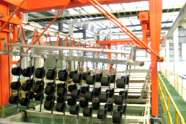
Batch Cleaning: Immersion type, suitable for complex-shaped workpieces
Continuous Through-Feed: Spray type, suitable for high-volume, simple-shaped workpieces
Environmentally Friendly Processes: Prioritize silane/zirconium conversion films over traditional phosphating for phosphorus-free and nickel-free operation
4.2 Spraying System
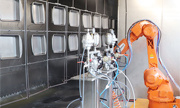
Manual/Automatic/Robotic: Robotic spraying suits complex trajectories and high consistency requirements, but investment is higher
Spray Gun/Rotary Bell: Rotary bells offer higher efficiency and finer atomization for large areas; spray guns are suitable for edge touch-up
Paint/Powder Supply System: Automatic paint mixing, circulation agitation, temperature control, quick color change
4.3 Curing System
Heat Source: Gas, electricity, steam, thermal oil
Oven Type: Straight-through, bridge, U-shaped; select based on factory layout
Energy-Saving Design: Insulation thickness, heat recovery, zone temperature control
4.4 Automation and Intelligence
Modern automated coating production lines come standard with PLC + touchscreen control. Advanced options include:
3D Vision-Guided Robots: Automatically identify workpiece offsets, adaptively adjust trajectories
Online Film Thickness Measurement: Real-time feedback, closed-loop adjustment of spraying parameters
MES Data Interface: Connect with factory management systems for production traceability
Action Suggestion: Create three lists: "Must-Have Configurations," "Optional Configurations," and "Future Expansion," then allocate budget reasonably.
Step 5: Evaluate Suppliers and Turnkey Capability
When selecting a supplier, do not look only at the price; evaluate their comprehensive capabilities.
5.1 Technical Capability
Does the supplier have a process laboratory? Can they perform full-process validation of pre-treatment, spraying, and curing?
Are there successful case studies for similar products? Arrange site visits.
Do they master advanced technologies such as robot offline programming and digital twins?
5.2 Engineering Capability
Can they provide customized coating solutions rather than assembling standard equipment?
Do they have a complete project management team? Can they coordinate civil works and utility interfaces?
Are delivery and installation/commissioning timelines reasonable?
5.3 Service Capability
After-sales response time? Are there local service outlets?
Is the spare parts supply system well-established?
Can they provide long-term support such as operator training and process optimization?
Action Suggestion: Invite 2-3 shortlisted suppliers to submit technical proposals and quotes, then conduct solution comparisons and business negotiations. Request detailed technical specifications, project schedules, and warranty terms from suppliers.
Step 6: Calculate Return on Investment and Total Cost of Ownership
The final step is financial evaluation to ensure the investment is economically viable.
Direct Savings: Improved material utilization, reduced energy consumption, lower labor costs
Indirect Benefits: Customer premium from quality improvement, revenue growth from increased capacity
Strategic Value: Environmental compliance, brand image, improved supply chain position
6.3 Key Metrics
Payback Period: Typically 3-5 years is acceptable; excellent projects can achieve 2-3 years
Internal Rate of Return (IRR): Generally should exceed the company's weighted average cost of capital
Net Present Value (NPV): Greater than zero indicates feasibility
Action Suggestion: Prepare a "Project Feasibility Analysis Report" containing financial models and sensitivity analysis for submission to management or the board for decision-making.
Conclusion: Choose the Right Coating Line, Win at the Starting Line
Selecting a painting line is a complex systems engineering task requiring comprehensive consideration of product, process, equipment, finance, management, and other dimensions. By following the six-step process above—defining product requirements, determining capacity targets, selecting process routes, planning equipment configuration, evaluating supplier capabilities, and calculating investment returns—you can significantly reduce selection risks and ensure investment returns meet expectations.
Remember, the best coating line is not necessarily the most expensive, nor the cheapest, but the solution that best fits your factory's actual needs, operates stably, and offers the lowest total cost over its full lifecycle. If your project is complex or you lack internal experience, it is strongly recommended to engage professional coating line consultants or collaborate deeply with turnkey-capable efficient coating solutions providers.
Choose the right coating line equipment to make surface treatment your product's core competitive advantage, not a bottleneck.