In today's era of shrinking manufacturing profits, the efficiency of your coating line directly determines your cost competitiveness. An inefficient coating line not only occupies valuable factory floor space but also continuously consumes labor, energy, and materials. However, the actual Overall Equipment Effectiveness (OEE) of most coating lines is only 50-65%, meaning nearly half of the potential capacity is idle or wasted. Through systematic diagnosis and improvement, achieving a 30% efficiency increase is entirely feasible. This article provides actionable improvement plans from seven dimensions.
I. Measurement and Diagnosis: OEE is the Starting Point
Without measurement, there is no management. The first step to improving efficiency is establishing an accurate efficiency baseline.
OEE = Availability × Performance × Quality
Availability: Actual running time / Planned production time (losses from breakdowns, changeovers, waiting for materials)
Performance: Actual cycle time / Theoretical cycle time (losses from speed loss, minor stoppages)
Quality: Good units / Total produced (losses from rework, scrap)
Action Plan:
Install running sensors and counters on key equipment for automatic data collection
Create OEE dashboards to track the three major losses daily
Identify the largest efficiency loss areas for priority improvement
Many companies find that excessive changeover time and minor stoppages are the two main causes of efficiency loss, contributing to over 60% of non-productive time.
II. Reduce Changeover Time: The SMED Method
Changeovers (color changes, fixture changes, program changes) are the most common interruptions on a coating line. Using the SMED (Single-Minute Exchange of Die) method, changeover time can be reduced from hours to minutes.
Typical changeover time distribution on a coating line:
Spray booth cleaning: 40%
Paint/powder change: 30%
Fixture change: 20%
Program switching and verification: 10%
Improvement Measures:
Convert internal changeovers (must be done with line stopped) to external changeovers (can be prepared while line is running)
Use quick-connect fittings, quick-change fixtures, and color-coded piping
For powder coating lines, use mobile spray booths or quick-color-change powder feed centers
Pre-set spray programs for one-click recall
With SMED, changeover time can be reduced from 45 minutes to under 10 minutes, directly improving availability by 15-20%.
III. Eliminate Bottlenecks: Balance Line Takt Time
A coating line consists of multiple stations in series: pre-treatment, spraying, curing, conveying, etc. The efficiency of the entire line is limited by the slowest station (the bottleneck).
Bottleneck Identification Methods:
Observe work-in-progress accumulation between stations — accumulation indicates the upstream station is too fast and the downstream station is the bottleneck
Calculate the theoretical cycle time of each station; the longest cycle time indicates the bottleneck
Solutions:
Add resources to the bottleneck station (e.g., increase number of spray robots, lengthen curing oven)
Transfer part of the bottleneck workload to other stations
Optimize operating methods and parameters at the bottleneck station
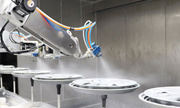
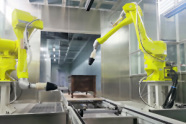
For example, on one automated coating line, the spray robot was the bottleneck. By optimizing paths and reducing empty travel, cycle time was reduced from 90 seconds to 70 seconds, increasing overall line capacity by 22%.
IV. Reduce Minor Stoppages: Improve Equipment Reliability
Minor stoppages refer to short-duration interruptions (typically <5 minutes) that occur frequently, such as gun clogs, sensor false alarms, and conveyor jams.
Common Causes and Countermeasures:
Gun clogs: Install in-line filters and clean regularly; use high-quality coatings
Sensor false alarms: Clean sensors regularly; use interference-resistant models
Air pressure fluctuations: Add air receiver tanks; install pressure regulators
Through systematic preventive maintenance, reducing minor stoppage frequency by over 50% can improve OEE by 5-10%.
V. Speed Up and Parameter Optimization: Unlock Performance Potential
While maintaining quality, moderately increasing operating speed is a direct way to improve efficiency.
Optimizable Parameters:
Conveyor speed: Increase gradually while monitoring coating quality
Robot trajectory: Optimize paths to reduce empty moves and waiting
Curing temperature and time: Within allowable range, appropriately shorten hold time
Precautions:
Conduct DOE (Design of Experiments) before speeding up to understand speed-quality relationship
Establish an approval process for speed adjustments to avoid batch scrap from arbitrary changes
For flexible coating lines, different products can have different optimal speeds
Typical speed-up projects can shorten cycle times by 10-15%, equivalent to a 10-15% efficiency improvement.
VI. Reduce Rework Rate: Do It Right the First Time
Rework is a hidden killer of efficiency. Each reworked product consumes 2-3 times the production resources (repetitive work, additional inspection, management costs).
In-line inspection: Install film thickness gauges and colorimeters for real-time feedback and closed-loop adjustment
Operator training: Ability to identify common defects to prevent batch issues
First-off verification: Strict first-off inspection after each changeover to avoid batch defects
Reducing rework rate from 10% to 3% directly improves OEE by approximately 7-8%.
VII. Energy Management and Intelligent Scheduling
Energy costs typically account for 15-25% of total operating costs on a coating line. Reducing energy consumption not only saves money but also reduces waiting time caused by thermal inertia.
Synergistic Energy Saving and Efficiency Measures:
Oven automatic standby: Reduce temperature when no workpieces are present; quickly ramp up when production resumes
Variable frequency drives: Fans and pumps run on demand, avoiding full-load idling
Intelligent scheduling: Group workpieces requiring similar temperature profiles to reduce oven ramp-up frequency
Heat recovery: Use exhaust waste heat for pre-treatment heating or workshop heating
Intelligent scheduling systems can automatically optimize production sequences based on order priority and equipment status, reducing empty oven waiting time. For customized coating solutions, such digital tools have become standard features.
VIII. Continuous Improvement Culture
Technology and equipment improvements are only the foundation. Truly sustained efficiency gains require building a culture of continuous improvement.
Implementation Measures:
Establish efficiency improvement teams (involving production, process, and maintenance personnel)
Hold weekly efficiency review meetings to analyze OEE data and select improvement topics
Implement suggestion systems to reward frontline improvement ideas
Achieving a 30% efficiency improvement on your coating line is not an unattainable goal. Through OEE diagnostics to pinpoint losses, applying SMED to shorten changeovers, eliminating bottlenecks, reducing minor stoppages, optimizing speed parameters, reducing rework, implementing intelligent scheduling, and building a continuous improvement culture, most coating lines can achieve significant efficiency gains within 6-12 months.