





















Related News

15
2026
-
04
Why Your Coating Line Has Uneven Coating—and How to Fix It
Author:
Chuangzhi Coating
Uneven coating is one of the most common and frustrating quality problems in coating production. Whether it is inconsistent film thickness, obvious color difference, localized exposed substrate, or sagging, these defects not only affect product appearance but can also lead to reduced corrosion resistance, customer rejection, or even batch scrap. Many enterprises spend significant time troubleshooting but often only address symptoms rather than root causes. In fact, uneven coating is usually not caused by a single factor, but by the combination of problems in multiple stages. This article systematically analyzes six core causes of uneven coating on coating lines and provides actionable diagnostic and corrective solutions.
I. Pre-Treatment Issues: Unstable "Foundation" for Coating Adhesion
Pre-treatment is the first critical step for coating quality. If pre-treatment is inadequate, subsequent spraying will be ineffective regardless of how well it is done.
1.1 Insufficient Surface Cleanliness
Symptoms: Cratering, fish eyes, poor adhesion, localized peeling.
Causes: Residual oil, cutting fluid, polishing dust, or mold release agent on workpiece surfaces.
Solutions:
- Check degreasing bath concentration and temperature to ensure they meet process requirements
- Add high-pressure spray or ultrasonic cleaning to remove stubborn contaminants
- Regularly replace rinse water to avoid secondary contamination
- Use surface tension test pens for rapid cleanliness assessment
1.2 Non-Uniform Conversion Coating
Symptoms: Significant local differences in coating adhesion; early failure in salt spray tests.
Causes: Uneven thickness or coarse crystallization of phosphate/silane film.
Solutions:
- Check for clogged spray nozzles in pre-treatment to ensure full coverage
- Control bath pH, temperature, and treatment time
- Regularly measure conversion coating weight (e.g., phosphate coating weight 1.5-3.5 g/m²)

II. Spraying Parameter Deviations: Losing the Process Window
Spraying parameters are the core of controlling coating uniformity. Drift in any parameter directly affects film thickness distribution.
2.1 Improper Gun Distance and Angle
Symptoms: Excessive film thickness at workpiece edges (distance too close), insufficient thickness in center areas (distance too far).
Solutions:
- Fix the relative distance between spray gun and workpiece, typically recommended at 150-250mm
- Keep gun perpendicular to the spraying surface to avoid edge buildup caused by angled spraying
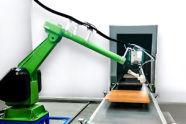
- For automated coating lines, regularly calibrate robot TCP (Tool Center Point)
2.2 Mismatch Between Atomization Pressure and Flow Rate
Symptoms: Orange peel (pressure too low), dry spray (pressure too high), or sagging (flow too high).
Solutions:
- Adjust atomization pressure based on coating viscosity, typically 0.2-0.4 MPa
- Use flow meters to monitor paint output in real-time, ensuring stability
- For intelligent coating systems, enable closed-loop flow control functionality
2.3 Improper Electrostatic Voltage Setting
Symptoms: Thin coating in deep cavities due to Faraday cage effect in powder coating; exposed concave surfaces due to electrostatic shielding in liquid coating.
Solutions:
- Reduce electrostatic voltage (from 80kV to 50-60kV) to minimize repulsion effects
- Increase gun-to-workpiece distance or use "reverse pulse" technology
- Use manual touch-up or additional robot spraying angles for complex workpieces
III. Equipment Failures: The Hidden Killer
Poor equipment condition is often an insidious cause of uneven coating.
3.1 Worn or Clogged Spray Gun
Symptoms: The spray pattern is irregular, with striped or fan-shaped gaps.
Solutions:
- Regularly inspect nozzle and needle wear; replace according to service life
- Thoroughly clean spray gun after each color change to prevent paint drying
- Use paint filters with higher filtration accuracy (recommended 50-100 mesh)
3.2 Conveyor System Vibration or Speed Variation
Symptoms: Periodic alternating thick and thin coating (related to chain pitch).
Solutions:
- Inspect guide rails, sprockets, and tensioning devices of overhead chain or floor rail
- Install encoders to monitor conveyor speed in real-time and synchronize with robot spraying
- For flexible coating lines, ensure stable conveying during quick color changes
3.3 Non-Uniform Temperature Distribution in Curing Oven
Symptoms: The coating on different parts of the same workpiece has different curing degrees, which manifests as differences in gloss or hardness.
Solutions:
- Use multi-point temperature recorders to measure oven temperature field; temperature difference should be controlled within ±5°C
- Clean filters of hot air circulation system and check fan speed
- Adjust air nozzle angles and openings to eliminate cold zones

IV. Coating Material Issues: Batch Variation and Mixing
The stability of the coating itself and correct mixing are equally critical.
4.1 Batch-to-Batch Color Difference
Symptoms: Inconsistent color between products sprayed with different batches.
Solutions:
- Require coating suppliers to provide batch-to-batch color difference reports (ΔE < 0.5)
- Use the same batch of coating for the same order whenever possible
- Establish incoming inspection procedures; compare color difference for each batch
4.2 Unstable Dilution Ratio and Viscosity
Symptoms: Leveling performance fluctuates; orange peel and sagging appear alternately.
Solutions:
- Use automatic paint mixing systems for precise proportioning according to formulas
- Equip viscometers for real-time monitoring with temperature compensation
- Record dilution ratio and application viscosity for each drum of coating
V. Environmental Factors: The Overlooked Variable
Temperature and humidity in the spraying environment significantly affect coating uniformity.
5.1 Uncontrolled Spray Booth Temperature and Humidity
Symptoms: "Boiling" or sagging of waterborne coatings; rapid solvent evaporation of solvent-based coatings causing orange peel.
Solutions:
- Control spray booth temperature at 20-25°C, relative humidity at 50-65%
- Install constant temperature and humidity HVAC systems, especially for waterborne coating lines
- Avoid turbulent airflow in spray booth; maintain slight positive pressure
5.2 Dust and Particle Contamination
Symptoms: Raised particles and impurities on coating surface.
Solutions:
- Maintain positive pressure in spray booth; air should pass through high-efficiency filtration (F9 or H13)
- Regularly clean booth interior walls, conveyor chains, and oven ducts
- Operators wear cleanroom suits to prevent fiber shedding
VI. Workpiece Design and Racks: Inherent Deficiencies
Sometimes the root cause of uneven coating lies in workpiece design or racking method.
6.1 Workpiece Structure Causing Shielding
Symptoms: Thin coating on deep cavities, inside corners, and back surfaces.
Solutions:
- Add flow holes or change structure during design phase
- Add auxiliary electrodes or use special spray guns (such as extension guns)
- Conduct simulations for customized coating solutions to identify risks early
6.2 Poor Rack Contact
Symptoms: Poor workpiece grounding in powder coating, leading to uneven powder attraction.
Solutions:
- Regularly clean rack contact points to ensure good conductivity
- Use wear-resistant and corrosion-resistant rack materials
- Design redundant grounding points, especially for large workpieces
VII. Systematic Diagnostic and Corrective Process
To troubleshoot uneven coating issues, we recommend following these steps:
Step 1: Problem Localization
- Collect defective samples; record defect locations, patterns, and batch numbers
- Use film thickness gauges to measure film thickness distribution across different areas
- Determine whether defects are random or regular
Step 2: Parameter Verification
- Check whether spraying parameters (pressure, voltage, flow, distance) are within set ranges
- Review equipment operation logs to confirm whether any alarms or abnormalities occurred
Step 3: Equipment Inspection
- Inspect spray guns, nozzles, filters, conveyor system, and curing oven temperature field
- Conduct spray tests using test panels to verify equipment condition
Step 4: Environment and Materials
- Measure spray booth temperature and humidity; check air filtration efficiency
- Check coating batch, dilution ratio, and viscosity
Step 5: Validation and Standardization
Re-spray test after adjustments to confirm problem resolution
Standardize optimized parameters and update process documents

VIII. Conclusion
Although uneven coating problems are complex, through systematic diagnostics—checking pre-treatment, spraying parameters, equipment, environment, and workpiece design one by one—most root causes can be identified and effectively resolved. Prevention is better than remediation: establishing daily inspections, regular calibration, and operator training are long-term mechanisms for maintaining coating consistency.
If you are troubled by uneven coating or wish to upgrade your coating line equipment for more stable and efficient coating quality, please contact our team. As a professional turnkey project integrator of coating lines, Attractivechina provide full-process services from process diagnostics and solution design to equipment delivery. Follow our official website or leave an inquiry to obtain customized solutions for your products.


Contact Us
No.2 Yingbin Avenue, High-tech District, Zhaoqing City, Guangdong Province, China.
Online Message