












Related News

09
2026
-
04
“Automatic vs. Semi-Automatic Coating Lines: Cost, Efficiency & ROI
Author:
Chuangzhi Coating
In the investment decision of coating lines, the choice of automation level is a core issue. Automatic coating lines and semi-automatic coating lines each have their own advantages and disadvantages. There is no absolute "best," only "most suitable." Automatic lines mean higher initial investment, lower operating costs, and more stable quality; semi-automatic lines have a lower entry barrier and higher operational flexibility, but may face pressure from rising labor costs and quality fluctuations in the long term. This article systematically compares the two technical routes from multiple dimensions including cost, efficiency, quality, and return on investment, helping you make a rational decision.
I. Definitions and Core Differences
1.1 Automatic Coating Line
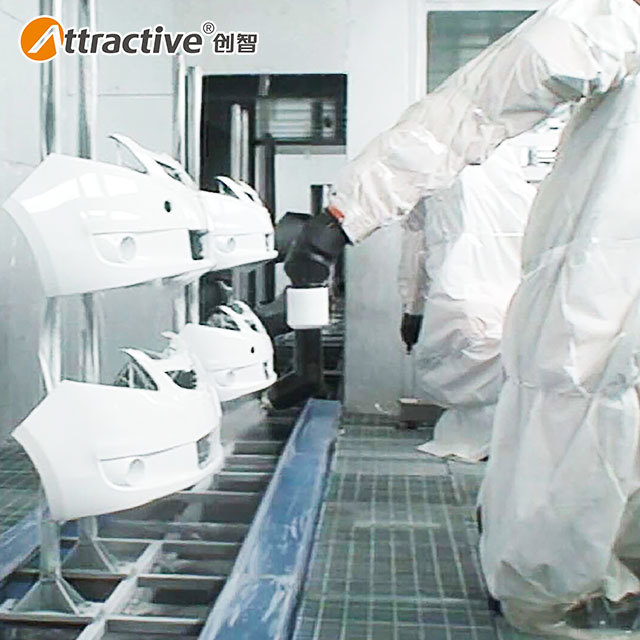
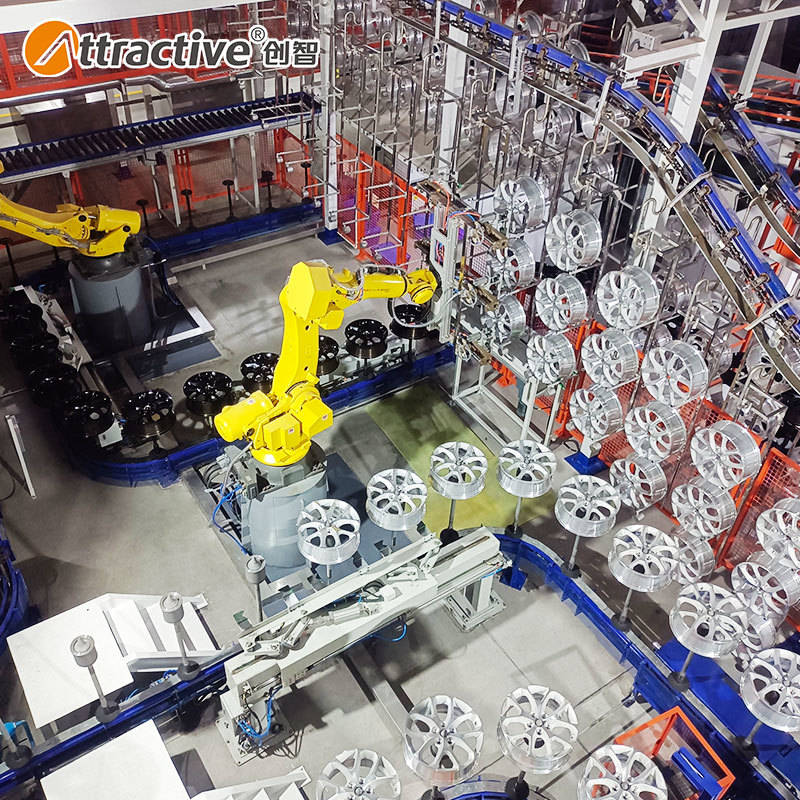
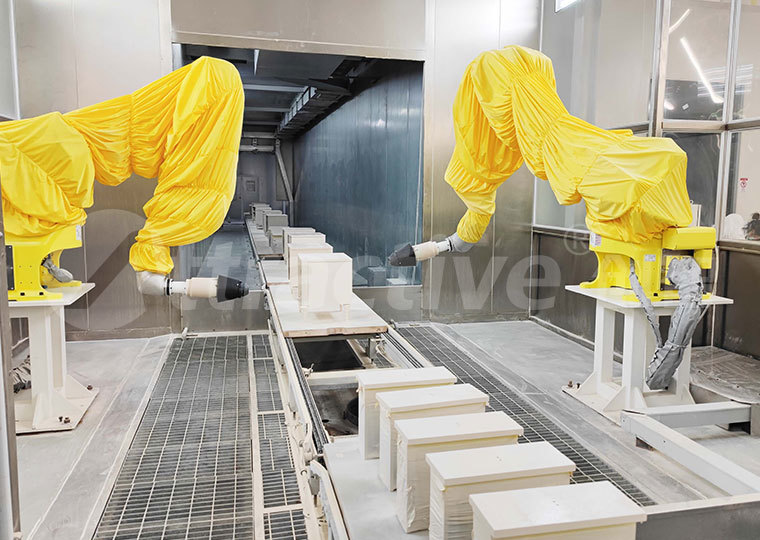
An automatic coating line means that the entire process from workpiece loading, pre-treatment, spraying, curing to unloading is completed by automated equipment without direct human intervention. Typical characteristics include:
- Robotic or reciprocator automatic spraying
- Automatic conveyor system (power-and-free chain, self-propelled trolleys)
- Centralized control system (PLC + SCADA)
- Automatic color change, automatic cleaning
- Online quality inspection and closed-loop control
1.2 Semi-Automatic Coating Line
A semi-automatic coating line means that certain key stages (usually spraying) are performed manually, while other stages (such as pre-treatment, conveying, curing) are automated or mechanized. Typical characteristics include:
- Manual gun spraying (in water curtain or dry spray booths)
- Assisted mechanical conveying (such as overhead chain, floor rail carts)
- Manual color change, manual cleaning
- Relies on operator skill
II. Cost Comparison: Initial Investment vs. Operating Expenses
2.1 Initial Investment (CAPEX)
| Item | Automatic Line | Semi-Automatic Line |
|---|---|---|
| Spraying Equipment | Robots + paint supply system: $210,000 - 420,000 | Manual guns + simple paint supply: $14,000 - 42,000 |
| Control System | PLC+SCADA+Vision: $70,000 - 140,000 | Simple electrical control: $7,000 - 21,000 |
| Conveyor System | Intelligent power-and-free/AGV: $110,000 - 210,000 | Simple overhead chain/floor rail: $28,000 - 70,000 |
| Installation & Commissioning | Complex, long lead time: $42,000 - 84,000 | Simple, short lead time: $7,000 - 21,000 |
| Total (Medium Scale) | Approximately $420,000 - 840,000 | Approximately $56,000 - 140,000 |
The initial investment for an automatic line is typically 5-8 times that of a semi-automatic line. This is the main reason many small and medium enterprises hesitate to adopt automatic lines.
2.2 Operating Expenses (OPEX)
| Cost Item | Automatic Line | Semi-Automatic Line | Explanation |
| Labor Cost | $14,000 - 28,000/year/shift | $42,000 - 70,000/year/shift | Automatic saves 60-70% labor |
| Coating Utilization | 70-90% (electrostatic + robot) | 30-50% (manual air spray) | Automatic saves tens to hundreds of thousands of USD annually on coatings |
| Energy Consumption | Optimized control, lower | Fluctuating, higher | Automatic saves 15-25% energy |
| Maintenance Cost | Higher (many precision parts) | Lower | Automatic maintenance costs about 30-50% higher |
| Rework and Scrap | <5% | 8-15% | Automatic provides stable quality, lower losses |
Long-term operating costs: Although automatic lines have higher initial investment, the cumulative savings in labor, coatings, and rework over a 5-year operating period often cover or even exceed the initial difference.
III. Efficiency and Capacity Comparison
3.1 Production Cycle Time
- Automatic Line: Stable cycle time, capable of 24-hour continuous operation. Robot speed can reach 1-2 m/s, color change takes only 2-5 minutes. Suitable for high-volume, high-cycle-time production.
- Semi-Automatic Line: Cycle time affected by manual speed, typically requires breaks and shift changes, difficult to run continuous night shifts. Color change takes 10-30 minutes. Suitable for low-volume, low-cycle-time production.
3.2 Capacity Utilization
Automatic lines can achieve high utilization through intelligent scheduling and quick changeover, with effective annual operating hours reaching 5500-6000 hours. Semi-automatic lines, constrained by manual efficiency and management level, typically achieve only 2000-3000 hours.
3.3 Changeover Flexibility
- Semi-Automatic Line: Manual color change, gun change, fixture adjustment, intuitive operation, suitable for high-mix, low-volume, frequent changeover scenarios. This is one of the core advantages of semi-automatic lines.
- Automatic Line: Although modern automated coating lines have quick color change and program switching capabilities, for very small batches (e.g., dozens of pieces), the programming and cleaning time for changeover may not be economical.
IV. Quality and Consistency Comparison
4.1 Coating Quality Stability
- Automatic Line: Robot trajectory repeatability ±0.1mm, film thickness deviation ±2-5μm, color difference ΔE<0.3. Almost no variation between batches, making it a mandatory requirement for high-end automotive, aerospace, 3C and other industries.
- Semi-Automatic Line: Quality highly dependent on operator skill and condition. Significant differences between shifts and workers, prone to defects such as uneven film thickness, sagging, and missed areas.
4.2 Complex Workpiece Handling Capability
For deep cavities, internal walls, and complex curved surfaces, robots can achieve precise spraying through offline programming and 3D vision; manual operation struggles to reach these areas stably, often resulting in blind spots.
4.3 Quality Traceability
Automatic lines can integrate online film thickness measurement, visual defect recognition, and MES systems to achieve quality data traceability for each workpiece. Semi-automatic lines typically rely on sampling inspection and post-hoc testing.
V. Return on Investment (ROI) Analysis
5.1 Typical Scenario Simulation
Assume an enterprise sprays 1 million products annually, with coating material cost of $0.70 per piece, annual labor cost (sprayers) of $111,000, and rework loss rate of 10% corresponding to $69,500.
Semi-Automatic Line:
- Initial investment: $111,000
- Annual operating cost: Coatings $700,000 + Labor $111,000 + Rework $69,500 + Maintenance $14,000 = $894,500
- Annual net profit (assuming fixed product profit): negligible
Automatic Line:
- Initial investment: $694,000
- Coating utilization increased to 85% → Annual coating savings of $104,000
- Labor reduced by 70% → Annual labor savings of $78,000
- Rework reduced to 3% → Annual rework savings of $48,600
- Annual operating cost: Coatings $596,000 + Labor $33,300 + Rework $20,800 + Maintenance $20,800 = $670,900
- Annual operating cost savings compared to semi-automatic line: $894,500 - $670,900 = $223,600
ROI Calculation:
- Simple payback period = $694,000 / $223,600 ≈ 3.1 years
- Considering a 10-year equipment life, cumulative savings over 10 years are $2,236,000, with a very attractive net present value.
5.2 Situations Suitable for Automatic Lines
- Annual output > 500,000 pieces or high product value
- Stringent quality requirements (automotive, aerospace, high-end home appliances)
- Continuously rising labor costs
- Stable long-term orders
5.3 Situations Suitable for Semi-Automatic Lines
- Annual output < 200,000 pieces
- Extremely high product variety, very small batch size (<100 pieces)
- Limited budget, need for rapid production launch
- Coating process still in exploratory stage

VI. How to Choose: A Step-by-Step Decision Framework
6.1 Step 1: Evaluate Output and Product Variety
- High output, low variety → Tend towards automatic
- Low output, high variety → Tend towards semi-automatic or flexible coating lines (automatic lines with quick changeover capability)
6.2 Step 2: Calculate Total Cost of Ownership
Quantify labor, coating, energy, maintenance, and rework costs over 5-10 years, comparing the Total Cost of Ownership (TCO) of the two options.
6.3 Step 3: Consider Quality Premium
If the quality improvement brought by an automatic line helps you secure high-end customer orders or product premiums, this implicit benefit should be included in the ROI calculation.
6.4 Step 4: Phased Implementation Strategy
For enterprises with limited capital or uncertain processes, a semi-automatic line can be implemented first. As output increases and the process matures, gradually upgrade to robotic spraying or full automation. Many customized coating solutions suppliers offer scalable modular designs.
VII. Conclusion: No Absolute Best, Only the Most Suitable
Automatic coating lines and semi-automatic coating lines are not opposing choices but rational options for different development stages and business models. Automatic lines trade higher initial investment for long-term low cost, high quality, and high efficiency, making them the necessary path for large-scale, high-end manufacturing. Semi-automatic lines, with their low entry barrier and high flexibility, meet the needs of small-batch, diversified production.
For most manufacturing enterprises, a rational strategy is: begin with the end in mind, plan dynamically. First clarify the product strategy and output targets for the next 3-5 years, then select the current most appropriate automation level based on financial models, while reserving space for future upgrades.
Whichever solution you choose, it is recommended to communicate in depth with experienced coating line equipment suppliers to obtain process validation data and customized solutions for your specific products. The right choice will make coating your competitive advantage, not a cost burden.
Next Page


Contact Us
No.2 Yingbin Avenue, High-tech District, Zhaoqing City, Guangdong Province, China.
Online Message