Turnkey Coating Line Projects: What Manufacturers Need to Know
Author:
Chuangzhi Coating
For many manufacturing enterprises, investing in a new coating line is a major and risky decision. From process design, equipment selection, civil works coordination to installation and commissioning, many specialized fields are involved. If enterprises handle scattered procurement and management themselves, not only will the project cycle be long, but they may also face issues such as subsystem incompatibility, finger-pointing, and cost overruns. This is where the "turnkey" model becomes an ideal solution. A turnkey coating line project means that the supplier is responsible for the entire process from solution design, equipment manufacturing, installation and commissioning to final acceptance. The customer only needs to "turn the key" to start production after project completion. This article systematically explains the key points manufacturers need to understand when selecting and implementing turnkey projects.
I. What is a Turnkey Coating Line Project?
Turnkey is a project delivery model where the supplier assumes all or most of the engineering responsibilities, delivering a complete, ready-to-operate coating line equipment system to the customer. The customer does not need to get involved in intermediate technical coordination and construction management, only needs to confirm whether the line meets the contracted performance indicators during project acceptance.
Typical turnkey project scope includes:
Process solution design and line layout planning
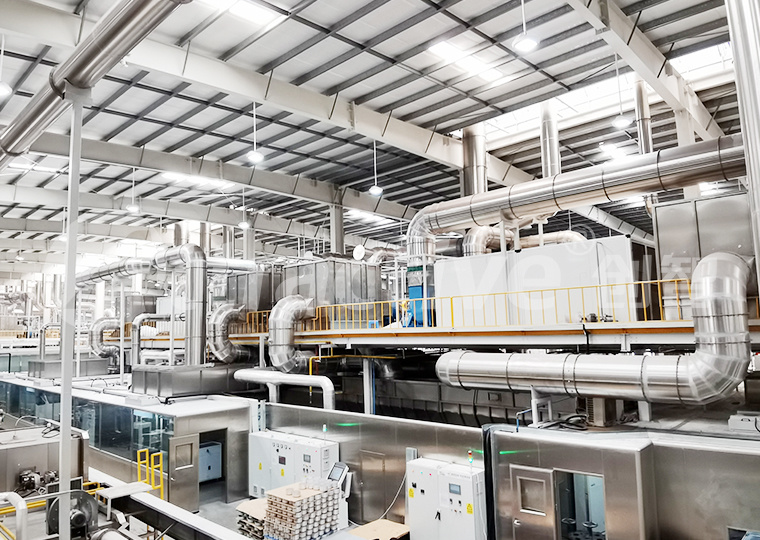
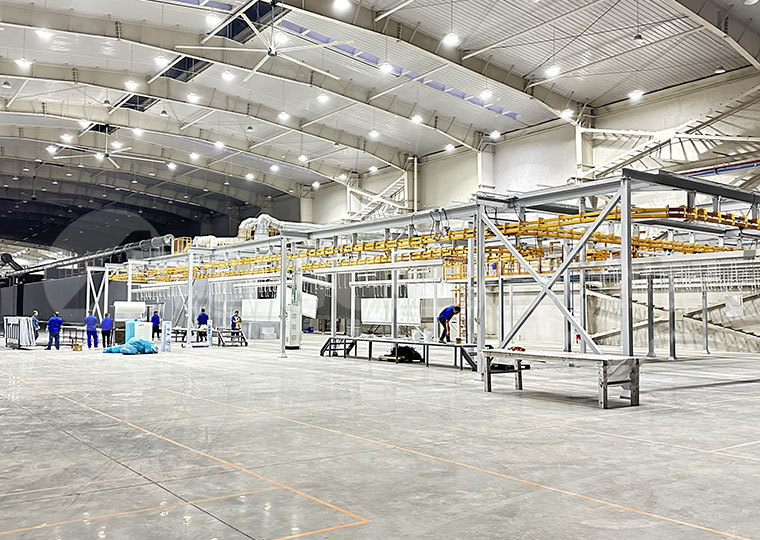
Manufacturing and supply of all equipment (pre-treatment, spray booth, curing oven, conveyor, environmental, control)
On-site installation and commissioning
Trial production and performance qualification
Operation and maintenance training
Technical documentation delivery
This model transfers complex technical risks and management burdens to professional automated coating line suppliers, allowing customers to focus on their core business.
II. Core Advantages of Turnkey Projects
2.1 Single Point of Responsibility, Avoiding Finger-Pointing
In traditional scattered procurement models, if interface issues arise between the spray booth supplier and the conveyor supplier, customers often find themselves caught in a blame game. In the turnkey model, the general contractor supplier takes full responsibility for the final performance of the entire line, and any coordination issues between subsystems are resolved internally.
2.2 Shortened Project Cycle
Turnkey suppliers have mature project management processes and standardized modules, allowing them to parallelize design, procurement, manufacturing, and installation work, reducing project cycles by 20-40% compared to customer-managed projects.
2.3 Reduced Technical Risks
Coating lines involve multiple disciplines including fluid mechanics, thermal engineering, electrical control, and environmental protection. Turnkey suppliers have interdisciplinary technical teams and rich experience libraries, able to identify and mitigate potential risks in advance, preventing customers from making wrong decisions due to lack of expertise.
2.4 Controllable Costs
Turnkey projects typically use fixed-price contracts. Customers know the total investment amount at project initiation, avoiding the budget overruns common in scattered procurement. Additionally, suppliers achieve better cost structures through volume purchasing and optimized design.
2.5 Guaranteed Performance Indicators
Professional turnkey suppliers commit to key performance indicators (KPIs) such as capacity, yield, energy consumption, and emissions in the contract, and verify them through trial production. This provides customers with strong performance assurance.
III. Key Evaluation Dimensions for Selecting a Turnkey Supplier
3.1 Industry Experience and Success Cases
Does the supplier have experience delivering coating lines in your industry? It is recommended to review at least three successful cases for similar products and, if possible, conduct site visits to understand the actual operating status of the equipment and customer satisfaction.
3.2 Process Laboratory and Validation Capability
Excellent turnkey suppliers should have their own coating process laboratory, capable of performing full-process validation of pre-treatment, spraying, and curing using customer-provided workpieces and coatings, determining optimal process parameters before line design. This greatly reduces the risk of "theoretical designs."
3.3 Core Technology Mastery
Does the supplier master the core technologies of customized coating solutions, such as robot offline programming, 3D vision guidance, intelligent control systems, and heat recovery technology? Or do they simply rely on external assembly? The stronger the in-house R&D capability, the higher the system integration and long-term maintainability.
3.4 Project Management and Construction Capability
Turnkey projects involve on-site construction management. Does the supplier have a professional project management team? Can they coordinate civil works and utility interfaces such as water, electricity, and gas? Do they have a complete safety management system?
3.5 After-Sales Service and Spare Parts Support
Coating lines typically have a service life of 10-15 years. Does the supplier have service outlets in the customer's region? How fast is the spare parts response? Can they provide remote diagnostics and preventive maintenance services?
IV. Typical Process of a Turnkey Project
4.1 Requirements Analysis and Solution Design Phase (4-8 weeks)
Customer provides workpiece drawings, output targets, coating standards, site conditions
Supplier performs process analysis, proposes preliminary layout and technical solution
Both parties sign technical agreement and commercial contract
4.2 Detailed Design and Equipment Manufacturing Phase (12-24 weeks)
Supplier completes detailed mechanical, electrical, and software design
Key equipment (such as robots, curing ovens, control systems) is manufactured and pre-assembled in the factory
Customer can perform Factory Acceptance Testing (FAT) to verify equipment functions
4.3 On-Site Installation and Commissioning Phase (8-16 weeks)
Equipment arrives at customer site for positioning and connection
Supplier engineers perform single-machine and integrated commissioning
No-load trial run to check conveying, spraying, curing, and other stages
4.4 Trial Production and Performance Qualification Phase (4-8 weeks)
Trial production using customer's actual workpieces and coatings
Gradually increase output, optimize process parameters
Both parties jointly conduct performance qualification to verify contracted KPIs (capacity, yield, energy consumption, emissions, etc.)
4.5 Acceptance, Training, and Handover (2-4 weeks)
Complete final acceptance (Site Acceptance Test)
Provide systematic training to customer's operators, maintenance personnel, and process engineers
Risk: Customer frequently changes requirements mid-project, causing delays and cost increases. Mitigation: Invest sufficient time in the solution design phase to develop a detailed technical specification, and agree on a change management process and cost calculation method.
5.2 Supplier Inexperience
Risk: Supplier lacks delivery experience for similar products, leading to design flaws or commissioning difficulties. Mitigation: Rigorously review supplier's successful cases and request references for customer sites that can be visited.
5.3 Delays in Civil Works and Utilities
Risk: Customer's factory infrastructure or utility connections are not completed on time, affecting equipment installation. Mitigation: Clearly define responsibility interfaces and milestone schedules in the contract; customer should assign a dedicated coordinator.
5.4 Ambiguous Performance Qualification Criteria
Risk: Definitions of "capacity" and "yield" in the contract are unclear, leading to disputes during acceptance. Mitigation: Clearly define KPI calculation methods, test conditions, and sampling rules in the technical agreement.
5.5 Slow After-Sales Service Response
Risk: Failures occur after line commissioning, and supplier responds slowly, causing production losses. Mitigation: Contractually agree on service response times and spare parts delivery times, and establish a spare parts inventory mechanism.
VI. Key Success Factors for Turnkey Projects
6.1 Clear Requirement Definition
Customers should clarify product specifications, output targets, quality standards, and budget scope as much as possible before project initiation. Vague requirements are the biggest root cause of project failure.
6.2 Choosing the Right Supplier
Do not only look at the price; comprehensively evaluate technical capability, industry experience, project management, and service reputation. The lowest price often means later changes and additions.
6.3 Effective Communication Mechanism
Establish regular project meeting schedules, with both project managers maintaining close communication to resolve issues promptly. It is recommended to use project management tools to track progress and issue lists.
6.4 Reasonable Expectation Management
Turnkey does not mean a "magic key." Customers should understand that commissioning and optimization of coating lines take a certain amount of time, especially for new products and processes, requiring a reasonable ramp-up expectation.
6.5 Long-Term Partnership Mindset
Treat the supplier as a long-term partner, not a one-time transaction. A good cooperative relationship helps secure prioritized technical support and upgrade services.
VII. Conclusion
Turnkey coating line projects are an effective way for manufacturing enterprises to quickly establish high-quality coating capabilities. They transfer complex technology integration, project management, and risk control to professional coating line equipment suppliers, allowing customers to focus on product development and market expansion.
However, turnkey is not "hand over and forget." Successful projects require customers to invest sufficient effort in requirement definition, supplier selection, contract negotiation, and process cooperation. Only by building trust and close collaboration between both parties can a truly efficient, stable, and economical automated coating line be delivered.
If you are planning a new coating line investment, we recommend engaging in in-depth discussions with turnkey-capable customized coating solutions suppliers to obtain process validation data and project proposals tailored to your products. As a professional turnkey project integrator of coating line equipment, Attractivechina has rich industry experience and numerous successful cases, committed to providing customers with full-process services from process design, equipment manufacturing to installation and commissioning. It is a trustworthy partner for you. The right choice will make your coating line a core competitive advantage for your factory.