












Related News
27
2026
-
05
Custom Coating Line Design for Heavy Machinery Components
Author:
Chuangzhi Coating
Unlike automotive parts or home appliances, heavy machinery components face completely different coating challenges. Excavator arms weighing several tons, crane booms over ten meters long, and irregularly shaped mining equipment housings impose stringent requirements on coating line design: oversized dimensions, extremely high weight, complex internal cavities, and corrosion protection for extreme service conditions. Standard coating lines cannot meet these demands; only customized coating solutions can. This article systematically explains the design essentials, core processes, and equipment selection for heavy machinery component coating lines, providing professional references for related manufacturers.

I. Special Challenges of Coating Heavy Machinery Components
1.1 Workpiece Dimensions and Weight
- Length up to 12-18 meters, width 2-3 meters, height 1.5-2.5 meters
- Single piece weight ranging from 500kg to 10 tons
- Conventional overhead chain conveyor systems cannot handle such loads
1.2 Coating Performance Requirements
- Extreme outdoor conditions: salt spray resistance exceeding 1,000 hours
- Impact resistance: withstand stone chipping (ASTM D3170)
- Weather resistance: gloss and color retention for 5-10 years
- Multi-coat system: zinc-rich primer + epoxy intermediate + polyurethane topcoat, total film thickness 150-300μm
1.3 Process Difficulties
- Many hard-to-spray areas such as deep cavities, weld seams, and edges
- High film thickness requirements prone to sagging in single pass
- Significant energy consumption for curing large workpieces
- Pre-treatment must thoroughly remove mill scale and weld slag
II. Core Design Elements of Heavy Machinery Coating Lines
2.1 Conveyor System — The "Highway" for Large Workpieces
Conveying heavy workpieces is the primary challenge in line design. Recommended solutions:
- Heavy-duty floor-mounted power-and-free chain: load capacity 2-10 tons, capable of heavy load, accumulation, and lifting
- Heavy-duty pallet conveyor system: workpieces fixed on pallets, suitable for high-precision positioning requirements
- Dual-track self-propelled trolleys: each trolley independently driven, variable speed, and liftable, offering highest flexibility
Conveyor design must consider: thermal expansion allowance when workpieces enter/exit ovens, turning radius (typically ≥3 meters), and maintenance access width.
2.2 Pre-treatment — The Foundation of Heavy Corrosion Protection
Heavy component surfaces often have mill scale, weld slag, and oil that ordinary spraying cannot remove.
- Shot blasting / sandblasting pre-treatment: independent blast room before entering coating line to remove scale and rust, achieving Sa2.5 cleanliness
- High-pressure spray + immersion combination pre-treatment: immersion tanks ensure full coverage for components with complex internal cavities
- Silane/zirconium conversion coating: replaces traditional phosphating, environmentally friendly with better adhesion
2.3 Spraying System — Balancing High Film Thickness and Uniformity
Heavy components often require total film thickness of 150-300μm, needing multiple spray passes.
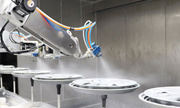
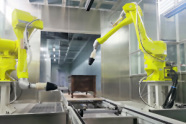
- Large-reach spray robots: arm reach 2.5-3.5 meters, mounted on mobile rails or gantries to cover entire workpiece
- Airless/air-assisted airless spraying: suitable for high-viscosity coatings, single-pass film thickness up to 60-100μm
- Electrostatic spraying optional: but Faraday cage effects must be considered; deep cavities may require manual touch-up
- Multi-station series arrangement: primer, intermediate, and topcoat applied at separate stations with flash-off zones between
2.4 Curing System — Energy-Saving Design for Large Ovens
Curing ovens for large components consume significant energy and require specialized optimization.
- Gas-fired direct heat recirculating oven: fast heat-up, lower operating cost than electric
- Zone temperature control: divided into preheat zone, holding zone, and forced cooling zone along the length to avoid energy waste
- Heat recovery system: exhaust waste heat used to heat pre-treatment baths or workshop space
- Forced cooling section: reduces workpiece cooling time, improving line cycle time
III. Case Study: Custom Coating Line for a Construction Machinery Manufacturer
3.1 Customer Requirements
A well-known excavator manufacturer needed a new coating line for medium-sized excavator arms, sticks, and buckets:
- Largest workpiece: length 8.5m, width 1.8m, weight 3.5 tons
- Annual output: 120,000 pieces
- Coating system: zinc-rich epoxy primer (80μm) + polyurethane topcoat (80μm), total 160μm
- Salt spray resistance: ≥1,000 hours
3.2 Design Solution
- Conveyor: dual-track self-propelled trolley system, 8 trolleys in circulation, each rated for 4 tons
- Pre-treatment: shot blasting + 8-station high-pressure spray (degrease - rinse - silanization - rinse - dry)
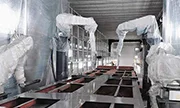
- Spraying: two gantry-mounted robots, each with airless spray guns; primer and topcoat applied in separate zones
- Curing: gas-fired direct heat oven, 28m length, three temperature zones, with heat recovery
3.3 Results
- Cycle time per piece: 18 minutes
- First-pass yield: 96.5%
- Coating utilization: improved from 40% (manual) to 70%
- Payback period: 22 months
IV. Environmental and Safety Design Essentials
Heavy machinery coating lines typically use solvent-borne high-solid coatings, generating significant VOC emissions.
- Exhaust treatment: Regenerative Thermal Oxidizer (RTO) or Catalytic Oxidizer (CO) with ≥98% destruction efficiency
- Wastewater treatment: pre-treatment wastewater requires physico-chemical + biological treatment to meet discharge standards
- Explosion-proof design: spray booth and paint mixing room designed as hazardous areas; electrical equipment Ex-certified
- Personnel protection: supplied-air respirators or central air supply systems
V. Why Choose Customization Over Standardization
Many suppliers try to "force-fit" standard coating line products onto heavy machinery projects, often resulting in:
- Conveyor system overload and frequent breakdowns
- Spray guns unable to reach workpiece edges, requiring extensive touch-up
- Non-uniform oven temperature, leading to localized under-cure
A true customized coating solution must start from workpiece characteristics, calculating load, heat balance, airflow, and spray trajectories item by item, validated through simulation. This is not a simple combination of standard equipment but a systems engineering effort.
Conclusion
Designing coating lines for heavy machinery components is a comprehensive test of a supplier's process understanding, non-standard design capability, and project management skills. A successful automatic coating line can improve coating efficiency for large workpieces by over 50%, while significantly reducing rework rates and operating costs.
SEO:
Next Page


Contact Us
No.2 Yingbin Avenue, High-tech District, Zhaoqing City, Guangdong Province, China.
Online Message