













Related News
19
2026
-
05
Smart Coating Lines: Automation, Data & AI Integration
Author:
Chuangzhi Coating
Traditional coating lines rely on fixed programs and manual experience, struggling with high-mix low-volume production, stringent quality requirements, and environmental pressures. The emergence of smart coating lines deeply integrates automation, data, and artificial intelligence, giving coating equipment the ability to sense, decide, learn, and self-optimize. This is not just a technology upgrade but a fundamental change in production models. This article systematically analyzes the three core pillars of smart coating lines and their synergistic value.

I. Automation: The "Muscles and Bones" of Smart Coating Lines
Automation is the physical foundation of smart coating lines. Without precise actuators, data and AI cannot be implemented.
1.1 Robotic Spraying and Flexible Conveying
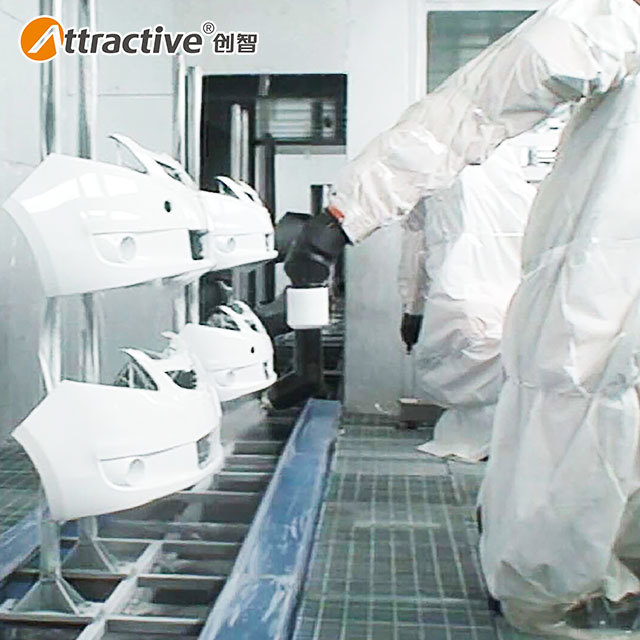
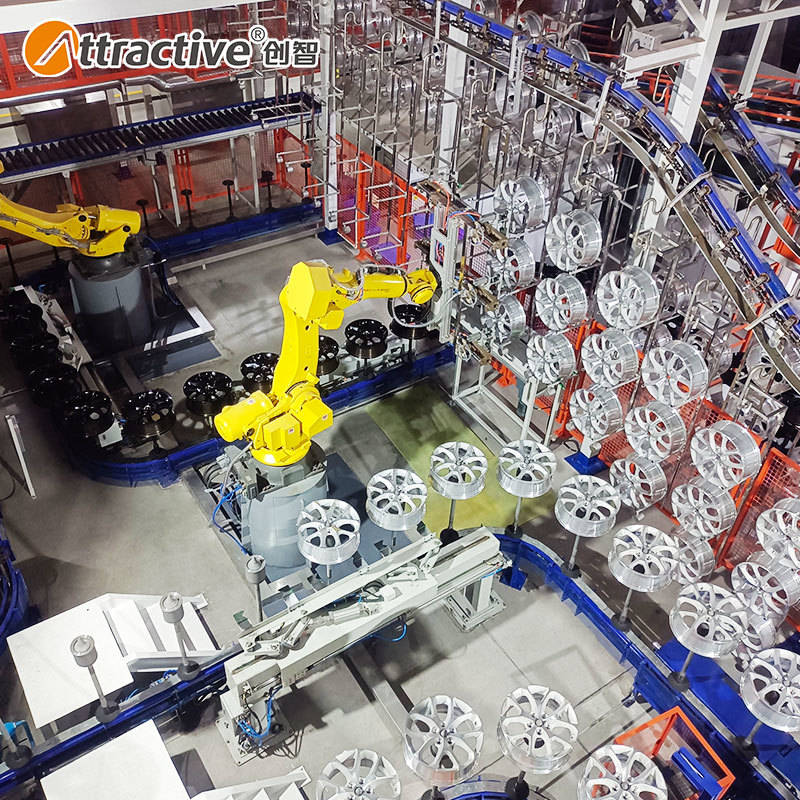
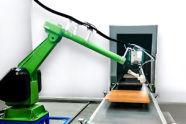
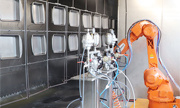
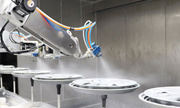
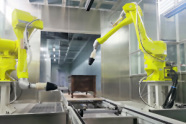
Modern automated coating lines commonly use 6-axis or 7-axis industrial robots with high-precision electrostatic bells to achieve precise spraying on complex trajectories. Robot repeatability can reach ±0.05mm, far exceeding manual capability. Flexible conveyor systems (AGVs, power-and-free chains, self-propelled trolleys) automatically route workpieces based on production commands, enabling mixed-model production.
1.2 Automatic Color Change and Quick Changeover
Smart coating lines are equipped with automatic color change valve blocks, pipeline cleaning systems, and quick-change fixtures. Color change time is reduced from traditional 30 minutes to 2-5 minutes; changeover time is reduced from half a day to under 30 minutes. This is the core capability of flexible coating lines.
1.3 Closed-Loop Execution Control
Through real-time feedback from encoders, flow meters, and pressure sensors, PLCs or robot controllers dynamically adjust spraying parameters to ensure film thickness, atomization quality, and spray trajectory remain optimal. Automation is no longer "fixed program" but a "sense-respond" closed loop.
II. Data: The "Blood" of Smart Coating Lines
Data is the bridge connecting automation and AI. Without high-quality data, AI cannot function.
2.1 Full-Process Data Collection
Smart coating lines deploy hundreds of sensors at key points:
- Process data: Temperature, pressure, flow rate, voltage, current, humidity
- Equipment status: Vibration, bearing temperature, motor current, running time
- Quality data: Film thickness, color difference, gloss, defect images
- Energy data: Electricity, gas, water, coating consumption
This data is collected at millisecond frequencies and uploaded to edge computing nodes or cloud platforms.
2.2 Data Standardization and Governance
Data from different devices and using different protocols needs to have a unified format and semantics. Smart coating lines typically use OPC UA or MQTT protocols to map data to standardized information models. Data dictionaries and tag systems are established to ensure usability for subsequent analysis.
2.3 Data Visualization and Monitoring
Through SCADA or industrial IoT platforms, managers can view real-time line status, OEE, energy trends, and quality distribution. Anomalies are automatically highlighted and can be pushed to mobile devices. Dashboards become the primary interface for production decision-making.
III. Artificial Intelligence: The "Brain" of Smart Coating Lines
AI transforms data into insights and actions, making "intelligence" possible.
3.1 AI Vision Defect Detection
Using deep convolutional neural networks (CNN), AI vision systems can identify over 15 defect types including runs, orange peel, craters, particles, color difference, and exposed substrate, with accuracy exceeding 98%. Compared to manual inspection, AI is faster (>100 parts/minute), more consistent, and never fatigues. Detection results are fed back to the spray station in real-time for closed-loop correction.
3.2 Process Parameter Optimization
Using machine learning (e.g., random forest, XGBoost, neural networks) to analyze historical data, models are built correlating process parameters with quality indicators. For new products, AI recommends optimal spraying parameters based on workpiece characteristics, reducing setup time by 70%. During online operation, if parameters drift beyond thresholds, the system automatically alerts and suggests adjustments.
3.3 Predictive Maintenance
Collect characteristic values (vibration, temperature, current, etc.) from key equipment (robots, fans, pumps, oven burners) to train remaining useful life (RUL) prediction models. The system warns of potential failures 2-4 weeks in advance, allowing planned maintenance and avoiding unexpected downtime. Unplanned downtime can be reduced by over 60%—one of the most ROI-positive AI applications in intelligent coating systems.
3.4 Intelligent Scheduling
AI algorithms automatically generate optimal production sequences based on order priority, coating inventory, equipment status, and color change costs. Products with similar colors and temperature requirements are grouped together to reduce color changes and oven ramp-ups. When equipment fails or urgent orders arrive, the system dynamically reschedules the line to minimize losses.
IV. Trinity: Synergistic Value of Automation, Data & AI
The true power of smart coating lines comes from the synergy of the three:
- Automation provides execution — precisely carrying out AI commands
- Data provides perception — reflecting line status and quality results in real-time
- AI provides decision-making — learning from data, continuously optimizing parameters and strategies
This synergy creates a "sense-decide-act-feedback" closed loop. With each workpiece produced, the system learns; with each adjustment, quality improves. This is an evolution speed unattainable by traditional coating lines.
V. Implementation Path: How to Build a Smart Coating Line
Moving from a traditional coating line to a smart coating line is recommended in phases:
| Phase | Goal | Key Actions |
|---|---|---|
| Phase 1 | Automation foundation | Upgrade robots, VFDs, automatic color change, SCADA monitoring |
| Phase 2 | Data collection & visualization | Deploy sensors, establish IIoT platform, OEE dashboard |
| Phase 3 | Single-point AI applications | Introduce AI vision inspection, parameter recommendation, predictive maintenance |
| Phase 4 | System integration & closed loop | MES integration, intelligent scheduling, full traceability, self-optimizing control |
Conclusion
Smart coating lines are the embodiment of Industry 4.0 in surface treatment. The deep integration of automation, data, and AI transforms coating processes from "fixed program execution" to "continuous learning and self-optimization." This delivers comprehensive improvements in quality, efficiency, and cost, while giving enterprises the agility to respond to market changes.
Whether you need a new intelligent coating system or want to digitally upgrade and add AI capabilities to an existing automated coating line, Attractivechina provides full-process services from diagnosis, design, implementation to training.


Contact Us
No.2 Yingbin Avenue, High-tech District, Zhaoqing City, Guangdong Province, China.
Online Message