












Related News

24
2025
-
04
Troubleshooting Guide for Common Faults in Coating Lines
Author:
Chuangzhi Coating
During the operation of coating lines, it is inevitable that various faults will be encountered. If these faults cannot be handled in time, it will not only affect the production progress, but also may have a serious impact on product quality. This article will provide a detailed introduction from three aspects: classification of common faults in coating lines, troubleshooting steps and specific fault handling.
Ⅰ. Classification of Common Faults in Coating Lines
Coating line faults can be roughly divided into four categories: mechanical faults, electrical faults, process faults and environmental faults.
a. Mechanical faults: mainly include conveyor belt deviation, chain breakage, motor abnormality, etc. This type of fault is usually caused by aging, wear or improper installation of equipment.
b. Electrical faults: including unstable power supply, sensor failure, PLC program errors, etc. Electrical faults often cause the equipment to fail to start or run abnormally.
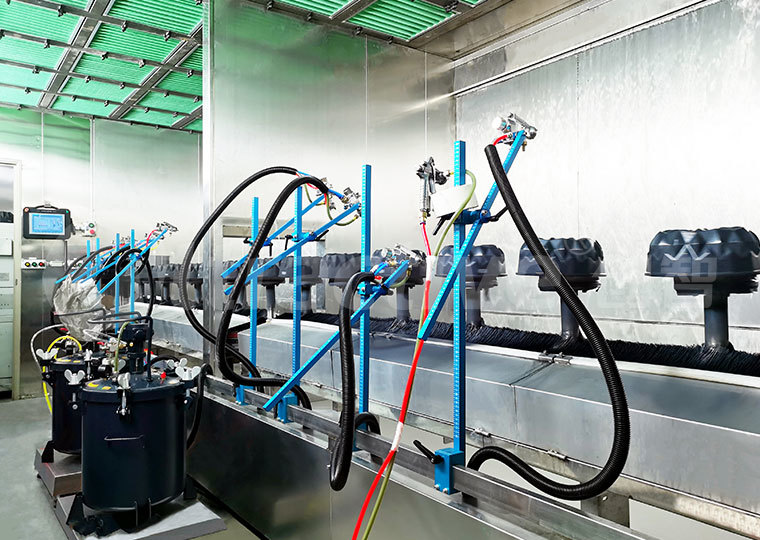
c. Process faults: such as unstable paint viscosity, uneven spraying, and substandard drying temperature. Process faults directly affect the coating effect and product quality.
d. Environmental faults: mainly involve problems such as substandard waste gas and wastewater treatment, and excessive noise. Environmental failures not only affect the production environment, but may also trigger penalties from the environmental protection department.
Ⅱ. Troubleshooting Steps for Coating Lines
In the face of coating line failures, orderly troubleshooting steps can quickly locate the problem and improve maintenance efficiency. The following are the general steps for troubleshooting coating lines:
a. On-site observation: First, maintenance personnel should carefully observe the fault site to understand the fault phenomenon, occurrence time and possible causes.
b. Information collection: Collect relevant information before and after the fault occurs by asking operators and checking equipment operation records.
c. Preliminary judgment: Preliminary judgment of the fault type and possible causes based on the fault phenomenon and information collection results.
d. Detailed detection: Use professional tools to conduct detailed detection of suspected faulty parts, such as measuring voltage and current, checking sensor sensitivity, etc.
e. Fault location: Accurately locate the fault point based on the detection results.
f. Develop a maintenance plan: Develop a detailed maintenance plan for the fault point, including required materials, tools, maintenance steps, etc.
g. Implement maintenance: Repair the fault according to the maintenance plan to ensure that the equipment resumes normal operation.
h. Trial run and acceptance: After the maintenance is completed, the equipment is tested to check whether the fault is completely eliminated, and necessary adjustments and optimizations are made.
Ⅲ. Specific Fault Handling Cases
a. Conveyor belt deviation fault
Fault phenomenon: The conveyor belt deviates from the predetermined track during operation.
Troubleshooting steps: First, check whether the conveyor belt tension is appropriate and adjust the tensioning device; second, check whether the roller is damaged or improperly installed, and replace or adjust it in time; finally, check the parallelism and coaxiality of the driving roller and the driven roller to ensure that they are on the same horizontal line.
Handling measures: According to the troubleshooting results, adjust the tensioning device, replace the roller or adjust the roller position until the conveyor belt runs smoothly.
b. Unstable paint viscosity fault
Fault phenomenon: The paint viscosity fluctuates greatly, affecting the spraying effect.
Troubleshooting steps: First, check whether the paint stirring system is working properly to ensure that the paint is mixed evenly; second, check whether the viscometer is accurate and calibrate it regularly; finally, check the paint storage environment to ensure that the temperature and humidity are appropriate.
Treatment measures: Strengthen the maintenance of the paint stirring system, calibrate the viscometer regularly, improve the paint storage environment, and ensure the stability of the paint viscosity.
c. Drying temperature failure
Failure phenomenon: The temperature in the drying chamber is lower than the set value, resulting in poor coating curing.
Troubleshooting steps: First, check whether the heating element is damaged or aged, and replace it in time; second, check whether the temperature sensor and controller are working properly to ensure accurate temperature control; finally, check the sealing performance of the drying chamber to prevent heat loss.
Treatment measures: Replace the damaged heating element, calibrate the temperature sensor and controller, strengthen the sealing performance of the drying chamber, and ensure that the drying temperature meets the standard.
Troubleshooting of the coating line is a complex and meticulous work, which requires maintenance personnel to have rich professional knowledge and practical experience. In actual operation, maintenance personnel should combine the actual situation and flexibly use these methods to continuously improve the efficiency of troubleshooting and maintenance, and escort the production of the enterprise. At the same time, enterprises should also strengthen the daily maintenance and maintenance of the painting line, reduce the occurrence of failures, and improve production efficiency and product quality.


Contact Us
No.2 Yingbin Avenue, High-tech District, Zhaoqing City, Guangdong Province, China.
Online Message