











Related News

02
2025
-
09
Large-Scale Painting Solutions for Complete Train Coating
Author:
Chuangzhi Coating
Complete train coating is not only for aesthetic enhancement but also requires coatings to achieve core protective functions such as weather resistance, salt spray resistance, and impact resistance. The ultra-large size of a single train carriage (20-25m in length, 3-4m in width, 4-5m in height) and complex structures (including windows, doors, and joints) impose far higher requirements on the painting booth's space adaptability, paint mist control, and spraying precision than ordinary vehicles. As a professional manufacturer of coating line equipment, we have developed a "space-customized + process-intelligent + environment-compliant" large-scale painting booth solution for the characteristics of complete trains, enabling efficient full-process coating from pretreatment to topcoat.
Preliminary Planning: Customizing Booth Size and Capacity Based on Train Characteristics
The core prerequisite for a large-scale painting booth is "adapting to train size," requiring precise planning from both spatial layout and production rhythm perspectives.
Size customization must meet the needs of complete train entry, exit, and operation: The length of a single-train coating booth should be ≥30m (reserving 5-8m of operating space at the front and rear of the carriage), width 6-8m (accommodating 2-3m of working space on both sides of the carriage), and height 6-8m (reserving lifting space for the spraying robot arm). For multi-car articulated coating needs (e.g., EMUs), a "multi-station integrated painting booth" can be designed, with each station controlled independently. Tracked conveying enables sequential carriage transfer, avoiding efficiency losses from single-car coating.
Conveying system must support ultra-heavy loads: Railway-standard rail-mounted AGVs (Automated Guided Vehicles) are used, with a load capacity of ≥50 tons, positioning accuracy of ±5mm, and adjustable speed of 0.5-2m/min. They enable 360° fine adjustment of the carriage (±100mm horizontally, ±50mm vertically) to ensure precise alignment of spraying robots with complex parts. Emergency traction devices are also equipped to prevent production downtime due to AGV malfunctions.
Capacity matching must align with coating cycles: For an annual output of 100 train sets (8 carriages per set), the coating cycle per carriage must be controlled at 8-12 hours (including pretreatment, primer, topcoat, and drying). Thus, the painting booth needs 3 core stations (pretreatment + primer + topcoat), each with independent ventilation and temperature control systems, enabling "parallel production and assembly-line operation."
Core Systems: Solving Three Technical Difficulties in Train Coating
To address the pain points of "difficult paint mist control, uneven spraying, and incomplete drying" in train coating, the painting booth is equipped with three core systems.
1. Negative Pressure Ventilation and Paint Mist Capture System
A single train carriage has a coating area of over 200㎡, generating massive paint mist. Negative pressure ventilation is key to preventing leakage and ensuring cleanliness. A "top-supply, bottom-suction" three-dimensional ventilation structure is adopted: The top is fitted with a flow equalizer (30%-40% opening rate) to deliver filtered clean air (class 10,000 cleanliness) downward at a uniform wind speed of 0.4-0.6m/s; the bottom uses honeycomb-shaped paint mist capture pads (50mm thick) combined with a water-spin paint mist treatment device, achieving a paint mist capture efficiency of ≥98% and preventing paint mist from adhering to the carriage surface to form particles.
The ventilation system is equipped with variable-frequency fans that automatically adjust wind speed based on the coating stage: 0.5m/s during spraying (for efficient paint mist capture) and 0.2m/s during drying (to reduce heat loss). Air curtains (wind speed ≥8m/s) are installed at the booth's entrance and exit to form an "air barrier" and prevent external dust ingress.
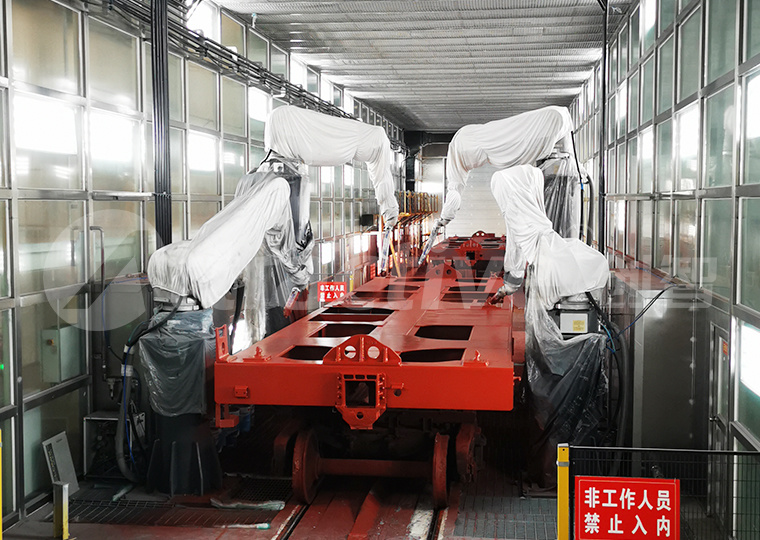
2. Intelligent Spraying Robot System
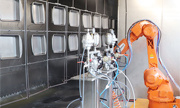
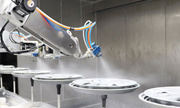
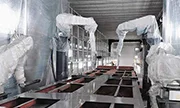
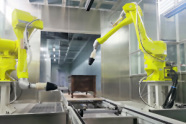
The complex structure of trains requires "dead-angle-free, uniform spraying," which is difficult for traditional manual operations to achieve. The painting booth is equipped with 4-6 7-axis heavy-duty spraying robots (working radius 6-8m, load ≥50kg), combined with 3D laser profile scanners that scan the carriage surface in real time (accuracy ±1mm) and automatically generate spraying paths: For flat areas (e.g., carriage sidewalls), reciprocating spraying is used (speed 5-8m/min, film thickness deviation ≤±5μm); for irregular parts (e.g., window frames, door hinges), "spot spraying + sweep spraying" mode is activated, with small spray guns (φ3-5mm) to avoid paint accumulation.
The paint supply uses a central paint supply system: Paint tanks (capacity 500-1000L) are equipped with constant-temperature devices (25±2℃) and agitators (speed 30-50r/min) to ensure stable paint viscosity (20-30s with Tu-4 cup); paint delivery pipelines are made of stainless steel, with pressure monitoring points every 10m to prevent spraying interruptions caused by pipeline blockages.
3. Gradient Temperature-Controlled Drying System
Train coatings are 80-120μm thick (30-40μm primer + 50-70μm topcoat), requiring gradient heating to ensure uniform curing. The booth's drying area uses a "hot air circulation + infrared auxiliary" composite heating method: The first stage (preheating) is 80-100℃ for 2-3 hours to slowly volatilize solvents on the coating surface; the second stage (curing) is 120-140℃ (primer)/60-80℃ (topcoat) for 4-5 hours. The PLC precisely controls the heating rate (5℃/min) to avoid coating cracking due to internal-external temperature differences.
The drying area is equipped with temperature sensors (one every 2m) that feed back the carriage surface temperature in real time. If the data deviation exceeds ±3℃, the heating power is automatically adjusted. A waste heat recovery device is also installed to use heat from exhausted hot air for preheating fresh air, reducing energy consumption by 25%-30%.
Environmental and Safety Configuration: Meeting Strict Compliance Requirements
Train coating involves large amounts of paint, making environmental protection and safety mandatory standards.
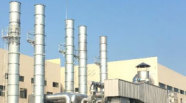
The VOC treatment system adopts a three-stage process of "paint mist filtration + activated carbon adsorption + RTO incineration": After paint mist is filtered by capture pads, it enters an activated carbon adsorption tower (iodine value ≥1000mg/g) with an adsorption efficiency of ≥90%; saturated activated carbon is desorbed with hot nitrogen, and the desorbed VOCs are sent to an RTO (Regenerative Thermal Oxidizer) incinerator (800-850℃) to decompose into CO₂ and H₂O. The total VOC removal rate is ≥95%, with an emission concentration ≤30mg/m³, meeting China's "Standards for the Control of Volatile Organic Compounds Emissions."
For safety protection, the painting booth is equipped with combustible gas detectors (detection range 0-100% LEL), temperature sensors, and spray fire-extinguishing devices. If the gas concentration exceeds 25% of the lower explosive limit or the temperature exceeds 60℃, alarms and fire-extinguishing systems are automatically triggered. A negative pressure monitor is also installed to maintain the booth's internal negative pressure at -5 to -10Pa, preventing paint mist leakage from endangering operators' health.

Application Case: Coating Upgrade for a Rail Transit Enterprise
After a large rail transit enterprise introduced this solution, the efficiency of complete train coating improved significantly: The coating time per carriage was reduced from 16 hours to 10 hours, and the coating qualification rate increased from 82% to 99.5%; the VOC emission concentration dropped from 80mg/m³ to 25mg/m³, reducing annual environmental costs by approximately 1.5 million yuan. Tests on its EMU carriages showed that the coating's salt spray resistance reached 1200 hours and weather resistance reached 15 years, meeting the requirements for use in harsh environments such as alpine and coastal areas.
Conclusion
The core value of large-scale painting booths for complete train coating lies in "customized adaptation"—it must overcome spatial and conveying challenges posed by ultra-large sizes, ensure coating precision and protective performance through intelligent processes, and meet environmental compliance. As equipment manufacturers, we can provide turnkey services from solution design, equipment manufacturing to commissioning and training based on customers' train types (conventional trains, EMUs, subways), capacity needs, and coating standards, helping rail transit enterprises achieve "efficient, high-quality, and green" complete train coating production.
SEO:


Contact Us
No.2 Yingbin Avenue, High-tech District, Zhaoqing City, Guangdong Province, China.
Online Message