















Related News

06
2026
-
02
Non-Stick Coating Line for Industrial Bakeware Products
Author:
Chuangzhi Coating
In commercial bakeries, large-scale central kitchens, and food processing plants, industrial-grade bakeware—from heavy-duty commercial baking sheets and various cake molds to continuous oven conveyor belts—forms the cornerstone of daily high-volume output. Their surface performance directly determines ease of release, cleaning efficiency, and ultimately, product quality and production throughput. Therefore, a professional Non-Stick Coating Line for Industrial Bakeware Products is no longer an "optional feature" but essential core production equipment that ensures food safety, enhances operational efficiency, and reduces long-term costs. Through high automation and precise process control, it durably and uniformly bonds high-performance food-grade non-stick coatings (such as PFOA-free PTFE or ceramic coatings) onto metal substrates (typically aluminum or steel), enabling them to withstand frequent thermal cycling, metal utensil scraping, and industrial cleaning.

Industrial-Grade Challenges: Stringent Requirements Beyond Domestic Standards
Unlike domestic utensils, industrial bakeware faces extreme and continuous operating conditions:
- High-Intensity Mechanical Stress: Frequent use of metal scrapers for demolding, stacked storage, and automated handling.
- Extreme Thermal Stress: Long-term exposure to high temperatures from 180°C to 260°C, withstanding rapid temperature changes.
- Harsh Chemical Cleaning: Must resist industrial-strength alkaline detergents and high-pressure spray washing.
- Absolute Safety Compliance: Coatings must pass stringent global food contact material regulations, ensuring no harmful substance migration.
- Mass Production Consistency: Requires thousands or even tens of thousands of products to have completely identical coating performance and appearance.
These challenges necessitate that a professional Non-Stick Coating Line is built from the ground up with industrial-grade reliability and precision.
Core Process Modules: Precisely Constructing the Protective Layer
A mature Industrial Bakeware Coating System is an interlocking precision engineering project, primarily consisting of the following core stages:
1. Precision and Purification Pre-treatment System
This is the lifeline for long-lasting coating adhesion. The line first subjects the metal substrate to thorough automated treatment:
- Physical Treatment: Utilizes sandblasting or shot blasting processes to remove mill scale and create a uniform microscopic roughness on the surface, vastly increasing the mechanical bonding area between coating and substrate.
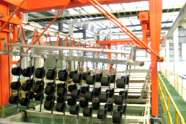
- Chemical Cleaning: Employs multiple stages of degreasing, alkaline cleaning, acid etching, and rinsing to ensure the surface is absolutely clean, free from any oils or contaminants. Control of water quality (often requiring deionized water) and cleanliness at this stage is critical, as it is key to ensuring a flawless coating without defects like fish eyes.
2. Automated Precision Spraying and Curing System
This is the "heart" and "furnace" of the production line.
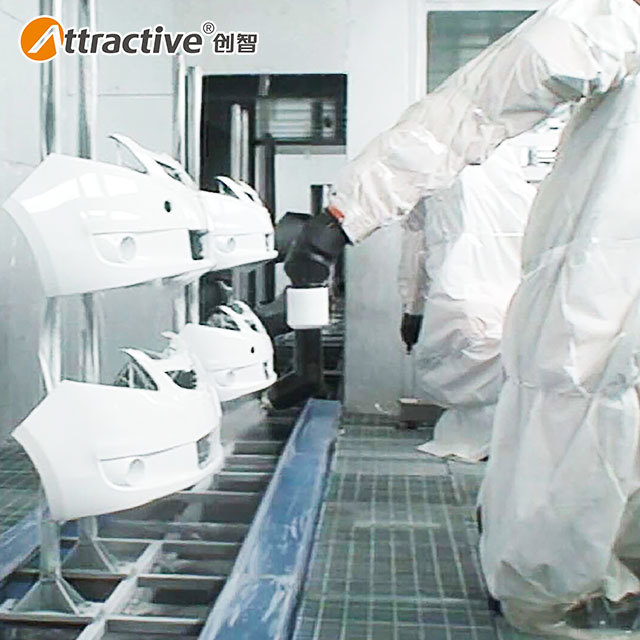
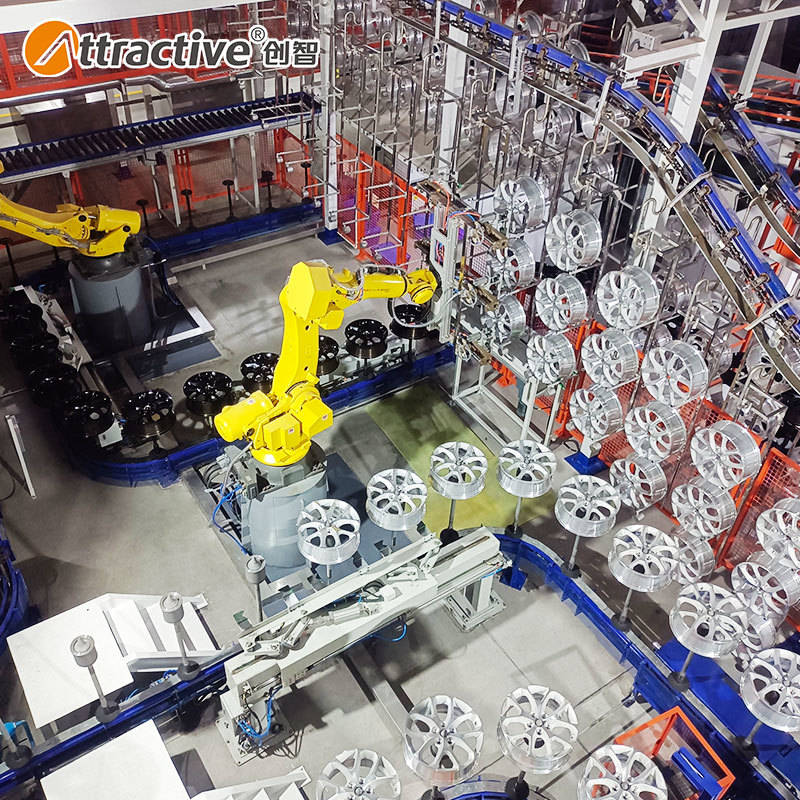
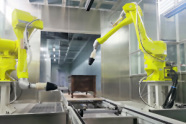
- Automated Spraying Unit: Utilizes multi-axis robots or dedicated automatic spraying equipment fitted with high-precision atomizers. The system uniformly and controllably applies non-stick coating particles (PTFE or ceramic) suspended in a liquid medium onto the workpiece surface with the aid of electrostatic technology. For molds with complex structures, robots ensure uniform coverage in cavities, corners, and edges. Advanced Automated Spraying Solutions enable precise control of film thickness (typically 15-25 microns per layer) and are equipped with efficient overspray recovery systems.
- High-Temperature Sintering Curing Oven: Coated workpieces enter a precision temperature-controlled sintering oven. This is the "alchemy" stage where the coating acquires its final properties. The oven uses multiple temperature zones to precisely control the heating, soaking, and cooling curves. For PTFE coatings, the peak temperature must be stabilized between 400°C and 430°C to allow complete resin melt-flow and sintering into a film. Extremely high temperature uniformity (within ±5°C) and a pure air environment inside the oven are core to achieving consistent gloss, no yellowing, and complete sintering (optimal non-stick performance and durability).
3. Full-Process Quality and Environmental Control System
- Online Quality Monitoring: Integrates automated film thickness measurement, visual defect inspection (for pinholes, impurities), etc., ensuring every product meets standards.
- Environmental Integration: Exhaust gases generated during spraying and curing are treated via RTO (Regenerative Thermal Oxidizer) or high-efficiency filtration systems, ensuring VOC and particulate emissions comply with regulations.
- Data Traceability: The central control system records all key process parameters, creating a traceable "process file" for each batch of product.

Investment Value: Empowering Efficient Food Industry Operations
Deploying a professional Non-Stick Coating Line for Industrial Bakeware Products creates multi-dimensional value for both manufacturers and end-users:
- Ultimate Product Performance and Safety: Produces coatings with strong adhesion (passing cross-cut test), high abrasion resistance (steel wool abrasion test), excellent high-temperature resistance, and 100% compliance with food contact safety standards.
- Significantly Enhanced End-User Productivity: Excellent non-stick properties facilitate easier demolding, reducing waste; easy-clean characteristics drastically cut cleaning time and water consumption, boosting overall kitchen operational efficiency.
- Superior Production Economics: For manufacturers, automated lines deliver very high material utilization (>95%) and production cycle times, lowering per-unit costs; stable, high quality also dramatically reduces rework and complaint risks.
- Building Lasting Brand Reputation: Durable, safe products are the best vehicle for building long-term trust with B2B clients and shaping a professional brand image.
How to Choose a Reliable Partner
Given its specialized nature, selecting a production line supplier should focus on the following:
- Deep Process Knowledge (Know-how): The supplier must possess expertise in non-stick coating chemistry, metal pre-treatment, and sintering processes, and be able to provide Customized Coating Solutions tailored to different substrates and coatings.
- Proven Track Record and Compliance Experience: Possesses successful case studies supplying renowned bakeware brands or food equipment manufacturers and is familiar with regulatory requirements in major global markets.
- Turnkey Project Capability: Can provide end-to-end services from process testing, line design, manufacturing, installation/commissioning, to personnel training, ensuring the line is successfully launched and meets design specifications.
- Technical Foresight: The production line should be adaptable to future process requirements for new environmentally friendly coatings (e.g., more durable ceramic coatings), offering a degree of upgrade flexibility.
Conclusion
As the food industry advances towards higher efficiency and stricter safety standards, the quality of industrial bakeware has become a critical detail determining the smoothness of the supply chain. A technologically advanced and reliably operating Non-Stick Coating Line for Industrial Bakeware Products is precisely the "precision mold" forging this critical detail. Through systematic engineering intelligence, it transforms technological materials into daily visible productivity and safety. For brands dedicated to manufacturing high-end baking equipment, investing in such a production line is not merely an upgrade to manufacturing capability; it is a declaration to the market of an ultimate commitment to quality and safety, thereby winning the long-term trust and preference of professional clients in a fiercely competitive market.


Contact Us
No.2 Yingbin Avenue, High-tech District, Zhaoqing City, Guangdong Province, China.
Online Message