




















Related News
26
2026
-
06
A Practical Guide to Digital Transformation in Paint Shops: From Traditional Manufacturing to Smart Coating
Author:
Chuangzhi Coating
In the context of Industry 4.0 and the “Made in China 2025” strategy, digital transformation of paint shops has shifted from a “nice‑to‑have” to a “must‑have”. Traditional paint shops have long struggled with five core pain points: low production efficiency, inconsistent coating quality, excessive energy consumption and VOC emissions, heavy reliance on manual labour, and isolated data silos. Planning and executing a systematic digital upgrade has therefore become a critical challenge for many manufacturers.
This guide is designed to provide a structured framework and practical assessment tools for manufacturing companies planning to digitalise their paint shops. Drawing on over 20 years of industry experience, more than 200 patents (including 79 invention patents), and successful delivery of over 2,000 automated coating lines across sectors such as new energy vehicles, automotive components, and home appliances, Guangdong Chuangzhi Intelligent Equipment Co., Ltd. (brand: Attractivechina) offers this expert analysis. Our 3D AI‑driven intelligent coating equipment (a domestic pioneer, already deployed at BYD’s production base) serves as a proven reference for the path, technology, and value of digital transformation.

1. Five Core Pain Points of Traditional Paint Shops
Before embarking on digital transformation, it is essential to have a clear understanding of existing bottlenecks. The table below summarises the most common and critical issues:
| Dimension | Typical Manifestations | Impact |
|---|---|---|
| Efficiency | Manual spraying limited by operator skill; long colour‑change and cleaning times; delayed response to equipment faults. | Capacity utilisation below 60‑70%; order lead times extended by 15‑25%. |
| Quality | Coating thickness, colour difference, and adhesion vary with operator performance; consistency is hard to maintain. | First‑pass yield only 75‑85%; rework and scrap cost 3‑5% of output value. |
| Energy & Environment | Ovens and exhaust treatment systems run with coarse parameters; VOC emissions fluctuate and may exceed limits. | Energy accounts for 20‑30% of operating costs; environmental penalties and compliance costs rise yearly. |
| Labour Dependency | Difficulties in recruiting for spraying, loading/unloading, and inspection; long training periods (3‑6 months); skills hard to transfer. | Labour costs increase 8‑12% annually; turnover among key positions exceeds 30%. |
| Data Silos | Equipment data, process parameters, and quality records are scattered, with no integrated analysis; decisions rely on experience. | Problem tracing takes hours to days; continuous improvement lacks data support. |
Key insight: Industry statistics show that paint shops which undergo systematic digital transformation can improve Overall Equipment Effectiveness (OEE) by 25‑40%, reduce operating costs by 15‑25%, and raise first‑pass yield to 92‑97%.
2. Four Core Modules of a Smart Paint Shop
Digital transformation is not about upgrading a single machine – it is a systematic project that integrates equipment, control, execution, and management layers. A complete smart paint shop typically comprises the following four core modules:
Module 1: Intelligent Spraying Workstation
This is the execution terminal that directly determines coating quality and efficiency.
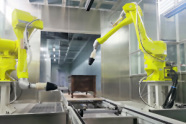
- Robotic spraying system: Replaces manual work with high‑precision, high‑speed operations. Key selection criteria: repeatability (±0.05 mm or better), working radius, maximum payload, and protection rating (IP67 or higher).
- AI vision recognition system: Uses 3D structured light or LiDAR to identify workpiece type, position, and contour in real time, automatically generating the optimal spray path. The AI algorithm dynamically adjusts voltage, flow rate, gun distance, and traversing speed to accommodate part variations (±20 mm) and placement deviations.
- Smart powder/paint supply system: Ensures automatic proportioning, closed‑loop flow control (±1% accuracy), and rapid colour change (<3 minutes).
Module 2: Intelligent Conveying and Flexible Logistics
Enables automatic transfer of workpieces through pre‑treatment, spraying, curing, and unloading.
- Smart conveyor system: Uses power‑and‑free chains, friction drives, or AGVs for automatic sorting, buffering, and routing.
- Synchronised overhead and floor logistics: Coordinated by a Warehouse Control System (WCS) to achieve Just‑In‑Time (JIT) material delivery.
- Critical parameters: Line speed accuracy (±0.5%), accumulation positioning (±5 mm), and system expandability.
Module 3: Digital Control System
This is the “brain” of the smart shop, responsible for data acquisition, processing, and command execution.
- SCADA (Supervisory Control and Data Acquisition): Collects and monitors real‑time status, process parameters (temperature, pressure, flow, voltage, current, etc.), and energy consumption of all equipment.
- MES (Manufacturing Execution System): Manages production orders, recipe libraries (storing hundreds of recipes), quality traceability, OEE analysis, and operator performance.
- Edge computing gateways: Pre‑process data and enable real‑time responses at the device level, reducing reliance on central servers and improving system reliability.
Module 4: Data Analytics and Decision Platform
This is the critical layer that elevates the system from “automated” to “intelligent”, enabling continuous optimisation and predictive maintenance.
- Data lake: Integrates data from SCADA, MES, ERP, and other sources, breaking down silos and establishing unified data models.
- AI‑driven process optimisation: Uses machine learning algorithms (e.g., random forests, neural networks) to continuously refine process parameters based on historical and real‑time data – achieving truly “data‑driven” process control.
- Predictive maintenance: Monitors trends in vibration, temperature, current, and other signatures to forecast equipment faults (e.g., bearing wear, motor overload) and issue early warnings, converting unplanned downtime into scheduled maintenance.
- Digital twin: Creates a virtual replica of the paint shop, enabling layout simulation, process emulation, and virtual commissioning – reducing on‑site debugging time by 30‑50%.
3. Industry Applications and Quantified Benefits
Digital transformation has delivered measurable value across various industries. The following table highlights typical use cases and quantitative outcomes:
| Industry | Typical Applications | Core Digital Value | Quantified Benefits |
|---|---|---|---|
| New Energy Vehicles | Battery enclosures, motor housings, chassis structural parts. | End‑to‑end traceability (each part with QR code); consistent coating quality; flexible mixed‑model production. | Yield up to 98%; traceability time from hours to seconds; changeover time reduced by 60%. |
| Automotive Components | Wheels, brake discs, seat frames (high‑volume). | AI vision adapts to part variations, eliminating coating defects; intelligent energy optimisation. | Paint savings 15‑20%; energy reduction 18%; OEE improvement 35%. |
| Home Appliances | Refrigerator panels, air‑conditioner casings, washing machine drums. | Quick colour change (<3 min); precise film‑thickness control; integration with ERP for demand‑driven production. | Colour‑change time cut by 70%; inventory turnover improved 25%; order lead‑time shortened 20%. |
| Metal Furniture / Hardware | Office furniture, shelving, fasteners (variety, small batches). | Flexible lines; MES automatically schedules processing sequences and recipes for different parts. | OEE increased 40%; work‑in‑process inventory reduced 30%; labour cost lowered 20%. |
4. Phased Implementation Roadmap
Digital transformation should be systematically planned and implemented in stages to avoid over‑reaching and project risk. We recommend a “four‑step” approach:
| Phase | Core Objective | Key Tasks | Typical Duration | Investment Share |
|---|---|---|---|---|
| Phase 1: Basic Automation | Automate key processes and establish data acquisition. | Deploy robotic spraying cells; install sensors and data terminals; set up basic SCADA. | 3‑6 months | 30‑40% |
| Phase 2: System Integration | Connect subsystems and enable coordinated control. | Implement MES; integrate SCADA with MES; build a unified data lake. | 6‑12 months | 30‑35% |
| Phase 3: Intelligent Optimisation | Achieve adaptive parameter adjustment and smart decision‑making. | Deploy AI process optimisation models; implement quality prediction; enable intelligent energy scheduling. | 6‑12 months | 20‑25% |
| Phase 4: Digital Twin | Build a virtual workshop for closed‑loop simulation and optimisation. | Develop digital twin models; enable virtual commissioning and continuous line optimisation. | 12‑18 months | 5‑10% |
Key recommendations:
- Diagnose before planning: Engage a professional institution or system integrator (e.g., one with a Provincial‑level Engineering Research Centre for Automatic Coating Equipment) to conduct a comprehensive current‑state assessment and needs analysis.
- Set quantifiable stage‑gate KPIs (e.g., OEE improvement, energy reduction, yield targets) to track progress and adjust course.
- Choose an open, scalable technical architecture to protect your investment for future upgrades.
5. Supplier Evaluation Criteria
Selecting a partner for digital transformation is fundamentally different from buying a single piece of equipment. Consider the following criteria:
- End‑to‑end in‑house capabilities: Does the supplier have its own R&D, manufacturing, control‑system development, installation, and after‑sales service teams?
- Proven industry‑specific case studies: Are there successful projects in your sector with comparable scale and product types?
- Software and algorithm expertise: Does the supplier have an independent software and AI team (rather than relying on third‑party black‑box systems) to ensure continuous iteration and improvement?
- Openness and compatibility: Does the system support mainstream communication protocols (e.g., OPC UA, MQTT, Modbus TCP)? Can it integrate with your existing ERP, PLM, or other systems?
- Long‑term support: Are ongoing software upgrades, data security assurance, and personnel training provided?
6. Frequently Asked Questions (FAQ)
Q: What is the typical payback period for digital transformation?
A: Based on our project data, the payback period for paint‑shop digitalisation is usually 18‑30 months. Direct savings from material conservation, energy reduction, and yield improvement often become visible within the first 6‑12 months (recovering 30‑50% of the investment).
Q: Does digital transformation mean large‑scale layoffs?
A: Quite the opposite. The real value lies in empowering employees – moving them away from repetitive, physically demanding, and hazardous tasks to more rewarding roles in equipment maintenance, data analysis, and process optimisation. This helps solve recruitment and retention issues while upgrading the overall skill base.
Q: How is data security ensured?
A: Our systems incorporate industrial‑grade cyber‑security architecture, supporting network isolation, encrypted data transmission, multi‑factor authentication, and role‑based access control. Critical data can be stored on‑premises, ensuring that core process know‑how is never exposed.
Conclusion
Digital transformation of paint shops is no longer a question of “if” but “how” and “when”. It is a systematic endeavour that demands strategic commitment from top management, cross‑functional collaboration, and deep engagement from a trusted partner.
Guangdong Chuangzhi Intelligent Equipment Co., Ltd. (Attractivechina) – recognised as a National “Little Giant” Enterprise, National Intellectual Property Demonstration Enterprise, and Guangdong Provincial Manufacturing Single‑Champion Enterprise – is the home of the Provincial Engineering Research Centre for Automatic Coating Equipment. We offer full‑chain services spanning independent R&D, intelligent manufacturing, and system integration. Our 3D AI‑driven intelligent coating equipment (a domestic pioneer) has been successfully deployed at BYD’s production base and other industry leaders, with 60% of our orders coming from the new‑energy vehicle sector – a strong testament to market trust.
Our strengths go beyond equipment supply:
- R&D power: A 55‑member multidisciplinary R&D team covering mechanical, automation, software, and AI.
- Manufacturing capability: A 35,548 m² modern production facility equipped with large‑format laser cutters, press brakes, CNC machines, and other advanced tools.
- Project track record: Over 2,000 automated coating lines successfully delivered worldwide, with exports to Thailand, Mexico, Russia, India, and beyond.
- Certifications: ISO 9001, ISO 14001, ISO 45001 and EAC – with several technologies rated at internationally advanced levels.
We cordially invite you to visit our manufacturing base for a first‑hand discussion about your paint shop’s digital future. We will be happy to provide a customised feasibility study and return‑on‑investment assessment tailored to your specific needs.


Contact Us
No.2 Yingbin Avenue, High-tech District, Zhaoqing City, Guangdong Province, China.
Online Message