


























Related News
07
2026
-
09
How to Verify a Coating Line Supplier's Delivery Commitments?
Author:
Chuangzhi Coating
In coating line procurement, a supplier's delivery commitments are a critical basis for decision-making. However, promises such as "on-time delivery," "performance meets specifications," and "worry-free after-sales service" often face their true test only after the contract is signed. Systematically verifying a supplier's delivery capability and transforming "verbal promises" into "enforceable guarantees" is a key step for buyers to mitigate project risks.
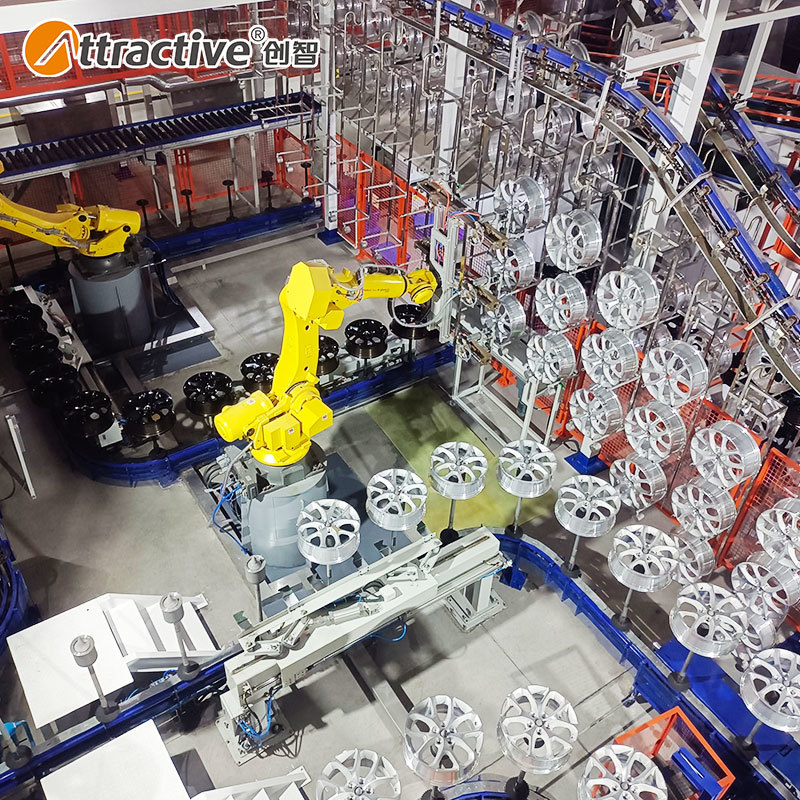
With over 30 years of experience in the coating equipment industry and delivery of over 2,000 production lines, serving sectors including automotive parts, rail transit, furniture, musical instruments, cookware, home appliances, hardware, and aerospace, Guangdong Chuangzhi Intelligent Equipment Co., Ltd. (brand: Attractivechina) has distilled five core audit dimensions for verifying a supplier's delivery commitments. These are intended for project teams to use for systematic assessment both before and after contract signing.

1. Manufacturing Capacity and Production System: Can the Commitment to On-Time Delivery Be Met?
The first layer of assurance for delivery commitments lies in whether the supplier's manufacturing capacity and management system can support the contracted timeline.
| Audit Item | Specific Content | Verification Method |
|---|---|---|
| Factory Scale & Equipment Capability | Owned factory area; sophistication and capacity of key processing equipment (e.g., laser cutters, press brakes, CNC machines) | On-site factory visit to observe equipment operation status and production line load |
| Production Planning & Scheduling | Is there a clear project scheduling system? Is the current order book saturated? | Request to view production schedules to assess capacity margin |
| Supply Chain Management | Procurement lead times and stocking strategies for critical purchased components (e.g., burners, fans, PLCs, sensors) | Inquire about the main supplier list and long-term cooperation agreements |
Red Flags: Factory scale is grossly inconsistent with claimed capacity, or the supplier cannot provide a clear production schedule.
2. Engineering and Design Capability: Can Commitments Be Accurately "Translated" into Solutions?
The depth of a supplier's understanding of customer needs directly determines the final solution's fitness.
| Audit Item | Specific Content | Verification Method |
|---|---|---|
| Requirements Responsiveness | Does the proposal precisely respond to the user's "Coating Process Technical Specification"? Does it address specific process challenges? | Cross-check the proposal against the requirements specification item by item |
| Design Team Size & Experience | Number of design team members; industry experience of core engineers | Understand team composition; conduct technical exchanges with lead designers |
| Process Database | Is there a mature process parameter library for different industries (e.g., automotive parts, cookware)? | Inquire about process solutions for past similar projects to verify data accumulation depth |
Red Flags: The proposal is too generic, lacking specific discussion on the customer's particular products (e.g., irregularly shaped parts, high-appearance-requirement parts).
3. Project Management and Risk Control: How Are Commitments Executed When "Unexpected" Events Occur?
Changes during project execution are normal. The supplier's management processes and contingency plans are key safeguards.
| Audit Item | Specific Content | Verification Method |
|---|---|---|
| Project Milestone System | Are clear milestone nodes (design, manufacturing, FAT, shipping, installation, commissioning) and acceptance criteria defined? | Request a detailed project schedule and assess its reasonableness |
| Communication & Reporting Mechanism | Is there a regular progress reporting system (e.g., weekly/monthly reports) and an issue escalation process? | Review communication records from past projects to assess information transparency |
| Change Management Process | Is there a formal process for handling requirements or design changes (impact assessment, approval, documentation)? | Request a change management document template |
Red Flags: Inability to provide a detailed project schedule, or vague answers to "what happens if there is a delay."
4. Factory Acceptance Testing and Quality Assurance: Can Promised Performance Be Verified Before Delivery?
Factory Acceptance Testing is a critical verification stage for ensuring equipment performance commitments are met; it cannot be skipped.
| Audit Item | Specific Content | Verification Method |
|---|---|---|
| FAT Scope & Standards | Does it cover no-load integration, safety interlocks, simulated loads, oven temperature uniformity, control system functions, etc.? | Request a FAT outline specifying test items, methods, and acceptance criteria |
| Customer Involvement Mechanism | Is there a clear invitation for customer representatives to witness the FAT? Is a detailed test report provided? | Contract terms should specify FAT timing, location, customer witness rights, and report delivery requirements |
| Performance Data Recording | Are key parameters (e.g., energy consumption, temperature profiles, operating speeds) measured and recorded during FAT? | Review sample FAT reports from past projects to assess their level of detail |
Red Flags: FAT process lacks customer witnessing, or test reports are superficial and lack critical data.
5. After-Sales Service System and Long-Term Support: Can Commitments Cover the Equipment's Full Lifecycle?
Delivery is not the end. Stable equipment operation requires long-term technical support, spare parts availability, and ongoing services.
| Audit Item | Specific Content | Verification Method |
|---|---|---|
| Service Team & Network | Is there a dedicated after-sales service team? What is the service coverage area? | Understand team size, response mechanisms (e.g., 24-hour hotline, on-site arrival time commitments) |
| Spare Parts Supply System | Is there safety stock for critical spare parts? Are spare parts lists and prices transparent? | Request a list of common spare parts and price sheets; inquire about spare parts shipping lead times |
| Technology Upgrade Capability | Are ongoing technical support services (e.g., control system software upgrades, process optimization) available? | Ask past clients about support for equipment upgrades and modifications |
Red Flags: After-sales service relies entirely on outsourced teams, or the supplier cannot provide a spare parts price list.
Conclusion: From "Listening to Promises" to "Looking at Evidence"
The process of verifying a supplier's delivery commitments is essentially about transforming vague verbal assurances into a verifiable, measurable "chain of evidence." The five dimensions above—capacity, design, project management, testing, and after-sales—cover the key stages of equipment procurement, from order to delivery to long-term operation. Each checkpoint is a critical test of the supplier's true capability.
For buyers, rather than worrying about whether commitments will be fulfilled after signing, it is better to verify them against these checkpoints before signing. A detailed "Supplier Capability Audit Report" is far more reliable than any verbal promise.
Attractivechina always welcomes customers to undergo rigorous capability audits. We understand that only through transparent communication and verification across these dimensions can a truly trust-based, long-term partnership be established.
If you are evaluating coating line suppliers and would like to obtain a systematic capability audit template or learn about Attractivechina's specific delivery cases in your industry, please feel free to contact our pre-sales planning team.
SEO:


Contact Us
No.2 Yingbin Avenue, High-tech District, Zhaoqing City, Guangdong Province, China.
Online Message