











Related News

28
2026
-
09
Automotive Wheel Coating Line for Efficient and Consistent Wheel Finishing
Author:
Chuangzhi Coating
Automotive wheels are important appearance and functional components of modern vehicles. In addition to their visual appeal, wheel surfaces need to withstand moisture, road dirt, chemicals, temperature changes, UV exposure, and mechanical wear. For wheel manufacturers, achieving a consistent finish across large production volumes requires more than high-quality coating materials. It also depends on a well-designed automotive wheel coating line that integrates surface preparation, automatic spraying, drying, curing, conveying, and quality inspection into one coordinated production system.
A modern automotive wheel coating line is designed to improve coating consistency while reducing repetitive manual operations. Attractivechina's automatic wheel painting solution is developed for automotive parts such as wheel hubs and wheel covers, with automated spraying technology and a customized production layout. The system can be configured according to production requirements, workpiece dimensions, plant conditions, coating specifications, and desired automation level. This makes the line suitable for manufacturers looking to upgrade from manual painting to a more stable and efficient production process.
Why Automotive Wheel Coating Requires a Complete Production Line
The surface of an automotive wheel is not a simple flat area. Spokes, edges, recessed sections, mounting areas, and curved surfaces can make coating coverage difficult to control manually. If the pretreatment is inconsistent or spraying parameters change from one operator to another, the finished wheel may show differences in color, gloss, coating thickness, or surface appearance.
An integrated automotive wheel coating line addresses these challenges by connecting each stage of production. Instead of treating cleaning, spraying, drying, curing, and inspection as separate operations, the complete system coordinates them through a continuous conveying process. This helps manufacturers establish more repeatable production conditions and makes it easier to manage large-volume orders.
For automotive wheel factories, automation can also reduce dependence on repetitive manual spraying. Robotic spraying equipment can follow programmed paths and maintain a more consistent distance and movement pattern around complex wheel geometries. The result is a more controlled coating process and a production environment that can be adjusted for different wheel models.
Pretreatment Provides the Foundation for Coating Quality
Before paint or another coating material is applied, the wheel surface needs to be properly prepared. Oil, dust, residues, and other contaminants can affect coating adhesion and create surface defects if they remain on the workpiece.
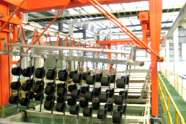
The coating process offered on the product page includes loading, degreasing, rinsing, pure water washing, water blowing, moisture drying, cooling, and flame treatment before automatic electrostatic dust removal and spraying. This sequence provides a structured preparation stage before the wheel enters the coating area.
Proper drying is particularly important because residual moisture can interfere with subsequent coating operations. Cooling after drying also helps bring the workpiece into a suitable condition for the next process. By integrating these stages into the production line, manufacturers can reduce unnecessary handling between processes and maintain a more consistent workflow.
Automated Spraying for Complex Wheel Surfaces
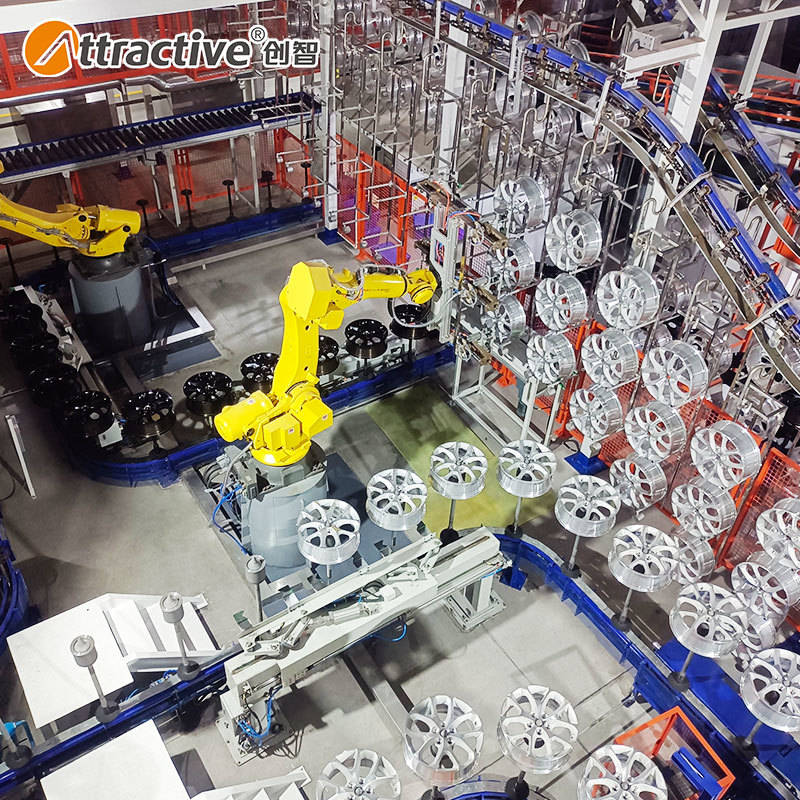
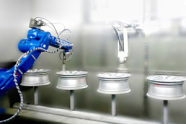
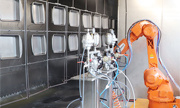
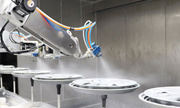
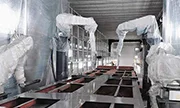
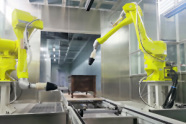
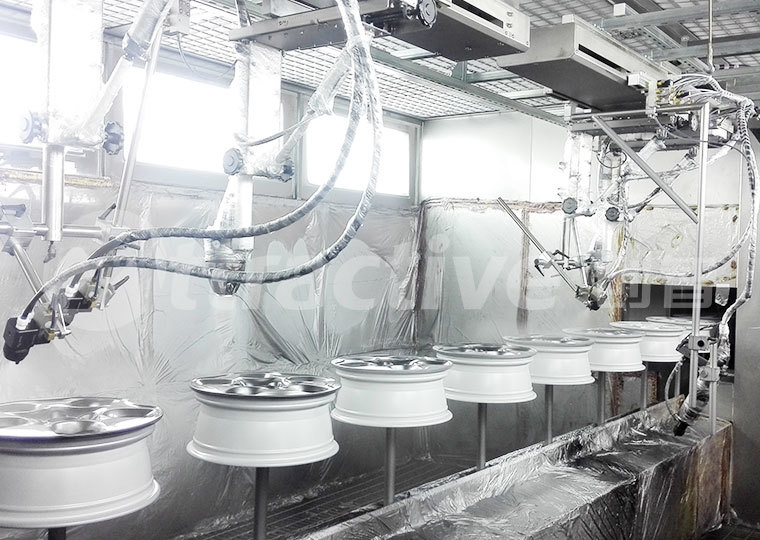
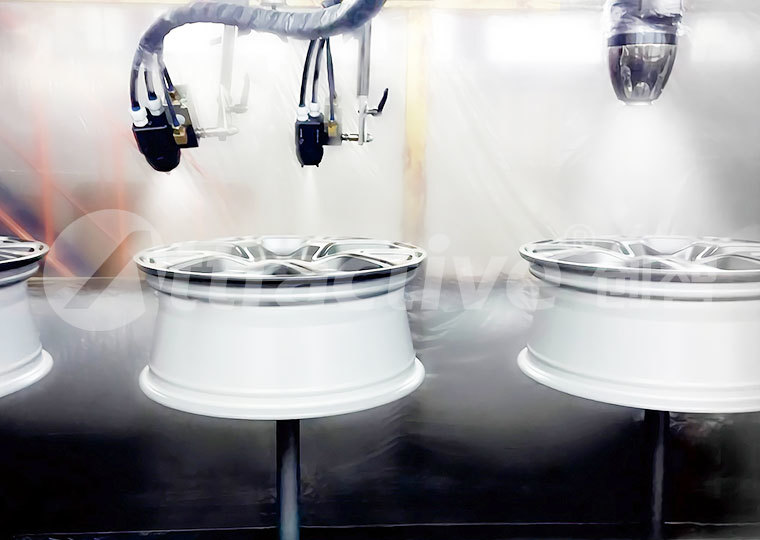
After pretreatment, the wheel enters the automatic spraying section. The product configuration uses robotic spraying, allowing the equipment to be programmed according to the geometry and coating requirements of the workpiece.
A typical multi-stage coating process may include primer spraying, surface drying, mid-coat spraying, additional drying, top-coat spraying, and final surface treatment before curing. The exact coating structure can be adjusted according to the coating material, wheel material, appearance requirements, and application conditions.
Automation is especially valuable when manufacturers produce different wheel designs. Once the spraying parameters and robot paths have been established for a specific model, the same process can be repeated with less variation than manual spraying. This helps production teams maintain consistent coating coverage and appearance while making model changes easier to manage.
Drying and Curing Need Controlled Conditions
Spraying is only one part of the coating process. The coating must also be dried and cured under suitable conditions to achieve the required finish and performance.
An automotive wheel coating line can integrate drying sections between coating stages and a dedicated curing system toward the end of the process. The product solution supports electricity or natural gas as heating energy, while the final configuration can be designed according to the customer's production conditions and coating requirements.
Temperature control, airflow, conveyor speed, and curing time all influence the final coating result. A properly designed curing system helps create stable processing conditions across the production line. It also reduces the need for operators to manually transfer wheels between different heating and drying areas.
Conveyor and Production Layout Can Be Customized
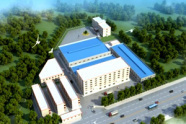
A coating line is not simply a collection of individual machines. The conveyor system, fixture design, spray booths, drying sections, curing equipment, loading areas, and inspection stations need to work together within the available factory space.
The referenced automotive wheel coating solution uses a continuous conveyor system and can be configured for different fixture sizes and workpiece pitches. The listed conveyor speed is adjustable, while the overall conveyor length and plant dimensions are designed according to the production project. Actual technical parameters should be determined after evaluating the customer's wheel dimensions, output requirements, factory layout, coating process, and utilities.
This customization is important because two wheel manufacturers may have completely different production requirements. One factory may focus on high-volume standard wheels, while another may produce multiple wheel designs in smaller batches. A flexible coating line can be designed around these differences instead of forcing every manufacturer to use the same equipment configuration.
Improving Efficiency Through Automation
For manufacturers still relying heavily on manual painting, automation can provide a path toward more stable production management. The referenced solution states that its automatic configuration can achieve higher production efficiency than traditional lines, while its heat recovery system is designed to reduce energy consumption. The equipment is also designed to reduce routine maintenance requirements.
Automation does not simply mean adding robots to a factory. The greatest value comes from coordinating robots, conveyors, pretreatment equipment, drying systems, curing ovens, ventilation, coating supply, and inspection processes as one production system.
When these systems are properly integrated, production managers can gain better control over process parameters and reduce unnecessary material handling. Automatic conveying also creates a more predictable production rhythm, which is particularly useful for manufacturers serving OEM, aftermarket, and large-volume automotive component markets.
Quality Control from Loading to Final Inspection
Coating quality should be monitored throughout the production process rather than checked only after the final wheel leaves the line. Surface preparation, spraying, drying, curing, and handling can all affect the final appearance.
The automotive wheel coating line can incorporate inspection and packaging after cooling and unloading. Operators can check surface appearance, coating uniformity, color consistency, and other customer-defined requirements before finished wheels are packaged.
For factories producing multiple models, production records and standardized process settings can also help establish repeatable operating procedures. When a new wheel design is introduced, the spraying route, fixture arrangement, conveyor settings, and coating parameters can be adjusted according to the new workpiece.
A Customized Automotive Wheel Coating Solution
There is no single automotive wheel coating line that is suitable for every factory. Wheel diameter, material, coating type, production capacity, automation requirements, available factory area, heating energy, and environmental requirements all influence equipment selection.
The Attractivechina solution is positioned as a customized turnkey system, with equipment dimensions and production capacity determined according to customer requirements. Its listed technical configuration includes robotic spraying, adjustable conveyor speed, controlled spray-room conditions, compressed-air requirements, heating options, and overseas engineering service support.
For manufacturers planning a new wheel painting factory or upgrading an existing production line, the most practical approach is to define the required output and coating process first, then design the equipment around the actual workpiece and factory conditions.
A well-integrated automotive wheel coating line can bring together pretreatment, automatic spraying, drying, curing, conveying, inspection, and packaging into a continuous production workflow. By combining automation with customized process design, manufacturers can improve production consistency, reduce repetitive manual work, and build a coating system that can adapt to changing wheel models and market requirements.
Next Page


Contact Us
No.2 Yingbin Avenue, High-tech District, Zhaoqing City, Guangdong Province, China.
Online Message