












Related News
10
2026
-
09
Selection Logic and Common Pitfalls of Coating Line Conveyor Systems
Author:
Chuangzhi Coating
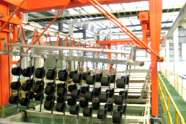
The conveyor system is often called the "skeleton" of a coating line, but it is far more than a means of transporting workpieces. It determines production cycle time, process routing, flexibility, and even directly affects the stability of coating quality. In many projects, attention during selection is focused on spray guns, ovens, and control systems, while the conveyor system is treated as a supporting role. As a result, after commissioning, problems emerge: cycle times cannot be reached, changeovers are inflexible, and workpiece sway causes uneven coating. This article examines the selection logic of conveyor systems and the details that are easily overlooked from a practical engineering perspective.

1. Three Basic Conveyor Types and Their Applicable Boundaries
There are three main types of conveyor systems commonly used in coating lines. Their respective characteristics determine which production scenarios they suit.
| Conveyor Type | Typical Structure | Advantages | Limitations | Applicable Scenarios |
|---|---|---|---|---|
| Overhead Conveyor | Workpieces hang below the chain and travel along a track | Simple structure, relatively low cost, minimal floor space occupation | No accumulation capability, fixed chain speed, poor flexibility | High-volume, single-product, continuous production |
| Power-and-Free Conveyor | Overhead chain with accumulation trolleys; workpieces can stop and accumulate on the track | Enables accumulation, diversion, and merging; high flexibility | Complex structure, higher investment, higher maintenance requirements | Multi-product, variable cycle time, production requiring buffering |
| Floor Conveyor | Workpieces placed on floor conveyor chains or carts | High load capacity, suitable for heavy workpieces | Occupies floor space, constrained workshop layout | Heavy machinery, large structural parts, chassis-type workpieces |
The first step in selection is not to compare which type is "better," but to clarify your own product family and production mode. For a single model produced at 100,000 pieces per year, an overhead conveyor may be the most economical choice. For a metal furniture factory that switches five colors daily, the flexibility value brought by a power-and-free conveyor far exceeds its additional investment.
2. Five Easily Overlooked Selection Details
In actual projects, the following details are often underestimated during the proposal stage but become bottlenecks after commissioning.
First, workpiece weight and fixture design. The load capacity of a conveyor chain depends not only on the chain itself but also on the rigidity of the fixture, the position of the lifting points, and the center of gravity of the workpiece. If the fixture for a heavy workpiece is improperly designed, it will sway during operation, preventing the spraying robot from positioning accurately and even causing collisions.
Second, matching process time with chain speed. Chain speed determines the dwell time of workpieces at each process stage. If pretreatment requires 8 minutes but the chain speed is designed to pass through in 6 minutes, the process effect will inevitably be compromised. During selection, the time requirements of each process must be calculated in sync with chain speed and track length, rather than setting the chain speed first and then fitting the process to it.
Third, determining the need for accumulation function. The core value of a power-and-free conveyor lies in "buffering." If the upstream and downstream cycle times of the production line are not fully synchronized, or if frequent changeovers are required, the accumulation function can prevent full-line shutdowns. However, if the production cycle is highly stable, the complex structure of a power-and-free conveyor instead increases maintenance costs.
Fourth, climbing and turning radius. Workshop space is often limited, and conveyor lines need to climb or turn. Different conveyor types have different limits on climbing angles and turning radii. Overhead conveyors can typically climb at 30°-45° with relatively small turning radii; floor conveyors have weak climbing capability and large turning radii. These constraints directly affect layout feasibility.
Fifth, maintenance accessibility. Are the drive units, tensioning devices, and lubrication points of the conveyor chain easily accessible? For an overhead conveyor running at height, if the maintenance access is poorly designed, every lubrication or chain replacement requires scaffolding, and long-term maintenance costs will far exceed expectations.
3. Matching Conveyor Systems to Different Production Scenarios
Drawing on experience accumulated by Attractivechina from delivering over 2,000 production lines, the following conveyor system choices for specific scenarios offer high reference value.
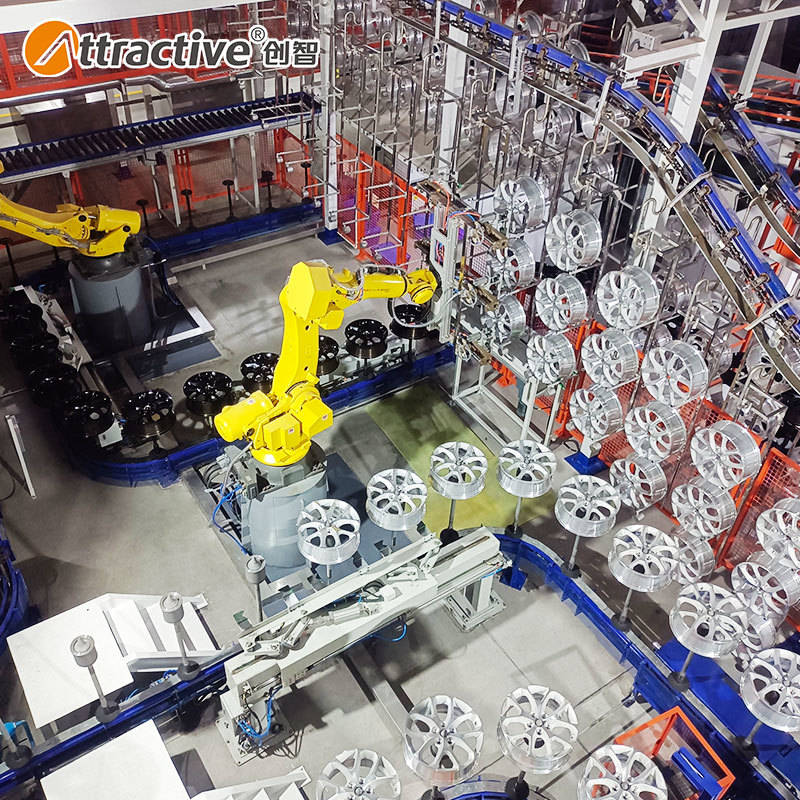
Scenario 1: High-volume production of automotive parts. Workpieces such as wheels and brake discs have regular shapes and large volumes. Overhead conveyors with accumulation capability are typically used to achieve precise cycle time control in the spraying area while providing buffering for pretreatment and post-curing.
Scenario 2: Mixed-model lines for cookware and home appliances. Different sizes of cookware or panels require frequent changeovers. A power-and-free conveyor combined with an RFID identification system enables automatic diversion of workpieces and switching of process parameters, with changeover times controllable at the minute level.
Scenario 3: Heavy industrial equipment. Workpieces such as agricultural machinery and electrical cabinets are heavy and irregularly shaped. Floor conveyors or cart-type conveyors are more suitable, combined with heavy-duty fixtures and anti-sway design to ensure stable operation.
Scenario 4: Wood products and plastic parts. These workpieces cannot withstand high temperatures and often require double-sided spraying. An overhead conveyor combined with rotating hangers allows workpieces to rotate during spraying, improving coverage while preventing collisions between workpieces.
4. Coordination Between Conveyor Systems and Automated Spraying
When robots or reciprocators are introduced into a coating line, the positioning accuracy and operational stability of the conveyor system become critical. Robotic spraying requires workpieces to remain stationary or move at a constant speed at the moment of spraying, with positional deviation not exceeding ±2mm. The positioning mechanisms of power-and-free conveyors, chain pitch errors of overhead conveyors, and repeat positioning accuracy of floor conveyor carts all directly affect the accuracy of spray trajectories.
In addition, the speed stability of the conveyor system also affects film thickness uniformity. If chain speed fluctuates by more than ±1%, under the same spraying parameters, measurable differences in film thickness will appear at different positions on the workpiece. Therefore, on automated spraying lines, conveyor systems typically need to be equipped with encoder feedback and closed-loop speed control.
5. Common Misconceptions and Avoidance Suggestions
Misconception 1: Treating the conveyor system as a standard purchased part. The conveyor system is part of custom engineering. Its track routing, fixture design, and drive configuration all need to be designed according to product characteristics and factory conditions. Applying standard models often leads to subsequent modifications.
Misconception 2: Comparing only the unit price of the conveyor chain. The cost of a conveyor system should include tracks, drives, tensioning, fixtures, control systems, and installation and commissioning. A low-bid conveyor chain may have cut corners in fixture design, material thickness, and drive configuration, leading to frequent failures after commissioning.
Misconception 3: Ignoring future product changes. If workpiece types may be added or capacity adjusted in the future, the conveyor system should reserve a certain range of speed adjustment and fixture compatibility. A conveyor line that cannot be expanded may become a bottleneck for upgrading the entire coating shop.
Conclusion
The selection of a conveyor system is essentially about finding a balance among efficiency, flexibility, investment, and maintenance costs. There is no "best" conveyor type, only the choice that best matches current products and future plans. In the early stage of a project, it is recommended to use the product family, capacity plan, factory conditions, and changeover frequency as inputs, and work with the supplier's engineering team to develop the conveyor solution. A fully validated conveyor system is the foundation for long-term stable operation of a coating line.
Attractivechina has over 30 years of experience in the coating equipment field, serving industries including automotive parts, rail transit, furniture, musical instruments, cookware, home appliances, hardware, and aerospace. During the planning stage of every production line, our engineering team treats the conveyor system as a core element for dedicated design rather than simple selection. For further discussion, please feel free to contact our pre-sales planning team.


Contact Us
No.2 Yingbin Avenue, High-tech District, Zhaoqing City, Guangdong Province, China.
Online Message