














Related News

04
2026
-
11
Aluminum Pot Coating Line for Efficient and Consistent Cookware Finishing
Author:
Chuangzhi Coating
An aluminum pot coating line is designed to help cookware manufacturers achieve consistent surface finishes, reliable coating adhesion, and efficient production. Aluminum pots and pans are widely used because of their lightweight construction and excellent thermal conductivity. However, their surfaces require appropriate treatment and protective coatings to improve durability, appearance, and resistance to everyday wear.
An integrated coating line combines surface pretreatment, spraying, drying, and curing into a coordinated production process. By controlling each stage, manufacturers can improve coating consistency while reducing defects caused by contamination, uneven application, or improper curing.

Why Surface Pretreatment Matters
Surface preparation is a critical step in aluminum cookware manufacturing. Oil residues, dust, oxidation, and other contaminants can weaken the bond between the substrate and the coating, potentially leading to peeling, uneven finishes, or reduced service life.
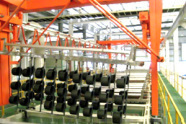
A suitable pretreatment system can incorporate cleaning, degreasing, washing, and drying processes according to the cookware material and coating requirements. Proper preparation provides a cleaner, more uniform surface for subsequent spraying.
For manufacturers producing different sizes or types of aluminum cookware, selecting the right pretreatment configuration helps maintain consistent quality across production batches. Process parameters should be adjusted to suit the actual workpiece, surface condition, and coating specification.
Automated Spraying for Uniform Coverage
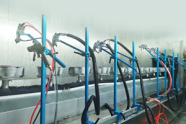
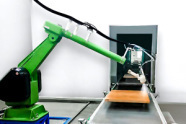
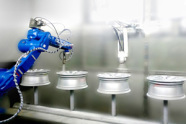
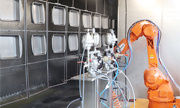
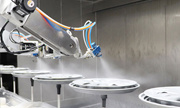
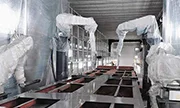
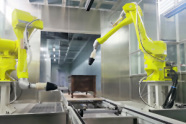
After pretreatment, the cookware moves to the spraying stage. An aluminum pot coating line can use fixed spray guns or robotic spraying systems, depending on product geometry, production volume, and automation requirements.
Controlled spraying helps distribute coating material more evenly across the cookware surface. Consistent application is particularly important for curved pot bodies, frying pans, and other components with different surface angles. Suitable spray parameters can help reduce common defects such as uneven film thickness, missed areas, and excessive coating buildup.
The system can be configured for different cookware applications, including non-stick pans, aluminum pots, kettles, and rice cooker inner pots. Depending on the product design, coating requirements may include non-stick, protective, or decorative finishes. The selected coating material and application process should be compatible with the substrate and intended operating conditions.
Temperature Control and Curing Performance
Curing is another important factor in achieving stable coating performance. Insufficient curing may affect adhesion and surface properties, while unsuitable temperature settings can damage the coating or reduce production consistency.
A properly configured curing oven provides controlled heating to support the coating manufacturer's specified curing conditions. Temperature management, conveyor speed, and heating duration should be matched to the coating formulation and workpiece characteristics.
For cookware manufacturers, stable curing conditions help improve repeatability between batches and support more predictable product quality. Monitoring these parameters also helps operators identify process deviations before they result in a large number of defective products.

Supporting Efficient Production and Quality Control
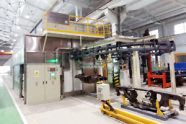
An integrated aluminum pot coating line helps coordinate material handling, spraying, and curing. Automated conveying can reduce unnecessary manual handling and maintain a more organized production flow. When combined with appropriate inspection procedures, the system supports consistent output and more efficient use of labor and coating materials.
Quality checks may include visual inspection, coating coverage, adhesion testing, film thickness measurement, and verification of curing conditions. The specific inspection standards should be established according to customer requirements and applicable cookware specifications.
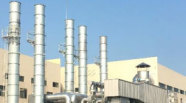
Production planning should also consider ventilation, paint or coating material management, operator safety, and waste treatment. Appropriate environmental and process controls help manufacturers maintain stable operations while managing resource consumption.
A Flexible Solution for Different Cookware Products
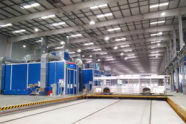
The right coating line depends on the cookware range, required output, available factory space, and desired automation level. A customized layout can coordinate pretreatment equipment, spray booths, conveyors, and curing ovens to match the manufacturer's production process.
The aluminum pot coating line presented by AttractiveChina is intended for aluminum cookware and related products. The published configuration identifies fixed-gun or robotic spraying options and gives a reference output of up to 800 pieces per hour. Actual production capacity depends on workpiece dimensions, coating requirements, process settings, and the final equipment configuration.
The listed reference applications include non-stick pans, kettles, rice cooker inner pots, and other cookware. The page also describes support for different cookware materials and customized equipment dimensions.
Choosing the Right Aluminum Pot Coating Line
Before selecting a system, manufacturers should evaluate product dimensions, substrate materials, coating types, production targets, curing requirements, and factory utilities. These details help determine the suitable conveyor arrangement, spraying method, pretreatment process, and oven capacity.
A well-matched aluminum pot coating line can help cookware producers improve finish consistency, streamline production, and maintain quality across different product batches. By integrating pretreatment, controlled spraying, and reliable curing, manufacturers can establish a coating process suited to their specific cookware products and long-term production needs.
Next Page


Contact Us
No.2 Yingbin Avenue, High-tech District, Zhaoqing City, Guangdong Province, China.
Online Message